
Need a Professional Hand?
If a DIY fix isn't enough, our insured technicians are just a click away. We’ll diagnose the issue and get your home running right again.
BOOK NOWA Wolf oven not heating up is one of the more stressful appliance failures a homeowner can face. The unit is expensive, integrated into your kitchen, and not something you simply swap out. At Wilson & Myers, we handle Wolf oven repair calls across Denver Metro Area regularly, and a meaningful number of them resolve in minutes without any parts. This guide covers what to check first, what the F-codes actually mean, and when to call a pro. Bonus: Explore troubleshooting video in the end of the blogpost.
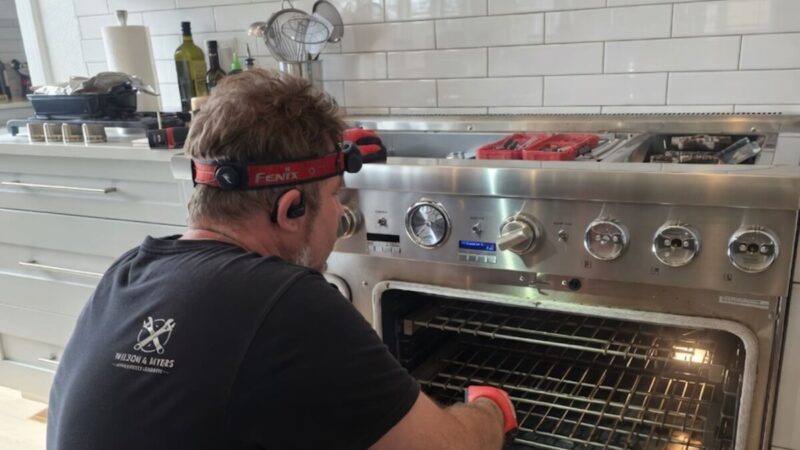
These take under two minutes combined. Each one has resolved a real wolf oven troubleshooting call.
Showroom Mode, sometimes called Demo Mode, disables the heating system entirely while keeping the display and controls fully active. It is designed for retail floor display. It gets enabled accidentally at delivery, during a firmware update, or after a power event. The oven looks completely normal. The inside simply never gets hot.
To disable it: press and hold the CONVECTION BAKE and BAKE buttons simultaneously for five seconds, then confirm on screen. The exact key sequence varies slightly by model, so check your owner’s manual or subzero-wolf.com for your specific unit. If the oven starts heating within two minutes, Showroom Mode was the culprit.
Electric and dual-fuel Wolf ovens run on a 240-volt circuit fed by two 120-volt legs through a double-pole breaker. When one leg trips silently, the control panel continues working on the remaining 120 volts. The heat circuit, however, needs the full 240 volts to function. Result: a wolf oven not heating up but looking completely operational.
Go to your electrical panel. Find the double-pole breaker for the oven. Flip both halves fully OFF, wait five seconds, then flip both fully ON. Then run a five-minute preheat test. Gas Wolf models are less susceptible to this issue but can lose power to the ignition circuit through the same mechanism.
Wolf ovens use a door switch that tells the control board the door is closed before allowing the heating circuit to run. A door that is slightly misaligned, or a switch that has shifted, can prevent all heat even when everything else is working normally.
Close the door firmly and confirm it seats evenly across the full perimeter. If the door feels loose, bouncy, or does not close flush, wolf oven door hinge replacement or a latch adjustment is likely needed. A worn hinge prevents the switch from engaging. This is also the classic wolf oven door not closing symptom, which often presents as a wolf oven not getting hot even when everything else seems fine.
On Wolf GR Series gas ranges and DF Series dual-fuel ranges, the cooktop burners run on a completely separate circuit. A failed oven does not affect the cooktop at all. You can finish cooking dinner on the burners while you wait for the repair.
This applies to both gas and dual-fuel configurations. The cooktop runs independently. Only the oven heating system is affected by bake element failure, igniter failure, or an F-code shutdown.
Wolf wall ovens (SO and ICBSO Series) are standalone units, so a non-heating oven does not affect your separate cooktop or range at all.
Wolf has produced several distinct range and oven series over the past three decades. Each uses a different heating system. Knowing which one you have tells you immediately which components can fail and in what order.
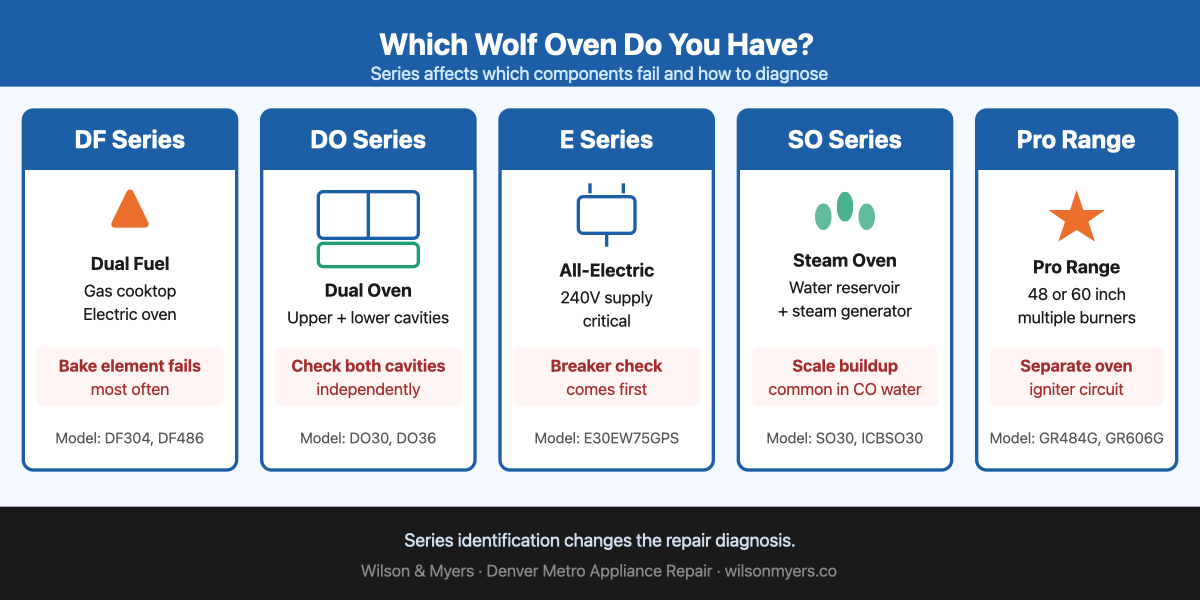
Your model number is on a label inside the oven door frame, typically on the left side. The first two or three letters tell you the series. A model starting with “GR” is an all-gas range. “DF” is dual fuel. “SO” or “ICBSO” is a wall oven. “M” or “R” followed by digits is a legacy gas range.
Every Wolf oven control board monitors its own systems and shuts down heat when something reads out of range. The F-code on the display is not just a label. It tells you exactly which system triggered the shutdown, which saves diagnostic time.
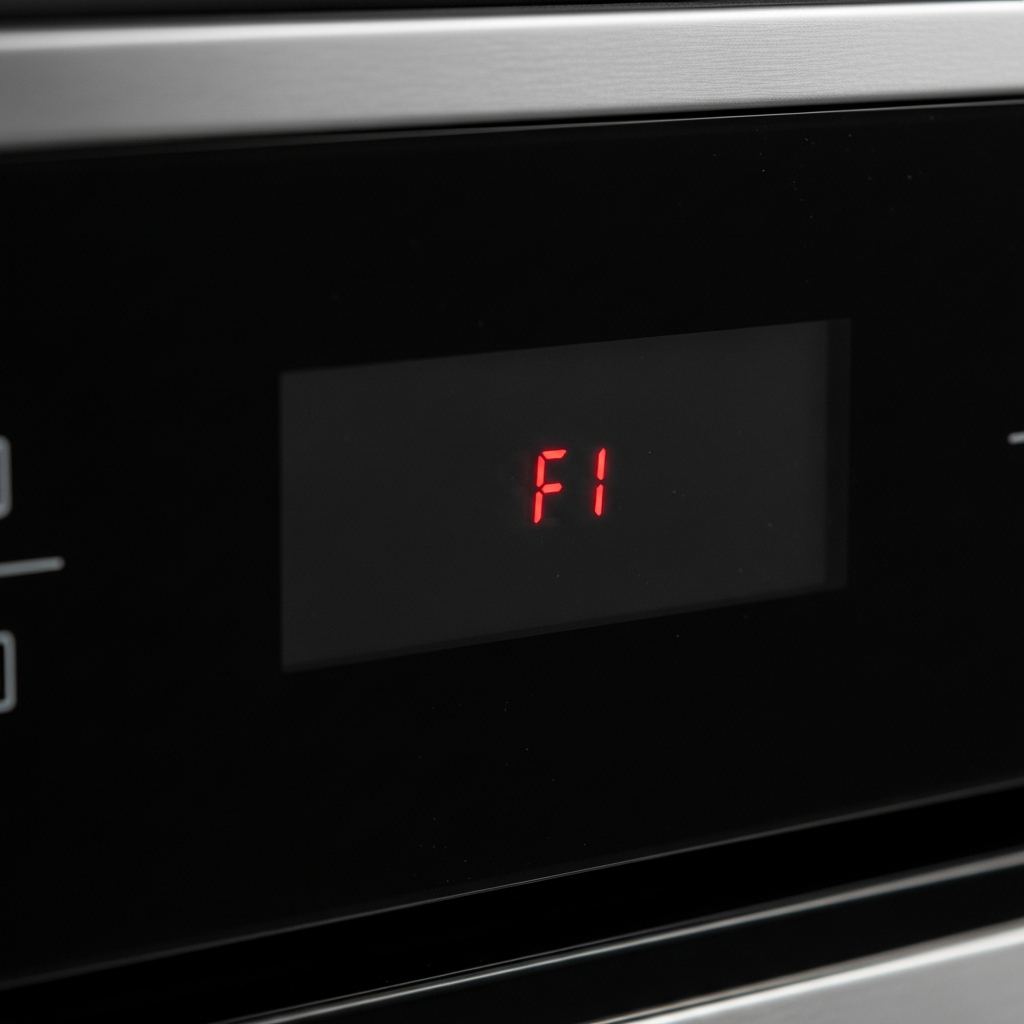
F1 on a Wolf oven almost always means the door latch system failed to complete its cycle. Sometimes this code is accompanied by continuous beeping. If the wolf oven won’t stop beeping after a self-clean, F1 is the most likely explanation. This happens most often after a self-clean cycle. The latch motor drives the lock into position and a microswitch confirms it. When either fails, the board sees an incomplete lock signal, throws F1, and refuses to run heat.
Why does this happen after self-clean specifically? The self-clean cycle runs at roughly 900 degrees Fahrenheit. At that temperature, the latch motor and its plastic components experience extreme thermal stress over 2 to 3 hours. A motor or microswitch that was already marginal often fails at that point.
First step for wolf oven f1 error: do a full breaker reset (off 60 seconds, then on). If F1 clears and heat returns, you caught it early. If F1 returns after a few minutes of operation, the latch mechanism needs service.
F2 means the control board detected an overheat condition inside the oven cavity. The board shuts down heat as a safety response. This can be caused by a runaway temperature event, a short in the heating circuit, or a control board fault. A breaker reset may clear it temporarily. Recurring F2 codes need a technician.
Both point to the RTD temperature sensor. It is a small probe inside the oven cavity that reads actual temperature and reports back to the control board. F3 means the sensor circuit reads open (broken wire or failed probe). F4 means it reads shorted. Neither is user-resettable in any meaningful way. A power-cycle will clear the code temporarily, but it returns as soon as the oven begins to warm.
The RTD temperature sensor itself is the most common culprit. Occasionally it is just a loose or corroded connector at the board end. A technician can test resistance at the sensor terminals and know in minutes whether the probe, the wiring, or the board is the issue.
Here is the realistic order based on what Wilson & Myers technicians see most on Wolf service calls in Denver Metro.
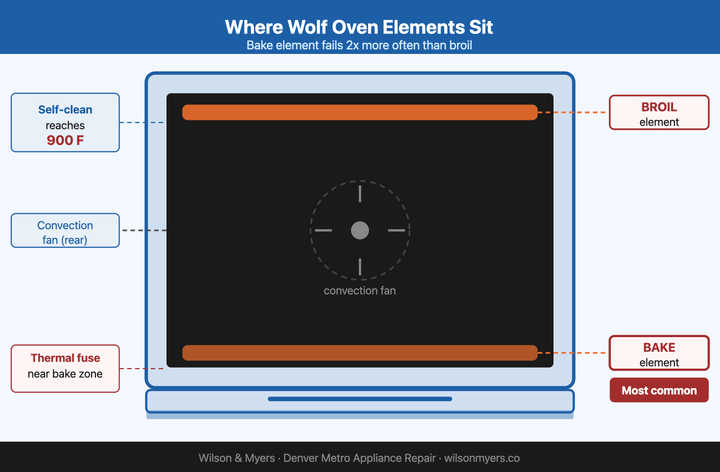
Wolf no heat after self clean happens often enough that Wolf maintains a dedicated support page for it. The self-clean cycle runs at extreme temperatures for two to three hours. Several things can go wrong in that process.
The door latch motor and microswitch are the most frequent casualties, producing F1 after the cycle ends. A bake element that was already degraded sometimes fails completely under the thermal stress of self-clean. A thermal fuse, which is a one-time safety device that blows permanently when temperature exceeds a set limit, can also trip if the self-clean cycle pushed cabinet temperatures unusually high.
Wolf oven not heating up after self clean often means two components failed at once: the thermal fuse and either the element or the latch. That combination requires a technician. Replacing only one without testing the other is a common mistake that results in a repeat call.
The breaker reset is always worth trying first. Off for 60 seconds, then on. If the oven heats and the door releases, the latch motor reset itself. If F1 returns within a few minutes, or if the oven still does not heat at all, the components need testing.
If the door is still locked after the self-clean cycle ended:
Do not force it. The latch motor drives the lock mechanically. Forcing the door risks breaking the latch housing or the door handle. A power-cycle reset is safe. Forcing the door is not. Book a diagnostic if the reset does not release the door.
Knowing how to reset wolf oven correctly is the first skill any Wolf owner needs. A full reset clears soft errors from the control board. It does not fix hardware failures, but it is always the right first step when an F-code appears.
Wolf oven temperature calibration is a separate adjustment. Most models let you offset the setpoint through the control panel settings. If the oven consistently runs 25 degrees hot or cold, calibrate it before replacing any components.
Wolf provides a 2-year full warranty covering parts and labor on all components. Some models also include extended coverage on specific sealed system components. Many owners do not realize their unit is still covered.
To check your wolf oven warranty status: locate the serial number on the label inside the oven door frame. Enter it at subzero-wolf.com/support under the owner resources section. The page will confirm coverage dates and what is included.
If your oven is under 2 years old and the bake element, igniter, door latch, or RTD sensor has failed, that repair may be covered at no cost. Call Wolf customer care before scheduling any paid service and describe the specific fault. At Wilson & Myers, we check wolf oven warranty status as part of every service call. If the repair is covered, we tell you before writing up any work order.
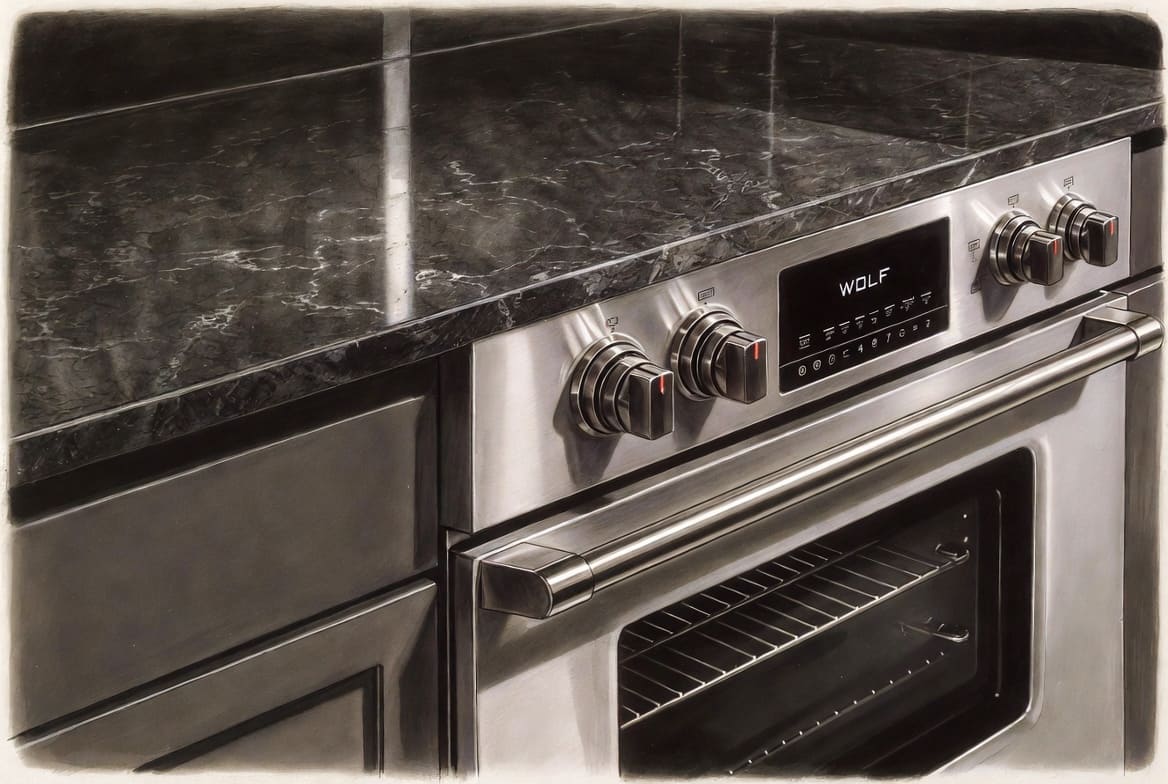
Almost always yes. A Wolf range runs from several thousand dollars on the low end to over fifteen thousand for a pro-style configuration. A built-in wall oven is similarly priced. Replacement is not just buying a new unit. It usually involves custom cabinetry modification, countertop adjustment, and installation.
Wolf ovens are built for 18 to 25 years of service with proper maintenance. The most common failures, bake element, igniter, RTD sensor, and door latch, are mid-range repairs that make financial sense at almost any point in the unit’s life. Control board failures are more expensive but still clear the repair-vs-replace threshold for most Wolf configurations.
The practical rule: if a repair quote approaches or exceeds half the cost of replacing the unit plus reinstallation, weigh the options carefully. For Wolf, that threshold is rarely reached on heating system failures alone. Wilson & Myers gives you a straight assessment before any work begins.
If you own a Sub-Zero refrigerator alongside your Wolf oven, see our Sub-Zero refrigerator not cooling guide and our Sub-Zero freezer troubleshooting guide for the same level of diagnostic detail.
Most of the Wolf oven repair calls we handle at Wilson & Myers could have been delayed or prevented entirely with straightforward habits.
Use the self-clean cycle no more than three or four times per year. Every self-clean cycle puts the latch motor, door seals, and thermal fuse under extreme stress. Running it more frequently shortens the life of those components noticeably.
A wolf oven temperature problem that shows up as inconsistent baking often starts with the door gasket. Inspect it annually after the unit reaches eight years old. Press along the full gasket perimeter with your hand while the oven is at 350 degrees F. You should feel no warm air escaping at any point. A gasket that has compressed or cracked lets heat out and makes the oven run longer to reach temperature, accelerating element wear.
A wolf oven not heating properly, or taking longer than usual to reach temperature, is often the RTD sensor beginning to drift. F3 and F4 appearing occasionally and then clearing is an early warning. Address it before it fails completely. Waiting leads to the oven going cold mid-preheat.
If a wolf range igniter keeps clicking on the cooktop side even after the burner is lit, that is a separate issue from oven heating. For wolf gas range repair needs on the burner side, have a technician inspect the sealed burner caps and gas valve condition every five to seven years. Igniter contacts corrode slowly. Catching a weakening igniter early is less disruptive than replacing it on an emergency basis.
For related premium-brand repair guidance, see our Viking repair page and our Thermador repair page. Both brands share the same premium-range service approach as Wolf.
Wilson & Myers provides Wolf oven repair and wolf range repair and wall oven repair across Denver Metro Area. Our insured technicians service all Wolf configurations including GR and DF Series ranges, SO and ICBSO built-in wall ovens, and M and R Series legacy units.
We source Wolf parts through national supplier networks and manufacturer contracts. We diagnose the full system before recommending any repair, and we check warranty coverage before writing up any work order.
For the full range of wolf appliance repair services including ranges, wall ovens, and cooktops, visit our Wolf brand page. We also handle range and cooktop repair for Wolf gas cooktop issues. Our Sub-Zero and Wolf work shares the same technician team and the same premium-appliance service approach. See our Sub-Zero refrigerator guide if you own both appliances. We also cover range hood repair for Wolf hood units. See our Miele and Sub-Zero pages for the broader premium-appliance context.
Start with Showroom Mode and the double-pole breaker both are free to check and fix. If those are fine, a wolf oven wont heat up usually means a failed bake element on electric models or a weakened hot surface igniter on gas models. Wolf F-codes narrow it further: F1 points to the door latch, F2 to an overheat event, F3 and F4 to the RTD temperature sensor.
Go to your electrical panel and flip the oven’s double-pole breaker fully off. Wait 60 seconds. Flip it fully on. Wait for the display to initialize and then run a bake test at 350 degrees F. If an F-code returns within a few minutes, the underlying component has failed and a reset will not fix it. Call a pro.
The display and controls run on 120 volts. The heat circuit on electric and dual-fuel Wolf ovens needs the full 240 volts. If one leg of the double-pole breaker has tripped, the display works but no heat reaches the oven. On gas models, a glowing igniter that fails to pull enough current keeps the gas valve shut, producing the same symptom. Check the breaker first, then inspect the igniter if the unit is a GR, M, or R Series gas range.
F1 means the door latch microswitch did not confirm a completed lock position. This most commonly happens after a self-clean cycle. The self-clean cycle runs at extreme temperatures and puts the latch motor and switch under sustained thermal stress. A full breaker reset is the first step. If F1 returns, the latch motor or microswitch needs replacement.
Wolf provides a 2-year full warranty on parts and labor. To check your coverage, find the serial number on the label inside the oven door frame and enter it at subzero-wolf.com/support. Do this before scheduling any paid service. A bake element, igniter, or door latch failure on a unit under 2 years old may be fully covered.
Showroom Mode, sometimes called Demo Mode, disables all heating while keeping the display and controls fully operational. It is designed for retail floor environments. It gets triggered accidentally at delivery or after a power event. The oven appears to function normally, but nothing heats. The toggle varies by model. Check your owner’s manual or subzero-wolf.com for the specific key sequence for your unit.
A Wolf range or wall oven typically lasts 18 to 25 years with proper maintenance. This is significantly longer than mass-market appliances. The most common failures occur between years 8 and 15: bake element, igniter, door gasket, and RTD temperature sensor. The control electronics often outlast the kitchen design.
Yes, on GR Series all-gas ranges and DF Series dual-fuel ranges. The cooktop burners run on a circuit that is fully independent of the oven heating system. A failed bake element or igniter does not affect the cooktop at all. Only the oven compartment is out of service. Wolf wall ovens are standalone units, so a non-heating oven has no effect on a separate cooktop.
Our insured technicians diagnose Wolf ovens across Denver Metro Area. Call Wilson & Myers or book online.
Found This Helpful?
It is a week before Thanksgiving, and you set the oven to 350 degrees before starting the stuffing. Forty minutes later, the preheat signal fires. That is roug…
You opened the KitchenAid freezer this morning and the bin was empty. In my experience, the arm is the first thing worth checking: the fix costs nothing and ta…
A Frigidaire oven not heating can come down to a setting rather than a part. Before you book a repair, two checks cost nothing and take under a minute: the clo…
A Whirlpool dryer that tumbles but never heats traces to one of five faults, and three of them cost nothing to check. Here is the order to work through them, p…
F8 E4 means water reached the drip tray, not a fill fault. Here is the two-step reset and why it can fire on a brand-new install with a dry tray…
A gas smell during oven preheating is normal for about 90 seconds. Here is how Denver technicians tell routine startup odor from a real gas leak…
Welcome to the community.
You'll receive our next expert update soon.

Wilson & Myers is a verified member of the Denver Metro Chamber of Commerce.


