

Need a Professional Hand?
If a DIY fix isn't enough, our insured technicians are just a click away. We’ll diagnose the issue and get your home running right again.
BOOK NOWA dryer not spinning usually traces to one of six faults in the drive system. Spin the drum by hand: drum spins too freely with no resistance means the drive belt has snapped. A hum with the drum sitting still points to the motor start capacitor. This guide ranks each cause from most common to […]
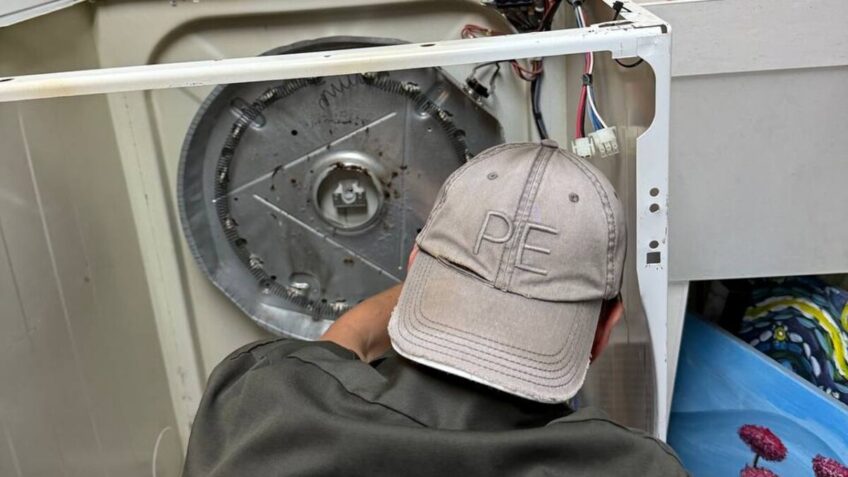
A dryer not spinning usually traces to one of six faults in the drive system. Spin the drum by hand: drum spins too freely with no resistance means the drive belt has snapped. A hum with the drum sitting still points to the motor start capacitor. This guide ranks each cause from most common to most complex and tells you which ones are genuine DIY fixes and which require an insured technician.
The drum stopped. Maybe the motor is humming; maybe the dryer is completely silent. Some causes here are DIY jobs you can handle today. Others, including the motor start capacitor and motor winding failures, carry electrical hazards that belong in pro territory. Knowing which is which before you open the cabinet saves time and avoids turning a simple fix into a bigger repair.
A dryer drum not spinning or dryer drum not turning is not always a dead motor. Dryer not spinning but heating, dryer not turning at all, and dryer not spinning only humming are each different faults with different fixes. Dryer running but not spinning after 15 minutes then restarting is yet another pattern. The sound-as-diagnostic triage card-list below maps your symptom and sound to the most likely cause in under a minute.
| Symptom / Sound | Cause | Path | Urgency |
|---|---|---|---|
| Drum spins freely by hand, motor hums | Broken drive belt | DIY-capable (teardown required) | Moderate |
| Drum will NOT move by hand, motor hums under load | Motor seized or foreign object jammed | Pro recommended | High |
| Hum only, drum starts if you push it by hand | Motor start capacitor failed | Pro recommended (capacitor safety) | High |
| Rhythmic thumping or knocking before drum stopped | Worn drum rollers (flat spot) | DIY-capable (open cabinet) | Moderate |
| Squealing or screaming sound before drum stopped | Seized idler pulley bearing | DIY-capable (replace with belt) | Moderate |
| Grinding / metal-on-metal shriek, drum wobbles | Rear drum bearing failure | Pro recommended | High |
| Stops mid-cycle after 10-15 minutes, restarts after cooling | Motor thermal overload (check vent) | DIY vent check; Pro if recurs | Moderate |
| Clicking or scraping, drum hard-stops by hand | Foreign object jammed between drum and housing | DIY (remove object) | Low |
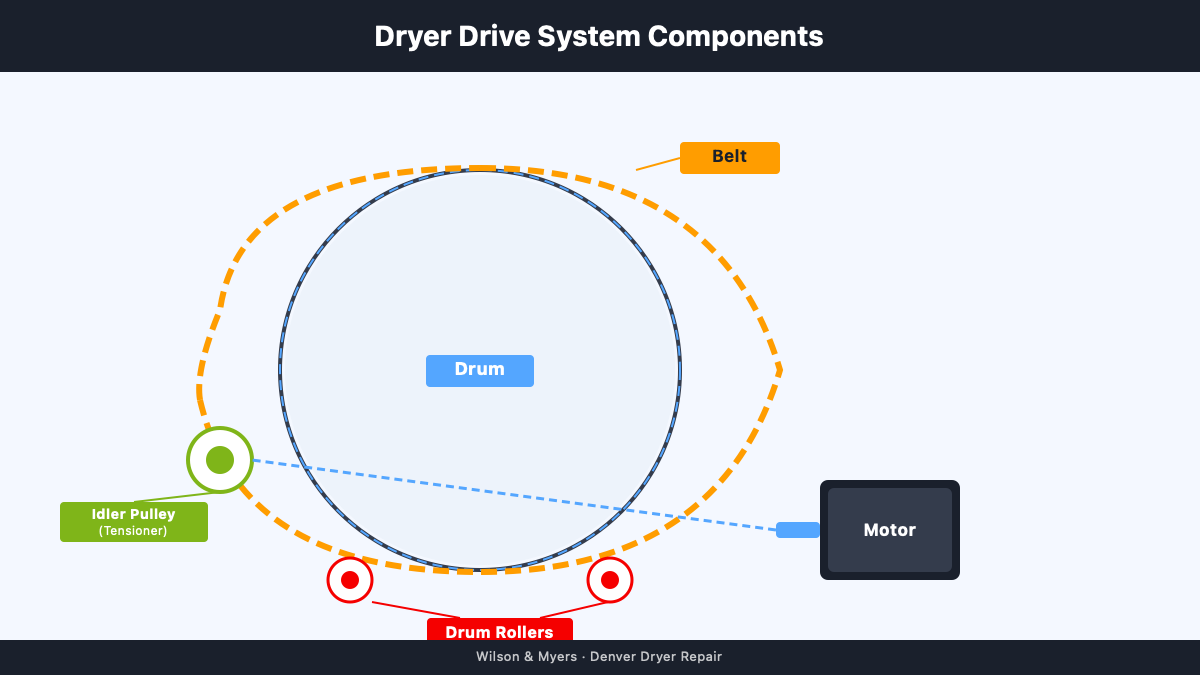
Open the dryer door and push the drum. When the drum spins too freely with no resistance, the belt has snapped. Normal belt tension creates clear rotational drag. Zero resistance means the belt is gone. The motor will still hum when you press Start and heat may still work, because the heating element and the drive belt sit on separate circuits. The drum simply sits still because nothing connects it to the drum shaft and motor pulley anymore.
That spinning vs heating separation is why dryer not spinning but heating belongs in this article. Belt breaks heat still works because the blower wheel shares motor shaft rotation, not the belt drive. If a burning rubber smell came with the drum stop, our dryer smell guide covers that separately. If the dryer did not start at all, see our dryer not starting guide first. For heating failures on their own, the dryer not heating guide addresses that separate circuit.
Warning: Unplug the dryer from the wall before opening the cabinet or reaching inside.
Belt replacement is DIY-capable but requires cabinet teardown. Whirlpool dryer and Maytag dryer models share a common platform. The front panel lifts off cleanly, and the Whirlpool belt 341241 platform part applies across most models in both brands. GE dryer models require rear access. Samsung dryer owners should check warranty status before attempting the repair on machines under five years old.
The idler pulley is the spring-loaded tensioner that keeps belt tension pulling tight against the motor shaft. When its bearing seizes, a high-pitched squealing or screaming sound precedes failure by weeks. The bearing runs dry on the post, the noise worsens, and one day the wheel locks. Belt tension collapses. The drum stops. The rule: replace idler pulley with belt whenever the cabinet is open, because the idler runs under the same heat and load and wears at the same rate.
In my experience, almost every dryer belt job also turns up a worn idler pulley. Skip the pulley and the new belt wears through in a few weeks. The rule: replace idler with belt whenever the cabinet is open.
On Whirlpool and Maytag platform machines, the idler uses a metal arm with a plastic wheel that seizes on its post. Samsung DV idler bracket cracks under heat cycling, causing the belt to slip off entirely on DV-series models. Always inspect the idler when the cabinet is open. Replace it at any sign of roughness or wobble in the wheel.
Drum rollers are the small support wheels that carry the drum’s weight as it rotates. Drum glides are the plastic slides along the front bulkhead. When a roller develops a flat spot, each revolution produces drum roller flat spot thumping that typically precedes a locked drum by weeks or months. When one roller fails, the others are close behind. The standard repair follows the four rollers replace as set rule on the same visit, which also includes inspecting the drum glides. A grinding metal-on-metal shriek with drum wobble points to the drum bearing at the rear. That is a pro repair on most platforms.
Ruled out the belt, idler, and rollers? If the drum hums but won’t spin, Wilson & Myers can confirm the capacitor or motor in one diagnostic visit. Book online
A dryer that hums but won’t spin is the signature of a failed motor start capacitor. The capacitor delivers a sharp burst of current that kicks the motor into initial rotation. Without it, the motor energizes and hums but cannot overcome inertia to begin spinning. The capacitor hand-push test is the clearest no-tools evaluation available: press Start and push the drum by hand in the direction of rotation. If it begins spinning and runs normally, the capacitor has failed. Your push substituted for the energy the capacitor should have provided. Diagnosing a motor winding failure requires a multimeter. The hand-push test rules out a capacitor fault without any tools.
Warning: Motor start capacitors hold an electrical charge even after the dryer is unplugged. I discharge every capacitor before I touch the terminals, even with the cord pulled. Discharging requires a multimeter and comfort with electrical components; if you have any doubt, this is a pro repair.
Capacitor holds charge unplugged, making this a safety hazard that most homeowners should not attempt. Capacitor failures are most common on GE dryer models and older Whirlpool dryer platform machines. Samsung dryer and LG dryer units typically use electronic start assist systems, making capacitor failure less common on those platforms. For a Kenmore dryer, the platform determines the answer: Kenmore 100-600 series follow Whirlpool platform rules; Kenmore 800 series follow LG.
A motor thermal overload trip is not the same as a dead drive motor. The classic pattern: the dryer stops mid-cycle after 10 to 15 minutes, then restarts after 30 minutes of cooling. Motor thermal overload vent restriction is almost always the cause; the drive motor itself is fine. A blown thermal fuse produces a different result. A failed thermal fuse cuts power permanently and will not reset with cooling. Motor winding failure is a separate fault entirely. The motor produces no hum and will not start under any circumstances. No hand-push test will change that, and motor replacement is the highest-cost repair on this list.
Denver motor overload vent calls make up a disproportionate share of dead-drum calls in fall and winter. Many 2-story homes in Highlands Ranch, Parker, Littleton, and Castle Rock have laundry closets on the second floor. Vent runs of 15 to 20 feet to an exterior cap, often with a 90-degree bend, accumulate lint faster than a short-run setup. That forces the drive motor to work harder against restricted airflow. Colorado’s dry high-altitude climate also creates heavy dry climate static lint wear on drum glides and seals. If the dryer stops mid-cycle and restarts after cooling, check the vent before ordering any part. Post-move installs are especially prone to this: if you recently had a dryer hook-up and the vent was rerouted, have the vent run inspected by an insured technician before winter.
A coin, bra underwire, or zipper pull lodged between the drum lip and the cabinet physically stops the drum. Unlike a belt failure, the drum will not rotate freely by hand. Unplug the dryer, push the drum, and if it hard-stops before a quarter turn, reach around the drum lip and work the object loose. You will often hear a scraping or clicking sound as the drum fights the obstruction. Winter laundry loads belt strain is real. A soaking-wet king-size comforter can stall the motor and trip thermal overload just as reliably as a blocked vent. Remove half the load, unplug for 30 minutes for the motor thermal reset, then restart. If the dryer runs normally, that was the entire cause.
Samsung dryer DV-series models have a unique belt-routing path and a known weak point. Samsung DV idler bracket cracks under heat cycling, the belt slips off, and the drum stops. Check the bracket before replacing the belt. For Whirlpool dryer and Maytag dryer models on the shared platform, the Whirlpool belt 341241 platform part applies across most models in both brands. Front panel removal is the most accessible teardown among major brands. Replace all four drum rollers as a set on either platform when the cabinet is open.
GE dryer models use rear-access teardown rather than front-access, and older GE units are more likely to need a motor start capacitor replacement. The LG dryer front-load platform uses heavy-duty drum rollers. The LG software reset SenseClean function is worth a five-minute unplug before any mechanical diagnosis. For Kenmore dryer models, identify the series prefix before ordering anything: 100-600 series follow Whirlpool platform rules; 800 series follow LG.
Three causes here are genuine DIY territory: a broken belt on an accessible platform, a jammed foreign object, and an overloaded drum. The rest involve electrical safety risk or significant teardown complexity. A capacitor hand-push test that confirms a failed capacitor means a pro repair, because the capacitor holds charge unplugged and the discharge procedure is not beginner-safe. No hum and no response from the motor points to winding failure, the highest-cost repair on this list, and a situation that may tip the repair-versus-replace decision on an older machine. Grinding and wobbling at the drum bearing, or recurring motor thermal overload trips after the vent has been cleared, also belong in a technician’s hands.
Our Wilson & Myers technicians carry insured coverage on every repair and source all parts through national supplier networks and manufacturer contracts. Wilson & Myers provides dryer repair across Denver Metro Area, including Denver, Aurora, Littleton, Highlands Ranch, Parker, Castle Rock, and the surrounding communities we serve.
Drum still not spinning after the easy checks? A Wilson & Myers technician confirms the fault and walks you through the repair path on the same visit. Book online
Why is my dryer not spinning? The most common cause is a broken drive belt, which lets the drum turn freely by hand with no resistance. Other causes include a seized idler pulley, worn drum rollers, a failed motor start capacitor, drive motor failure, or a foreign object jammed between the drum and cabinet. Spin the drum by hand first: drum spins too freely means belt; no movement means jam or seized bearing; hum with spin on push means capacitor.
A dryer not spinning but heating means the drive belt has almost certainly broken. The heating element and the drive belt run on separate circuits, so when the belt snaps, heat keeps working but the drum stops. Open the door and push the drum: dryer won’t spin but heats up and the drum spins too freely confirms the broken belt without opening a panel.
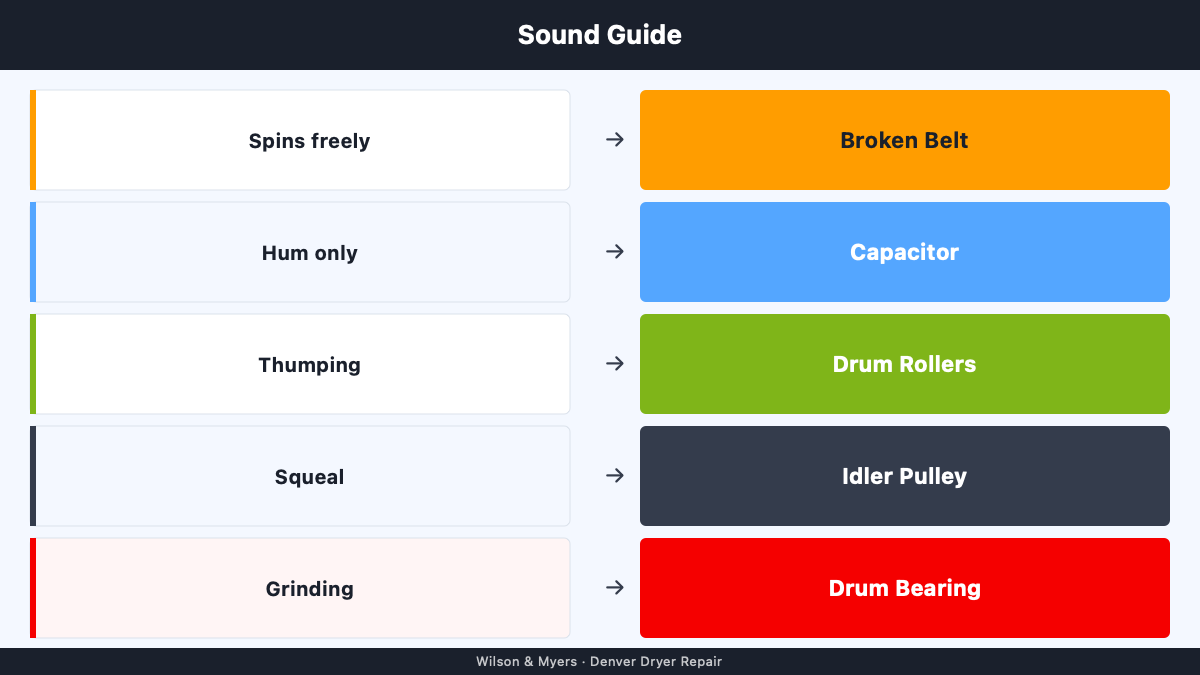
Dryer making noise but not spinning points to the cause by sound. Rhythmic thumping means worn drum rollers with flat spots. A squealing sound before stopping means the idler pulley bearing is seizing. Grinding with drum wobble means drum bearing failure. A hum with no drum movement means motor start capacitor failure or a physical jam between drum and housing.
Dryer hums but won’t spin is the diagnostic signature of a failed motor start capacitor. The motor energizes and hums but cannot generate the initial torque to begin rotating. Run the capacitor hand-push test: press Start and push the drum by hand. If it begins spinning, the capacitor is the fault. This hand-push test capacitor evaluation is the fastest way to separate a capacitor fault from a winding failure. If it does not respond, you may have a motor winding failure or a mechanical jam.
Dryer not spinning belt not broken means the fault is elsewhere in the drive system. Check the idler pulley for a seized bearing or broken spring. Check drum rollers for flat spots. Run the capacitor hand-push test to evaluate the motor start capacitor. Check for a foreign object jammed between the drum and housing. Each of these keeps the dryer drum not spinning even when belt tension is normal.
How to fix dryer not spinning depends on the cause. Start with the hand test: drum spins too freely means belt; won’t budge means jam or seized bearing; hum with spin on push means capacitor. Belt and overload fixes are DIY-capable. Capacitor replacement and motor repair carry safety risk and require an insured technician for dryer repair in Denver Metro Area.
Dryer turns on but doesn’t spin varies in severity. My dryer stopped spinning: if the drum spins freely by hand, it is likely a minor belt repair. A failed motor start capacitor is moderate in part cost but carries electrical safety risk. Motor winding failure is the most serious because motor replacement is the highest-cost repair on this list and may affect the repair-versus-replace decision on older machines. Use the diagnostic card-list above to scope the problem before committing to a repair path.
If the easy checks point to the belt or overload, the steps above give you the path. If the hum-but-won’t-spin or grinding-bearing pattern is what you are dealing with, book a diagnostic online and we will confirm the fault on the same visit. I see dead-drum calls most often on winter service calls in Denver Metro Area; diagnosing by sound before opening the cabinet is always the faster path.
Our insured technicians diagnose dryer drive-system failures across Denver Metro Area. We source parts through national supplier networks and manufacturer contracts, so belt, idler, and motor repairs happen fast.
Found This Helpful?
It is a week before Thanksgiving, and you set the oven to 350 degrees before starting the stuffing. Forty minutes later, the preheat signal fires. That is roug…

Has your refrigerator water dispenser stopped delivering water? In my experience, a large share of these calls end before a technician arrives. A child lock ac…
You open the dishwasher after the cycle and the plates look exactly as you loaded them: dry, cold, with last night's dinner still caked on. Your dishwasher is…
A Whirlpool dryer that tumbles but never heats traces to one of five faults, and three of them cost nothing to check. Here is the order to work through them, p…
A washer that shakes violently during spin traces to one of seven causes, from a bunched load to a failed drum bearing. Here is the order to check them, and th…
A gas smell during oven preheating is normal for about 90 seconds. Here is how Denver technicians tell routine startup odor from a real gas leak…
Welcome to the community.
You'll receive our next expert update soon.

Wilson & Myers is a verified member of the Denver Metro Chamber of Commerce.


