

Need a Professional Hand?
If a DIY fix isn't enough, our insured technicians are just a click away. We’ll diagnose the issue and get your home running right again.
BOOK NOWYour oven isn't heating because one of seven components failed: bake element, igniter, thermal fuse, temperature sensor, control board, gas safety valve, or a single lost leg of 240V power. Identify your fuel type first; gas and electric ovens fail for entirely different reasons. Recent self-clean cycles trip thermal fuses most often. The ranked list below takes you from most to least common.

Dinner was planned. You preheated the oven, walked away, came back fifteen minutes later, and the oven cavity is stone cold. The clock on the display works fine. The stovetop burners light without a problem. But the oven itself is dead. That moment of frustration, standing in your kitchen trying to figure out what went wrong, is exactly why this guide exists. We rank the seven real causes from most to least common so you spend two minutes on the likely culprits before considering the long-shot ones.
The diagnostic path splits immediately at fuel type. Electric ovens use 240V resistive heating elements; gas ovens use a hot-surface igniter wired in series with a gas safety valve. A dead element and a weak igniter look identical from where you stand, but the fix is entirely different. Identify your oven’s fuel type before running any check below.
Start at the breaker panel. Confirm the oven breaker is fully on, not tripped to the middle position. Then open the oven door and look at the bake element along the bottom of the cavity. Blistering, a visible break in the coil, or a sag points directly to Cause #1. If the element looks intact and you ran self-clean within the last 48 hours, go straight to Cause #2. That sequence explains the majority of electric oven no-heat calls.
Turn the oven to bake and wait 90 seconds. Look through the oven window: the igniter should glow bright orange. Glow present but no flame within two minutes means a weak igniter, the most common gas oven cause. No glow at all means the igniter has burned open or the thermal fuse blew. Glow plus flame but the oven never reaches temperature points to the temperature sensor or control board. Working surface burners confirm gas supply is fine. The fault sits entirely in the oven-side circuit.
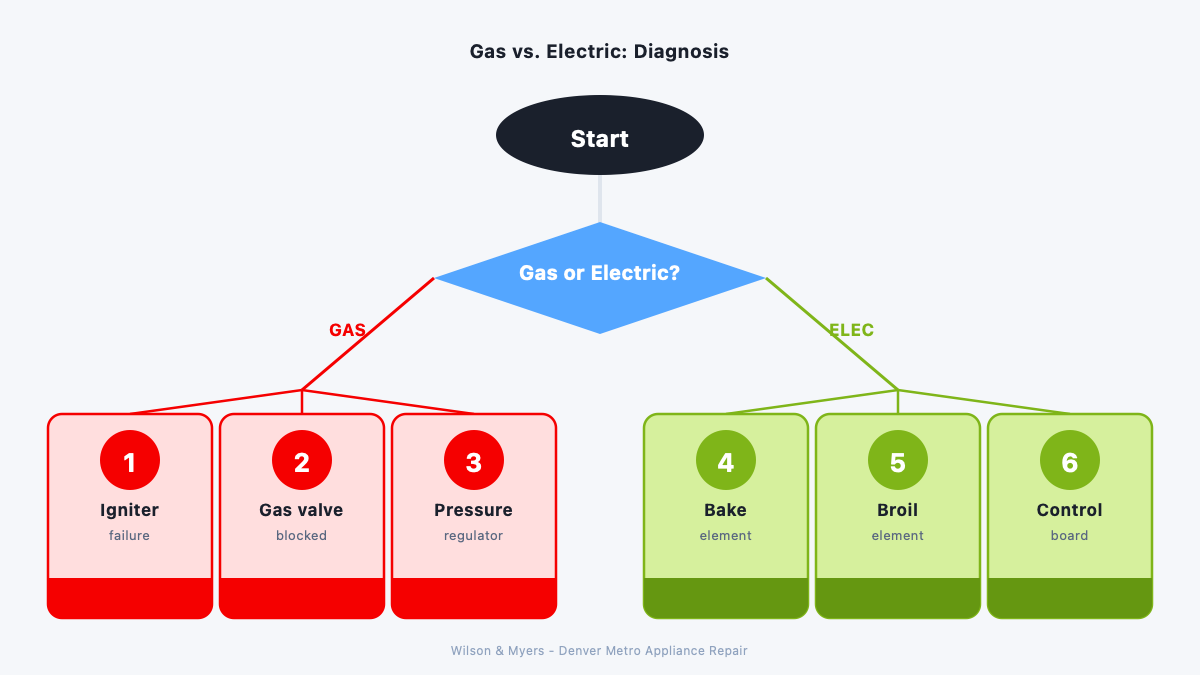
Gas oven: 1 Faulty igniter (most common) | 2 Blocked gas valve | 3 Failed pressure regulator.
Electric oven: 4 Burned-out bake element | 5 Failed broil element | 6 Control board fault. Red = pro repair required. Green = DIY possible (4, 5) or pro (6).
You set the oven to 375°F, the preheat chime never sounds, and the cavity sits at room temperature after twenty minutes. For electric ovens, bake element burned out is the diagnosis in roughly 35 to 45 percent of no-heat calls. Look at the element along the bottom of the cavity: blistering, a white spot, or a visible gap in the coil confirms it. A coil can also open silently with no visible damage. An ohm-meter at the terminals tells you for certain: 18 to 25 ohms cold is good; infinite resistance means failed. The job is under an hour and realistic for a careful homeowner. Our techs see a bake element burned out on roughly one in three electric oven calls in Denver Metro homes.
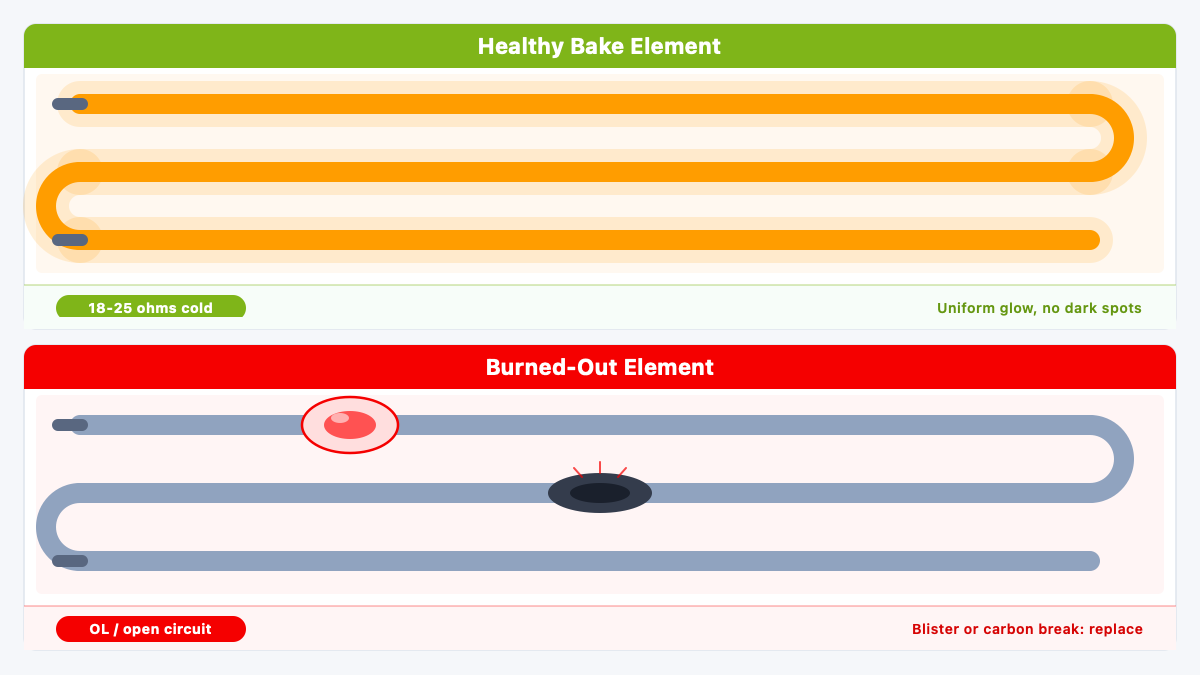
Top: Healthy bake element (uniform M-coil, 18-25 ohms cold). Bottom: Bake element burned out (blister at break point, white hot-spot, carbon deposit). Open circuit on ohm-meter confirms replacement needed.
For gas ovens, this cause slot belongs to an oven igniter weak scenario. The igniter glows orange but only draws 2.8 to 3.0 amps, just under the 3.2 to 3.6 amp threshold the gas safety valve needs to open. No gas flows. Oven stays cold. This accounts for 40 to 50 percent of gas no-heat calls. If you smell gas at any point, leave the home and call your gas utility’s emergency line immediately. If your gas oven will not ignite at all, see our guide to why a gas oven won’t light.
The oven worked fine yesterday. You ran the self-clean cycle overnight. This morning the oven is completely dead. That sequence points to a blown oven thermal fuse with near certainty. An oven thermal fuse blown during self-clean is the single most predictable no-heat cause we see. Self-clean cycles reach 800 to 900°F inside the cavity. If the range hood is off or the exhaust is restricted, heat builds at the fuse location and trips it. The fuse is a one-time sacrificial device: once blown, it requires replacement. Testing is a continuity check with zero ohms for good, infinite for blown. The part is very inexpensive and the replacement job takes 20 to 40 minutes.
After self-clean cycle fuse trips are preventable going forward. Replacing the fuse fixes the immediate problem; if it trips again after replacement, the exhaust restriction is still active and needs to be cleared.
The oven preheats slowly, food comes out undercooked, and the display shows a temperature that does not match reality.
If your oven does eventually reach temperature but just takes longer than it should, see our guide to why your oven takes so long to preheat, where sensor drift is covered in more detail. That pattern points to the oven temperature sensor, called an RTD (resistance temperature detector). All modern ovens use a surface-mount RTD that reads 10,000 ohms at 70°F as its calibrated baseline. On pre-1995 ovens, the equivalent component was a bimetal thermostat. An oven thermostat failed on those older units produces the same slow-heat symptom; if your oven is from the last three decades, it has an RTD. When the sensor drifts out of spec, the control board reads a false temperature and cycles the heating elements too slowly. The result is oven not maintaining temperature at any set point, and food that takes longer to cook or comes out underdone even when the element itself is working correctly.
The 10K ohm baseline is brand-agnostic: Samsung, Whirlpool, Frigidaire, Bosch, Wolf, and every other manufacturer uses the same RTD standard in ovens built after 1995. That uniformity matters for diagnostics because the same multimeter test works regardless of brand. Testing requires an ohm-meter at the sensor probe leads with the oven at room temperature. A reading outside the 9,000 to 12,000 ohm range at 70°F means the sensor has drifted and needs replacement. The sensor is typically a two-wire probe mounted to the back wall of the oven cavity, accessible with the oven empty. Replacement is realistic for a careful homeowner: disconnect power, remove one or two mounting screws, swap the probe. Oven preheating slowly after the repair and then holding temperature correctly confirms the fix.
The oven heats on some cycles but not others, throws an error code, or accepts the bake command without activating the element. Random or intermittent failure points to the oven control board or oven relay board. When a capacitor leaks or a relay contact welds open, the board sends no signal or a corrupted one.
Diagnosing a control board without a schematic requires a pro. PCB-level repairs sit at the higher end of any oven repair quote. On a basic-tier oven over 15 years old, the part price alone can approach replacement value, which is the point where the repair-vs-replace calculation becomes real. For Wolf, Thermador, or Bosch ovens, the calculation still strongly favors repair: swapping a board on a premium range is a fraction of buying new.
The igniter glows bright orange and draws the full 3.4 amps the circuit is designed to deliver. The gas safety valve should open. It does not. No gas flows, oven stays cold. This is the gas safety valve stuck closed scenario, accounting for 10 to 12 percent of gas no-heat calls. The valve is a bi-metal solenoid that fatigues over years of thermal cycling.
Confirming this failure requires measuring amperage through the live igniter circuit, strictly a job for a licensed gas tradesperson in Colorado. The repair carries the same requirement. Gas oven repairs involving the safety valve require licensed gas tradespeople.
The oven heats, but slowly. After an hour it has reached only 250°F when you set 375°F. The stovetop surface elements work fine. This is a 240V oven single leg power issue. Electric ovens run on two 120V legs from the breaker panel. When one leg drops, the element receives only 120V and produces roughly half its wattage. The oven heats but cannot reach set temperature, presenting as oven not getting hot enough rather than completely dead.
Confirm with a voltmeter at the outlet behind the oven: 240V across hot terminals is correct, 120V means one leg is lost. Reset the breaker and retest. If the breaker trips again, an electrician handles the service feed. We diagnose the oven-side issue and refer service feed problems out of appliance repair scope.
A small percentage of no-heat calls come down to the oven door switch, wiring faults, or gas supply. A failed door switch makes the control board think the door is open, so it will not energize the heating circuit. Check it with a continuity test at the switch terminals. On gas ovens, confirm the supply valve at the wall is fully open; on LP, check the tank level. These causes together account for roughly 5 percent of calls.
If your oven not heating up but broiler works, or the reverse, the broil element burned out is a separate scenario from bake element failure. Only one of the two heating circuits failed rather than the complete system.
Working surface burners confirm gas supply is fine. On a gas range, the surface burners get gas directly through a valve operated by the knob on your cooktop panel. The igniter circuit is separate entirely. Turn the knob, gas flows, the spark electrode lights it. That circuit has no connection to the control board, no igniter in the electronic sense, and no safety valve tied to a current threshold.
The oven bake burner works differently. The control board energizes the igniter, which heats until it draws 3.2 to 3.6 amps. That current draw trips the gas safety valve open. Gas flows past the glowing igniter, and the flame lights. If the igniter weakens, the safety valve stays closed. If the thermal fuse blows, the entire oven circuit goes dead. None of this affects the surface burners at all because they are on a separate gas line with a separate valve. The failure is in the oven-specific igniter circuit: most likely a weak igniter (40 to 50 percent), thermal fuse (15 to 20 percent), or gas safety valve (10 to 12 percent).
Electric cooktop surface elements typically run on 240V from their own relay circuits, separate from the oven relay. A single-leg 240V power loss can affect the oven while leaving some surface elements functional, depending on how the panel distributes the two legs across appliance circuits. If the oven is dead but the cooktop elements all work normally on an electric range, the failure is most likely in the oven-specific relay or the bake element rather than the power supply. That directs you back to Cause #1 and Cause #4.
The oven not heating up but stove works pattern is one of the most specific symptom descriptions homeowners give us. The working surface burners have already done useful diagnostic work for you. On a gas range, you have ruled out gas supply. On an electric range, you have ruled out the main breaker. Both cases narrow the remaining candidates to oven-specific components.
240V circuits can cause serious injury. Simple part replacements run far less than control board or gas valve repairs. Always disconnect the oven at the breaker before opening any panel or touching element terminals. If you are uncertain at any step, call a professional rather than guessing.
Most oven failures are worth repairing. A Wolf dual-fuel range or a Thermador pro oven costs several times what any single-component repair runs. We source through national supplier networks and manufacturer contracts. For Wolf-specific help, see our Wolf oven not heating up guide.
Wolf dual-fuel ranges are engineered for decades of service. Bake burners are rebuildable. Dual-ring sealed burners on the cooktop cycle through commercial-level thermal stress. Sealed cavity construction holds calibration better than mass-market designs. When a Wolf oven stops heating, the repair almost never involves replacing the range itself. A bake igniter swap, a gas valve service, or a control board replacement keeps a 15-year-old Wolf performing to spec for another decade. Mass-market shops often decline Wolf work because they lack the OEM parts relationships and technical documentation. Our insured technicians service Wolf as a primary specialty, not a reluctant exception.
Our techs find that a marginal igniter, one that glows orange but draws only 2.9 amps, is responsible for roughly half the Wolf oven calls we run in Denver Metro homes. Measuring amperage before replacing the valve saves unnecessary parts cost on every one of those calls.
Thermador Pro Grand series ranges carry a Star Burner ignition system with multiple electrode positions per burner and a more complex control architecture than standard slide-in ranges. The Pro Grand oven section uses the same sealed-burner bake igniter principle but with tighter tolerances on the gas valve opening threshold. Technicians unfamiliar with Thermador spec tend to misdiagnose a marginal igniter as a valve fault, leading to an unnecessary valve replacement and a still-faulty oven. Getting the diagnosis right requires calibrated amperage measurement against Thermador’s published threshold. On Thermador Pro Grand calls, we calibrate amperage draw before any parts swap; misreading a marginal igniter as a valve fault is the most common mismatch we correct after another shop has already been out.
A Bosch built-in oven costs several times what a repair runs. These are precision appliances. Bosch oven not heating in a combination unit can trace back to the convection element, the steam generator heating element, or the control board managing both circuits. Diagnosing these correctly requires Bosch-specific wiring diagrams. Most regional shops lack the sourcing relationships for these variants. We handle Bosch built-in ovens including the HBL and HBLP series across the Denver Metro Area.
Bosch convection ovens add a European-format convection fan circuit. Those variants also include a water reservoir plumbing system. When Bosch oven not heating is traced to the steam generator element, the repair path is entirely different from a standard bake-element swap. Parts sourcing runs through our manufacturer-direct accounts, not generic wholesale channels.
A burned bake element on a 6-year-old Whirlpool is always worth fixing. For mass-market brands, repair wins on any oven under 10 years old. A Samsung oven not heating after a self-clean cycle is almost always a thermal fuse trip: inexpensive part, under an hour. Whirlpool oven not heating from element burnout follows the same pattern. Frigidaire oven not heating from igniter failure is identical work.
The repair-first rule extends across the mid-tier. GE oven not heating and Maytag oven not heating calls both fit the realistic-DIY cause set when the unit is under 15 years old. When it is time to hand it over, our Maytag oven repair page picks it up. LG oven not heating follows the same logic. Kenmore oven not heating fits this group as well, since most Kenmore units share GE or Whirlpool internals.
For Frigidaire ranges, the brand-specific path, including the CPSC recall check and Frigidaire’s own error codes, is in our Frigidaire oven not heating guide.
For the premium-mass tier, KitchenAid oven not heating up, Thermador oven not heating, and Bosch oven not heating all justify repair even further out, given their build quality and part availability. Our technicians maintain manufacturer-direct sourcing relationships for all of these brands.
The tipping point is a basic-tier oven over 15 years old with a control board failure, where board cost approaches replacement cost. Any oven over 25 years with multiple failures is a replacement candidate. If you own a wall oven, cabinet modification cost tips the math further toward repair. We also service commercial ovens across Denver Metro. If your oven falls into the repair category, the FAQ below answers the most common cost and timing questions.
After a self-clean cycle, a tripped thermal fuse is the most common sudden-onset cause. If self-clean did not run recently, a burned bake element (electric) or a weak igniter (gas) accounts for the majority of no-heat calls. Seven components can ultimately fail: the bake element, the igniter, the thermal fuse, the temperature sensor, the control board, the gas safety valve, or a single-leg 240V power loss. Match your symptom to the ranked list above. Oven not heating properly over time with food consistently undercooked points to temperature sensor drift. My oven is not heating up suddenly after self-clean almost always means the thermal fuse tripped.
On a gas range, surface burners and the bake burner use separate gas circuits. Working burners confirm gas supply is fine; the fault is in the oven-side igniter circuit, most likely a weak igniter or blown thermal fuse. On an electric range, working surface elements usually mean a failed bake element rather than a power supply problem. Turn the oven to bake, wait 90 seconds, and watch for an orange glow. No glow means the igniter is open or the thermal fuse has blown. Either path leads to a straightforward repair.
Start with the bake element: it accounts for 35 to 45 percent of no-heat calls on electric models. Check for blistering or a visible break in the coil. If the part looks intact and self-clean ran recently, test the thermal fuse for continuity. Single-leg 240V power loss produces a slow-heat rather than dead-oven symptom; a voltmeter at the outlet confirms it. The breaker may show fully on while the element tests at infinite resistance, which means it has opened silently. Disconnect power at the breaker, access the element terminals, and measure ohms cold. Anything above 40 ohms or reading OL on a digital meter confirms the failure. (Electric oven not heating up almost always traces back to this single check.)
The most common cause when a gas oven not heating up is a weak igniter. It glows orange during the preheat cycle but draws only 2.8 to 3.0 amps, just under the 3.2 to 3.6 amp threshold the gas safety valve needs to open. No gas flows. Gas oven not heating up enough to reach set temperature over time often points to temperature sensor drift instead. Confirm the sensor by testing ohms at room temperature. Other causes: thermal fuse blown after self-clean, gas safety valve stuck closed.
When the oven reaches only 250°F set to 375°F, the temperature sensor has usually drifted out of its calibrated range. Single-leg 240V power loss produces the same slow-heat pattern. A weak heating element partially functioning can also cause this. Test the RTD sensor at room temperature; it should read close to 10,000 ohms at 70°F.
Bake elements, igniters, thermal fuses, and temperature sensors are all homeowner-accessible jobs with basic tools and the breaker off. Control boards require schematic-level diagnosis. Always call a pro for those. Gas safety valves always require a licensed gas tradesperson. Never attempt to bypass one.
Seven components cause an oven to stop heating: the bake element, the igniter, the thermal fuse, the temperature sensor, the oven control board, the gas safety valve, and single-leg 240V power failure. Self-clean cycles trigger thermal fuse trips most often. Diagnose by fuel type first, then work through the ranked list above.
Simple part replacements sit at the lower end of any quote: elements, igniters, thermal fuses, and temperature sensors take under an hour and the parts are inexpensive. Control board and gas safety valve repairs run at the higher end because the diagnostic process is more involved and the parts carry a higher price. Premium brands like Wolf, Thermador, and Bosch command pricier parts than mass-market equivalents, but the repair-vs-replace math still strongly favors repair given the original purchase price. We source through national supplier networks and manufacturer contracts. Book online for an exact quote on your oven brand, model, and diagnosed cause. (Oven repair cost in Denver Metro varies by cause and by brand tier.)
Wilson & Myers serves the Denver Metro Area with insured oven repair across all brands. Book online and we will confirm your appointment.
Found This Helpful?
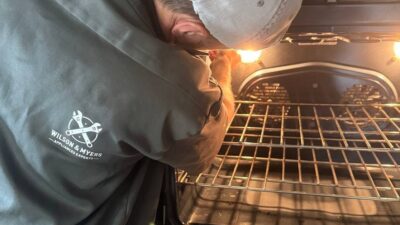
It is a week before Thanksgiving, and you set the oven to 350 degrees before starting the stuffing. Forty minutes later, the preheat signal fires. That is roug…
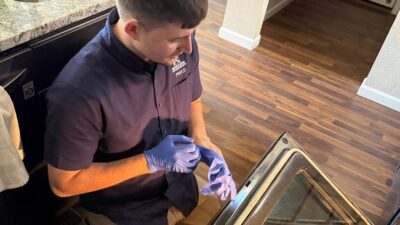
A Frigidaire oven not heating can come down to a setting rather than a part. Before you book a repair, two checks cost nothing and take under a minute: the clo…
Has your refrigerator water dispenser stopped delivering water? In my experience, a large share of these calls end before a technician arrives. A child lock ac…
You open the dishwasher after the cycle and the plates look exactly as you loaded them: dry, cold, with last night's dinner still caked on. Your dishwasher is…
A washer that shakes violently during spin traces to one of seven causes, from a bunched load to a failed drum bearing. Here is the order to check them, and th…
A gas smell during oven preheating is normal for about 90 seconds. Here is how Denver technicians tell routine startup odor from a real gas leak…
Welcome to the community.
You'll receive our next expert update soon.

Wilson & Myers is a verified member of the Denver Metro Chamber of Commerce.


