


Need a Professional Hand?
If a DIY fix isn't enough, our insured technicians are just a click away. We’ll diagnose the issue and get your home running right again.
BOOK NOWUnlike D90 or D95, which technicians report as shutdown codes, the LG dryer code D80 leaves the machine running. Running loads at that restriction raises drum temperatures. Clean the lint filter, inspect the flex duct, and clear the exterior vent hood. If D80 returns after those checks, the restriction is deeper in the duct or a component is at fault.
| Code | Restriction Level | Dryer Behavior |
|---|---|---|
| D75 | ~75% blocked | Dryer continues to run; early warning |
| D80 | ~80% blocked | Dryer continues to run; action recommended |
| D90 | ~90% blocked | Cool-down cycle, then dryer stops |
| D95 | ~95% blocked | Cool-down cycle, then dryer stops |
The LG dryer D80 code means the exhaust duct is approximately 80% blocked, and LG’s Flow Sense system triggers it when drum temperature rises in a thermal pattern consistent with severely restricted airflow. A dryer showing D80 keeps running. The code is a warning, and LG’s documentation gives the restriction percentage for each code, not the behavior.
Flow Sense has no airflow sensor. The Flow Sense restriction warning fires at four levels, and it monitors drum temperature during a cycle, reading a rising thermal signature as exhaust duct restriction. The DLEX series, most LG front load dryer models, and many top-load units carry this system.
What does D80 mean on LG dryer models? The answer is the same across the range. The LG dryer Flow Sense D80 threshold is the second of four levels, above D75 and below D90.
Failure to clean dryer vents is the leading contributing factor in home dryer fires, roughly a third of them, per NFPA. D80 reports the fire risk from restricted venting. A vent blockage at this level means reduced airflow, elevated temperatures, and lint in the heat path.
Six causes produce D80 on an LG dryer. Three are homeowner-accessible: a clogged lint filter, a kinked flex duct, or a blocked exterior vent hood. Three need professional scope: a duct run past LG’s spec, deep lint accumulation in a wall run, or a faulty thermostat.
Fabric softener sheets leave a waxy film on the mesh that looks invisible to the eye. A soap rinse lint filter check takes two minutes: hold the filter under warm running water, and if water beads on the surface instead of draining through, wash it with dish soap. Let it air-dry completely before reinstalling.
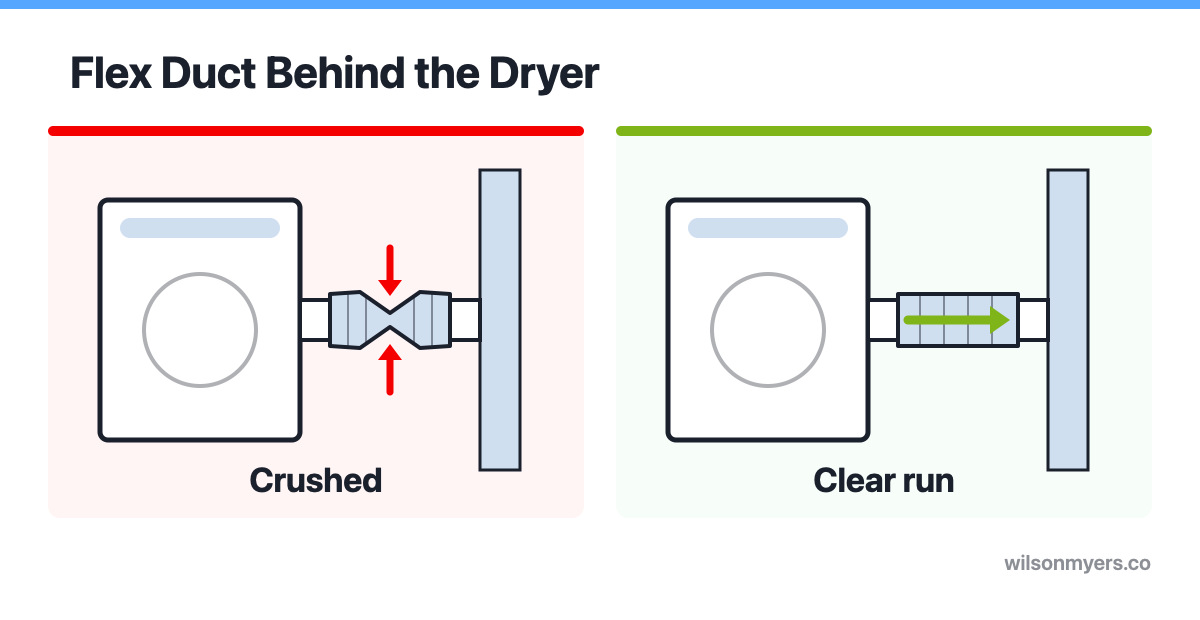
The flex duct kink risk is highest when the dryer is pushed tight against the wall, and a section crushed to half its diameter produces D80-level airflow restriction on its own. Unplug the dryer from the wall outlet before pulling it forward. Then inspect the flex section for any kink or collapsed segment, and replace it with a rigid metal duct upgrade where clearance allows, since LG recommends rigid metal over flexible foil or plastic.
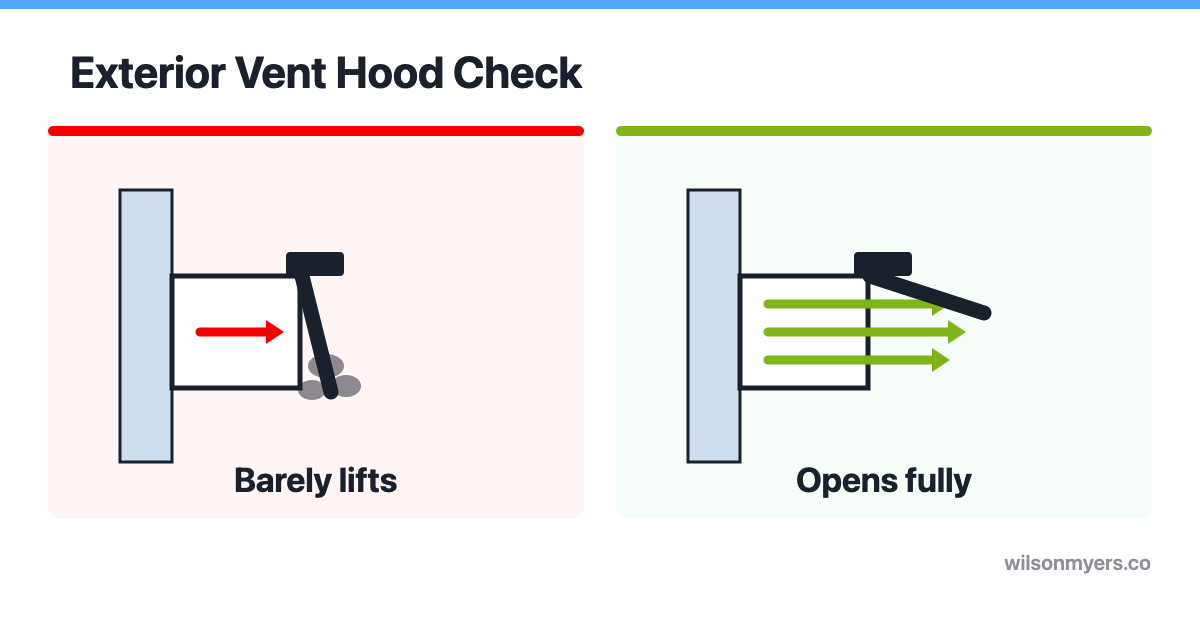
The vent hood on the exterior wall has a flapper that must open fully on every cycle. A flapper full-open test is simple: run the dryer on Air Dry and watch it from outside. In Denver Metro, we pull nesting material out of vent hoods every spring, and a flapper blocked by a nest produces D80 on an otherwise clean duct.
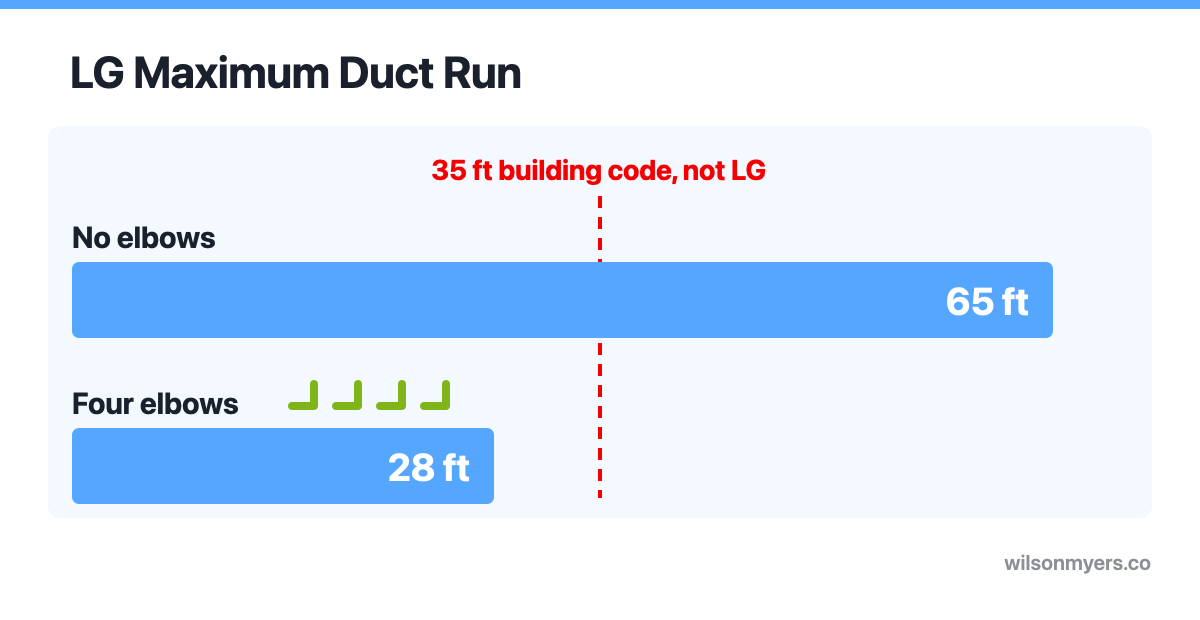
LG publishes a 65-foot maximum run for straight rigid metal duct. Each 90-degree elbow reduces that maximum by 6 feet, with no more than four elbows allowed. LG’s own table runs from 65 feet with no elbows to 28 feet at four elbows.
The 35-foot figure that appears in many vent guides is the IRC building code limit, not LG’s specification. An installation can satisfy the building code at 34 feet and still fall outside the LG 65-foot duct limit. The elbow count is what decides it.
That is why a duct that looks clean and short can still fire D80 under the 65-foot maximum run.
Count the elbows and compare against LG’s table.
Lint buildup at every elbow and coupling grows with every load. Short, straight, accessible runs can be cleared with a household dryer vent brush kit. Once the duct passes inside a wall or exits through a ceiling, household tools no longer reach, and professional rotating-brush equipment is what clears the accumulation at each bend. Restricted venting also cuts heat output before D80 ever fires, which is why a dryer not heating complaint often shares this root cause.
When D80 stays on after the obvious spots are clean, the restriction is usually a wall-run blockage at a bend that a household vacuum cannot reach. That is when you need professional equipment.
How to fix D80 on LG dryer models: work through four checks in order, cleaning the lint filter, inspecting the flex duct, clearing the exterior vent hood, then running a test cycle.
For an electric dryer, go directly to Step 1, but for a gas dryer, LG notes that D80 may indicate a lack of gas supply, not a blocked exhaust duct. Confirm the gas supply valve at the wall is fully open before beginning any duct inspection.
If the valve is already open and D80 persists, continue with the four steps below; if the dryer has not been igniting at all, contact your gas utility first.
Searching for D80 code LG dryer how to reset? You will not find a reset button. The D80 code on LG dryer models clears on its own after one successful unrestricted cycle. The restriction must be physically cleared first.
An LG ThinQ dryer D80 code appears on the display and in the app. If D80 persists after four steps, our dryer vent cleaning service reaches the deep duct runs household tools cannot.
Book online to schedule service.
An LG dryer D80 still showing after cleaning points to one of two causes. The restriction may be deeper in the duct run than a household tool can reach, or the code may be a false trigger from a faulty component.
A duct through walls, floors, or a ceiling often exceeds LG’s effective-length limit even when it passes building inspection. At four elbows LG’s table caps the run at 28 feet, well under the 35-foot building-code figure. In my experience, this is the cause behind persistent D80 where the laundry room sits far from an exterior wall. Our dryer hook-up service includes a duct routing evaluation for exactly this situation.
A thermostat-circuit fault is the other reason an LG dryer D80 won’t clear on a duct you have already opened. A hi-limit false trigger occurs when the thermostat opens below its design rating. The thermal pattern that follows is identical to a restricted duct. The cycling thermostat and the outlet thermistor can produce the same false signal, and a control board fault can also misinterpret normal sensor data.
Confirming a false trigger requires a clean duct and a full cycle: if D80 returns on a duct you know is open, the diagnosis moves to component testing.
Stop using the dryer if you also notice a burning smell or see scorch marks at the duct connections. Contact a technician. A dryer showing burn evidence alongside D80 is a different situation from a routine dryer smell.
D80 runs while D90 stops: that is the key difference in the Flow Sense sequence. LG defines D90 as approximately 90% restriction and D95 as approximately 95%. These codes share the same causes and the same homeowner checks.
D90 shuts dryer down after a cool-down mode cycle, unlike D80, which leaves the dryer running, and technicians and third-party repair sources report this consistently. LG’s documentation defines the restriction percentages but does not describe the behavioral difference. At D90 the urgency to clear the duct is higher, and professional cleaning is more likely.
The cool-down completes and the dryer goes quiet. The display holds D90. The drum is stopped and the load inside is still wet.
Third-party repair sources and technician reports describe the same sequence: once D90 triggers the cool-down and shutdown, the machine will not resume a heated cycle until the exhaust restriction is cleared. The dryer is waiting for the airflow condition to change.
That is the practical difference from D80. You can finish a load through D80 and address the duct afterward. D90 ends the cycle for you, and the load sits in a stopped drum until the restriction clears.
Unplugging the dryer does not clear D90 any more than it clears D80. The code returns on the next cycle if the restriction is still present. The only path back to normal operation is clearing the duct.
The wet load still needs handling while you work on the duct. For most fabrics, air-drying is the practical answer: hang the clothes and address the dryer separately. A large load or fabric that cannot dry flat is better taken to a laundromat while the duct repair happens.
A third option applies if the restriction is something you can clear yourself, such as a blocked vent hood or a kinked flex duct. Resolve the restriction first, then run the dryer on Air Dry before committing a full heated load.
Once the restriction is cleared, run the dryer on Air Dry first. Air Dry bypasses the heating element, so it confirms the duct is mechanically open without generating the thermal pattern that triggers Flow Sense. Audible airflow at the exterior vent and a flapper that holds fully open tell you the path is clear.
Then run heated cycles. The Flow Sense indicator does not update from a single load, and LG sets its own threshold for how many cycles it takes before a warning that stays lit counts as a fault. Our LG dryer repair page sets out that reset rule in full. Check the display as the cycles run rather than treating the first clean load as proof.
D95 represents approximately 95% restriction. At that level the blockage is near-total and self-service clearing rarely resolves it, so at D95 the first call is to a technician, not the last. For repairs across the rest of the range, see our LG appliance repair page, and for the machine itself LG dryer repair.
Two D80 situations belong on a professional service call. One is a duct that runs inside walls or through a roof, and the other is a D80 that persists on a confirmed-clean duct. Wilson and Myers handles both.
D90 adds a third situation for a service call: a duct you have confirmed is clear but the code returns on the next heated cycle. At D90 the machine has already shut down once. If it shuts down again after a duct check, the restriction is either deeper than your inspection reached or a component is triggering a false code.
Both outcomes fall outside homeowner tools. Our insured technicians bring the rotating-brush equipment and component-test tools to identify the cause on a D90 that persists after a confirmed-clear duct.
Our insured technicians cover Denver, Lakewood, Englewood, Littleton, Centennial, and the rest of the Denver Metro Area. Denver suburban duct routing involves longer horizontal runs and more bends than townhome installations. Those runs pick up lint faster at every elbow.
On duct calls, our vent cleaning service clears wall runs and roof exits that household dryer vent kits cannot reach, using rotating-brush equipment. On component calls, we test the cycling thermostat, hi-limit thermostat, and control board in sequence to identify the false trigger, and our dryer repair service covers the full LG laundry range.
If you smell burning during a cycle, unplug the dryer from the wall outlet and do not restart it before a technician inspects the unit. Scorch marks at the duct connections mean the restriction has raised temperatures. Those temperatures may already have damaged a component.
When D80 keeps flashing through a vent you have already cleaned, the restriction is past household tools. Book online. Our team brings the equipment to diagnose and clear D80 at the source.
The D80 error code LG dryer owners see means the exhaust duct is approximately 80% blocked, per LG’s official error code documentation. LG’s Flow Sense system detects this by monitoring drum temperature rather than measuring airflow directly. The dryer keeps running because D80 is a warning, not a shutdown command.
D80 clears automatically after one successful cycle with unrestricted airflow. Unplugging the dryer does not reset the code. Clear the restriction first: wash the lint filter with soap, straighten the flex duct, and check the exterior vent hood. Run one full cycle after completing those steps and the LG D80 error resolves on its own.
The dryer runs through D80, but continuing to run loads raises operating temperatures and dryer vent fire risk further. NFPA identifies failure to clean as the leading contributing factor in home dryer fires, roughly one in three. Address the restriction before running more full loads. Run an Air Dry cycle first to confirm the duct is clear.
Persistent D80 on a clean duct points to one of two causes. First: the exhaust duct restriction sits inside a wall run or at an elbow household tools cannot reach, and duct run length can also exceed LG’s limit once elbows are counted. Second: a faulty hi-limit thermostat is triggering a false code, and professional duct cleaning or component testing identifies which.
LG’s Flow Sense system uses four codes: D75 at roughly 75% restriction, D80 at 80%, D90 at 90%, and D95 at 95%. The D80 LG dryer continues to run as a graduated warning, while technicians and third-party repair sources report that D90 and D95 trigger a cool-down period followed by automatic shutdown. LG’s documentation defines only the restriction percentages, not the behavioral difference between codes.
D80 marks the operating condition that precedes dryer fires: restricted airflow, elevated drum temperatures, and lint in the heat path. NFPA data puts failure to clean at the top of the contributing-factor list, roughly one in three fires. Clear the restriction before running another full load.
Our insured technicians clear wall runs and roof exits that household kits cannot reach, and test the thermostat circuit when the duct is not the cause.
Found This Helpful?
You opened the KitchenAid freezer this morning and the bin was empty. In my experience, the arm is the first thing worth checking: the fix costs nothing and ta…
A Frigidaire oven not heating can come down to a setting rather than a part. Before you book a repair, two checks cost nothing and take under a minute: the clo…
A Whirlpool dryer that tumbles but never heats traces to one of five faults, and three of them cost nothing to check. Here is the order to work through them, p…
A washer that shakes violently during spin traces to one of seven causes, from a bunched load to a failed drum bearing. Here is the order to check them, and th…
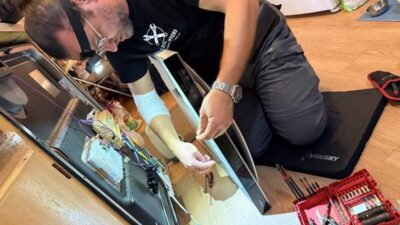
F8 E4 means water reached the drip tray, not a fill fault. Here is the two-step reset and why it can fire on a brand-new install with a dry tray…
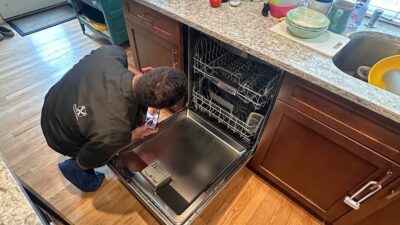
A Bosch dishwasher E22 error means one thing: the filter is blocked, and there is probably water sitting in the bottom of the tub…
Welcome to the community.
You'll receive our next expert update soon.

Wilson & Myers is a verified member of the Denver Metro Chamber of Commerce.


