


Need a Professional Hand?
If a DIY fix isn't enough, our insured technicians are just a click away. We’ll diagnose the issue and get your home running right again.
BOOK NOWIf both sections are warming up, cooling production has failed. This guide maps both paths, explains what GE’s display codes actually mean, and draws the line between what you can check and what needs an insured technician.
| What you are seeing | What it points to | What to do first |
|---|---|---|
| Fresh food warm / freezer still cold | Airflow failure: fan, damper, or frozen drain | Path A section below |
| Both sections warming / compressor running | Defrost heater or sealed system failure | Path B section below |
| Both sections warm / compressor clicking every 30-90 seconds | Start relay trying to engage | Unplug, then rattle-test the relay |
| Gradual cooling loss over several days | Refrigerant leak in the sealed system | EPA 608-regulated refrigerant work: insured technician required |
The two symptom paths split on one observation. GE refrigerator warm inside while the freezer stays cold means cold air is produced but not distributed. Both sections losing temperature together means cooling production has stopped.
The freezer compartment sits directly adjacent to the evaporator coils and stays cold even when airflow to the fresh food section stops. Typical Path A failures appear overnight: you wake up to warm milk while the freezer exhales a cloud of cold air. The compressor is humming.
Path B failures often develop over hours to a full day. In some cases you hear a click near the bottom rear every 30 to 90 seconds as the start relay tries to engage the compressor. In others, the French door refrigerator or side-by-side refrigerator runs quietly but never reaches temperature.
GE refrigerator not cooling but freezer works points at three components: the evaporator fan motor, the damper control assembly, and a frozen defrost drain. GE French door refrigerators with TwinChill dual evaporators add a fourth possibility that a single-evaporator layout cannot produce.
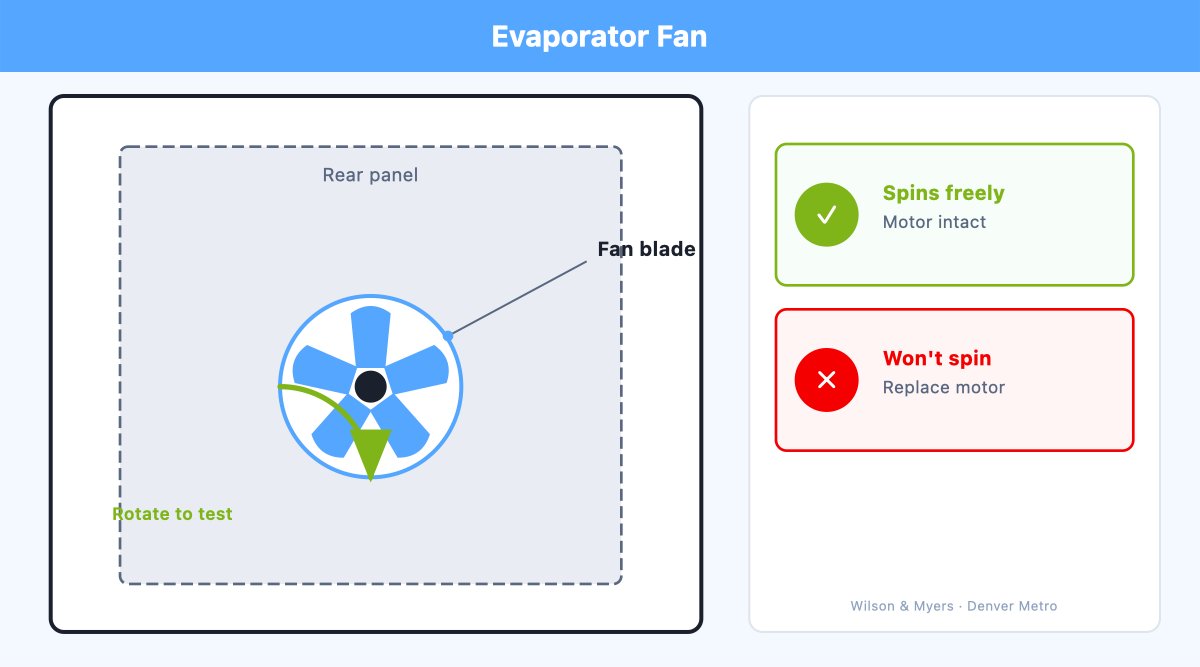
The evaporator fan motor lives inside the freezer compartment behind the rear panel. It pushes cold air from the evaporator coils into the fresh food section. When the motor fails, the freezer stays ice-cold because it sits right next to the coils, but the fresh food section warms within hours.
The evaporator fan blade test: hold the door switch closed with your finger and open the freezer. If the blade does not spin freely when you rotate it by hand, the motor is seized.
When the freezer is still ice cold but the fresh food section is warm, nine times out of ten the compressor is fine. We are looking at a fan, a damper, or a frozen drain.
A damper control assembly meters cold air from the freezer into the fresh food compartment. On older GE Arctica models it is a mechanical butterfly valve. On current GE Profile, GE Cafe, and standard models it is an electronic actuator driven by the control board.
Damper stuck closed cuts off airflow to the fresh food section entirely. The electronic version fails silently; remove the fresh food rear panel near the top and the damper sits locked in the closed position.
On GE models with a timed defrost, the defrost cycle starts every 8 to 15 hours depending on the model, while most newer models defrost based on usage. When the defrost heater begins to fail, frost accumulates between cycles, creating a defrost drain ice block sealing the air duct.
Symptoms: ice near the freezer light fixture, water pooling on fresh food shelves. Disconnect power for 24 hours with both doors propped open. If cooling restores after reconnecting, the defrost system has failed.
Standard GE refrigerators share one evaporator between both compartments. GE French door refrigerators with the TwinChill dual evaporator system have separate cooling circuits for the fresh food section and the freezer. That changes the diagnosis: the GE refrigerator fresh food section warm symptom on a TwinChill model does not necessarily point at the freezer-side evaporator.
The TwinChill fresh food evaporator can ice over independently, leaving the freezer circuit unaffected. If the evaporator fan and damper control both check out on your GE Profile refrigerator not cooling or GE Cafe refrigerator not cooling, the fresh food evaporator needs direct inspection. We see it regularly across GE French door models in Denver Metro homes, most often on Profile and Cafe units. Skipping this step is why these calls come back a second time.
Path B means the cooling production chain has failed. Start with the start relay: the test takes 30 seconds, the part is inexpensive, and it swaps without tools. Beyond the relay, Path B repairs involve refrigerant handling, panel removal, or board diagnosis and belong to an insured technician.
The start relay click test: unplug the refrigerator first, then pull the relay off the compressor terminal. Shake it near your ear. A rattle confirms the internal contacts have failed.
When the relay goes, the compressor clicks every 30 to 90 seconds without starting. Replacement needs no tools beyond a firm pull.
A failed defrost heater lets frost accumulate until ice blocks the duct and both sections go warm over two to three days. A technician checks continuity across the heater terminals on a de-energized circuit; open confirms failure. I have seen this one misdiagnosed as a dead compressor more than any other fault on the Path B ladder.
Disconnect power before removing any back or bottom panels. When the heater tests open, evaluate the defrost thermostat and control board together.
A GE refrigerator stopped cooling gradually over several days while the compressor runs is the refrigerant leak signature. Diagnosing and recharging the sealed system is EPA 608-regulated work. This is not a homeowner repair.
Sealed system wear past year twelve is the common culprit on older GE Monogram built-ins. Our freezer repair service covers sealed-system diagnostics alongside the full Path B ladder.
The temperature control board manages compressor cycles and reads thermistor input for actual compartment temperatures. A technician checks the thermistor first because thermistor failure mimics a board fault at a fraction of the cost.
If both sections are warm and the compressor is not running, book a GE refrigerator repair diagnostic before food loss mounts. Our insured Denver Metro technicians serve Aurora and Lakewood alongside central Denver.
If you are asking why is my GE refrigerator not cooling after a 24-hour manual defrost, do not reach for a button sequence next. GE’s owner’s manuals and support articles give no entry sequence for the GE refrigerator diagnostic mode, and they describe no GE built-in service mode meant for owners.
The combinations passed around online can make things worse. On several current GE French door models, holding Water, Crushed and Cubed for 3 seconds is the first step into Demo Mode, which turns the cooling system off. On many GE French door models, holding Freezer and Fridge together for 3 seconds switches the refrigerator control to OFF.
Instead, try a sixty-second hard reset: unplug the refrigerator, wait a full 60 seconds, then restore power. GE says cutting power for a minute or two sometimes clears a code. If the refrigerator was serviced recently, GE notes it may still be in diagnostic mode, and 30 seconds without power should reset the control panel.
Two settings leave the lights and display working while nothing cools. The first is a control set to OFF: GE notes that turning cooling off at the panel does not cut power to the refrigerator. The second is Demo Mode, which GE says keeps the lights and controls working while disabling the cooling system.
The power reset above is also GE’s first step out of Demo Mode, except on GE’s 2026 side-by-side models, where the owner’s manual gives a button press instead. After changing a setting, GE says to allow 24 hours for the temperature to stabilize before judging the result.
These are not diagnostic mode error codes you call up with buttons. On many GE models with electronic dispenser controls, a code flashes on the control panel by itself when the control detects a problem. In GE’s own list, FF means check frozen food for thawing because the temperature is rising too high, and CC means check the temperature controls because the refrigerator temperature is incorrect.
CI means check the icemaker, and PF means the power was interrupted. A lowercase dE means the defrost system has not operated properly in the last 24 hours, while a capital DE is Demo Mode. On GE’s 2026 side-by-side models, though, dE on the keypad is Demo Mode as well.
None of these codes names a failed part. If FF, CC or dE comes back after a power reset, book a diagnostic rather than ordering parts.
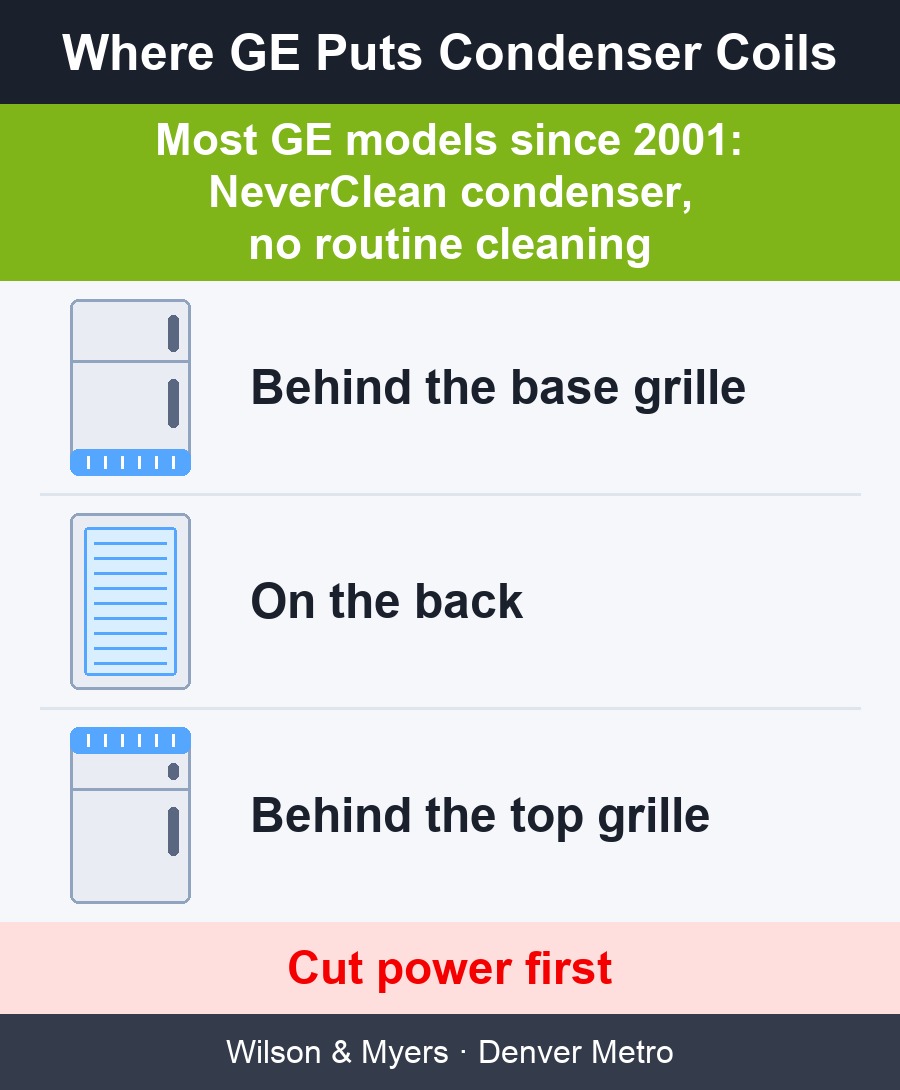
Dirty condenser coils do hurt cooling: GE says they reduce a refrigerator’s ability to hold its temperature. But GE says most of its refrigerators made since 2001 have a NeverClean condenser, located in the compressor housing, that does not require cleaning under normal conditions. On those models, a GE fridge not cooling will not be fixed with a coil brush, so go back to the two paths above.
The exceptions GE names are compact refrigerators and smaller top-freezer models, and the owner’s manual gives cleaning directions when a model has coils to clean. Where it does, unplug the refrigerator first, then work a long condenser brush through the coils and vacuum the floor beneath.
The Monogram top condenser is a different access story: GE Monogram built-in refrigerators place the condenser at the top behind an upper grille, not at the base. Owners trained on bottom-access models overlook this entirely and clean nothing while the condenser above them chokes. Monogram service always starts with that grille.
For a GE fridge not getting cold that does have coils to clean, GE ties the timing to conditions rather than a calendar. It says cleaning is needed more often with pets that shed, or when the refrigerator stands somewhere particularly dusty, such as a garage.
One pattern worth knowing: GE refrigerator not cooling in a Denver garage during winter is sometimes not a fault at all. GE Garage Ready models are rated for 38F to 110F. Other GE models carry a lower limit in their installation manuals: 60F for French door models and 55F for many top-freezers. Check the garage ambient temperature limit for your model before calling.
The repair-or-replace framework differs across GE’s wide price range. A budget GE top-freezer and a GE Monogram built-in do not share the same calculation.
In our experience a standard GE refrigerator eight years or older with a refrigerant leak is usually a replacement candidate: repair cost approaches the unit’s replacement value. The same refrigerator with an evaporator fan motor or start relay failure is worth repairing at any age. GE fridge warm but freezer is cold is almost always a Path A repair and makes financial sense.
For GE Profile and GE Cafe, push that threshold closer to ten or twelve years before the refrigerant leak equation flips to replacement.
In my experience, GE Monogram built-ins hold their service life longer than freestanding units; stable environments and less door cycling keep them running. GE Monogram refrigerator not cooling at year ten is still a repair candidate in most cases. A sealed-system repair at a fraction of replacement cost makes financial sense through year twelve or fourteen. We will tell you directly when a specific Monogram failure does not pencil out.
Wilson and Myers serves the Denver Metro Area for the full GE residential line: standard top-freezer and bottom freezer models, French door refrigerators with TwinChill dual evaporators, and GE Monogram built-ins with top condenser access. Parts sourced through national supplier networks and manufacturer contracts. We cover Denver, Aurora, and Lakewood.
Homeowners asking how to fix GE refrigerator not cooling who reach the sealed system hit a hard stop: refrigerant work is EPA 608-regulated. Our insured technicians handle the complete GE repair ladder, from evaporator fan replacements to sealed-system evaluations.
Call when the start relay rattle test passes but both sections remain warm, when the 24-hour manual defrost did not restore cooling, or when an FF or CC code comes back after a power reset.
Panel removal and sealed-system work belong to an insured technician. Complex Path B failures on GE Profile, GE Cafe, or GE Monogram need professional diagnosis; a thermistor or start relay often costs far less than a board.
Our GE appliance service page covers the full residential GE line. GE Profile owners: GE Profile service page. Monogram owners: GE Monogram service page.
LG owners: check the compressor class-action before paying for any repair; our LG refrigerator not cooling guide covers that first. Whirlpool owners start with our Whirlpool refrigerator not cooling guide.
When both sections are warm and the compressor is silent, food spoilage begins within hours. Book a diagnostic online and our Denver team will confirm scheduling.
The compressor is working but the cooling or distribution chain has failed. Both sections warm points to a faulty start relay, defrost heater failure, or sealed-system refrigerant leak. Fresh food warm with the freezer still cold points to the evaporator fan motor, damper control assembly, or a frozen defrost drain.
GE’s owner’s manuals and support articles give no entry sequence for the GE refrigerator diagnostic mode, and some combinations posted online switch the cooling off instead. On several current GE French door models, holding Water, Crushed and Cubed for 3 seconds is the first step into Demo Mode, which turns the cooling system off. The safe owner steps are a sixty-second power reset, a check that the controls are not set to OFF, and 24 hours for the temperature to stabilize after any setting change.
In GE’s own code list, FF means check frozen food for thawing because the temperature is rising too high. It is a temperature warning, not the name of a failed part. GE says disconnecting power for a minute or two sometimes clears the code. If FF returns, confirm the freezer door seals and the controls are set correctly, then book a diagnostic.
A click every 30 to 90 seconds near the bottom rear usually means the start relay is trying to engage the compressor and failing. A continuous hum with no cooling can mean the compressor runs but cannot build pressure, which points at the sealed system. Both warrant a diagnostic call before food loss mounts.
It depends on the model and the fault. A standard GE unit eight years or older with a refrigerant leak is typically a replacement candidate, while the same unit with an evaporator fan or start relay failure is worth repairing at any age. GE Monogram and premium Profile models shift that threshold well past year twelve, given what they cost new.
GE refrigerator fresh food warm but freezer cold points to a Path A airflow failure. The evaporator fan motor has stopped, the damper control assembly is stuck closed, or a defrost drain ice block has sealed the air duct. On GE French door refrigerators with TwinChill dual evaporators, the TwinChill fresh food evaporator itself may have failed independently of the freezer circuit. That fourth cause is specific to TwinChill models and is the one most generic guides miss.
Our insured Denver Metro technicians run the full GE diagnostic ladder, from evaporator fan replacements to sealed-system evaluations.
Found This Helpful?
You opened the KitchenAid freezer this morning and the bin was empty. In my experience, the arm is the first thing worth checking: the fix costs nothing and ta…
A Frigidaire oven not heating can come down to a setting rather than a part. Before you book a repair, two checks cost nothing and take under a minute: the clo…
Has your refrigerator water dispenser stopped delivering water? In my experience, a large share of these calls end before a technician arrives. A child lock ac…
A Whirlpool dryer that tumbles but never heats traces to one of five faults, and three of them cost nothing to check. Here is the order to work through them, p…
F8 E4 means water reached the drip tray, not a fill fault. Here is the two-step reset and why it can fire on a brand-new install with a dry tray…
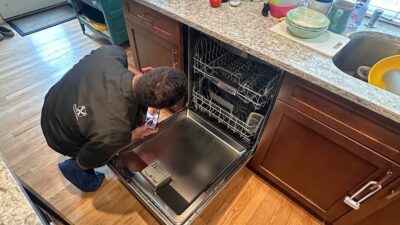
A Bosch dishwasher E22 error means one thing: the filter is blocked, and there is probably water sitting in the bottom of the tub…
Welcome to the community.
You'll receive our next expert update soon.

Wilson & Myers is a verified member of the Denver Metro Chamber of Commerce.


