


Need a Professional Hand?
If a DIY fix isn't enough, our insured technicians are just a click away. We’ll diagnose the issue and get your home running right again.
BOOK NOW| What You See | Most Likely Fault | Display Code |
|---|---|---|
| Drum spins normally, no heat, no code | One breaker pole tripped (L2 fault) | No code or L2 or F4 E4 |
| Drum spins, no heat, code on display | Low line voltage or heater relay | L2, F4 E4, or F4 E1 |
| Heats 10 to 15 min then stops, clothes damp | AccuDry sensor bar buildup | No code |
| No heat at all, electric dryer | Blown thermal fuse | No code |
| Drum spins, no heat, gas dryer | Igniter, solenoid, or flame sensor | No code |
Electric Whirlpool dryers run on a 240-volt circuit. The two-breaker 240V circuit splits into two 120-volt legs: one for the drum motor, one shared with the heating element. When one breaker trips, the drum spins normally while the heating element receives zero power. Low line voltage on that leg leaves the air cold while the drum sounds completely normal.
This is the most common source of a Whirlpool dryer no heat call and the pattern behind the Whirlpool dryer runs but no heat complaint. Whirlpool confirms F4 E4 same as L2 on its shared diagnostic video page; both codes point to the same lost supply leg. The display shows no code, the L2 error code, or F4 E4 depending on the model family.
Check both breakers at the panel, not just the top one. A tripped pole can sit halfway between ON and OFF and still appear to be on. Flip each pole fully off, wait one minute, then turn it back on. If the breaker trips again within a cycle, route the problem to an electrician rather than a dryer technician; our dryer not heating guide covers this check across all brands.
A blocked exhaust duct is Whirlpool’s own first troubleshooting step on a no-heat call. Restricted airflow lets exhaust heat build up inside the drum, safety components trip in sequence, and eventually the thermal fuse opens permanently. Denver basement duct runs in Metro-area homes often stretch 15 to 20 feet through crawl spaces to an exterior cap, and those longer runs collect lint faster than short wall-mount installations.
Pull the flex duct off the back of the machine and check it for kinks or packed lint. If the duct has not been cleaned in two or more years, schedule a dryer vent cleaning before a fuse blows and complicates the repair.
Whirlpool WED and WGD dryers display three codes tied to heating failures: F4 E4, L2, and F4 E1. F4 E4 and L2 identify the same voltage fault on different model families. F4 E1 is a separate, more urgent problem. Which code shows on your display determines whether you can self-diagnose or need to stop the machine immediately.
Per Whirlpool’s product support documentation, F4 E4 means low or no line voltage is reaching the heating circuit. One leg of the 240-volt supply has been lost. L2 carries the same meaning on older model families that display a two-character code. Whirlpool confirms F4 E4 same as L2 on its shared diagnostic video page: both codes mean one breaker pole has lost supply, not that the dryer itself has failed.
Reset both breaker poles: flip fully off, wait one minute, then turn back on. Cycle power to the dryer. If the code clears and the dryer runs a full heat cycle, the fault was a transient supply dip. If F4 E4 or L2 returns, check the terminal screws on the power connection per Whirlpool’s steps.
For a new or relocated machine, confirm the correct dryer hook-up configuration; repeated tripping routes to an electrician, not a dryer tech.
Whirlpool’s product support page describes F4 E1 as a problem with the Heater or Heater Relay. Technicians who diagnose this fault report the heater relay stuck closed, meaning the heating element runs continuously rather than cycling. The F4 E1 fire hazard comes from an element that never shuts off. Unplug the dryer immediately and do not use it again until a technician has replaced the control board.
When F4 E1 shows on a Whirlpool dryer, the heating relay is stuck on, not off. That means the element is running continuously. Unplug the dryer before anything else.
On a Whirlpool Cabrio dryer not heating without any error code, the thermal fuse is the first component to test. It is a one-shot safety device on the blower housing that opens permanently the moment exhaust temperature crosses its rated threshold. It cannot reset. A Whirlpool dryer stopped heating because the fuse tripped will tumble normally and stay cold; the fuse must be replaced, not cycled off and on.
On WED series and Whirlpool Cabrio dryers, the thermal fuse mounts directly on the blower housing: the component that pulls air through the drum and exhausts it outside. The blower housing location is the back panel access point for both the thermal fuse and the cycling thermostat. Unplug the dryer and remove the back panel to reach it. The fuse carries two wire leads and shows no visible burn mark when it fails; the only reliable test is a multimeter continuity test.
A blocked duct is the root cause behind most blown fuses. Lint accumulates, airflow drops, exhaust temperature climbs, and the fuse opens to prevent a fire. Replacing the fuse without clearing the vent means the new fuse blows again in weeks. Whirlpool dryer not heating no error code calls that bounce back inside two months almost always have an uncleared duct behind them.
Whirlpool Duet front-load dryers follow the same script: on any Whirlpool dryer not heating after replacing thermal fuse, the blocked duct is almost always behind it.
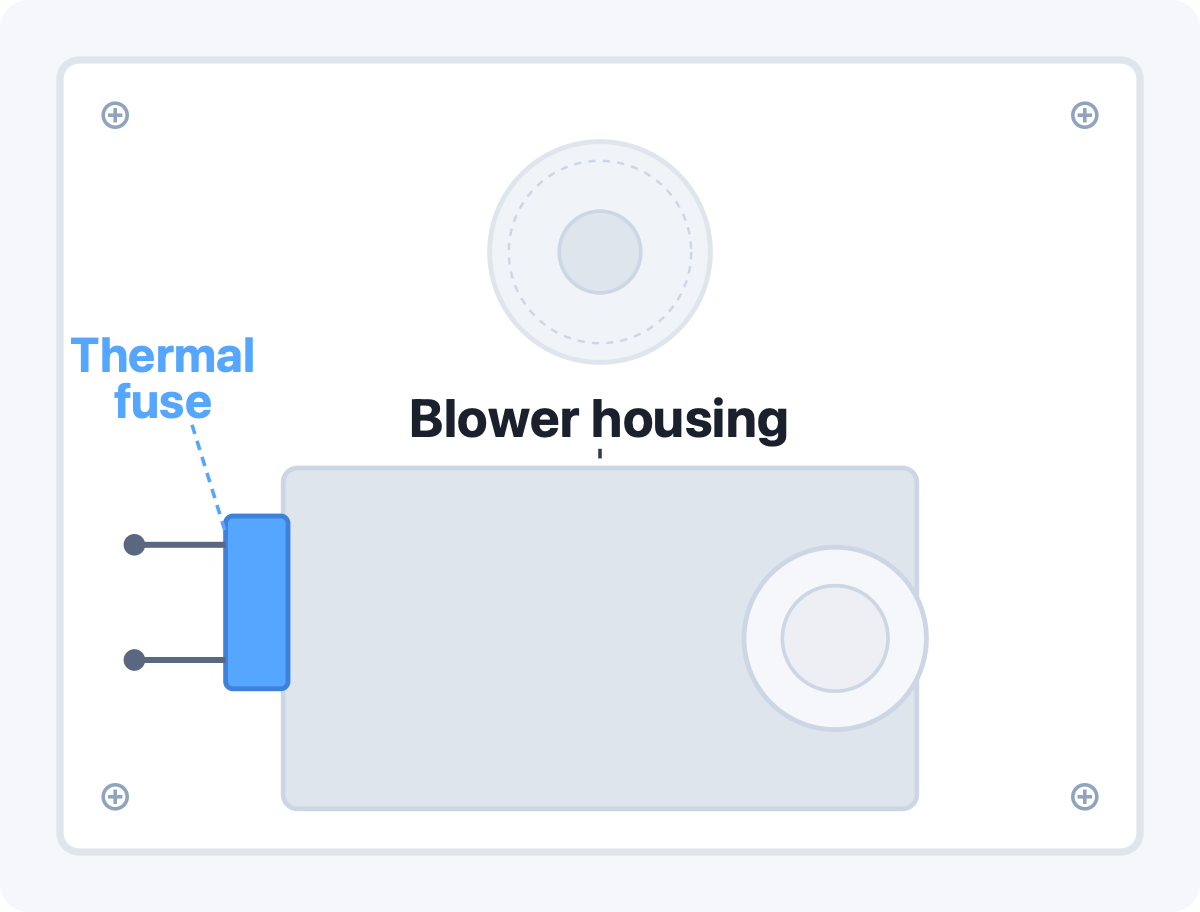
A multimeter continuity test confirms the fuse condition in three minutes before you order any part.
If the multimeter confirms a blown fuse and the duct is clear, a standard dryer repair visit covers the replacement. If the fuse keeps returning, a technician traces the full heating circuit for the upstream cause.
When the thermal fuse and the breaker are both intact, the fault lives in the heating element, the thermostats, or the thermistor on electronic-control models. Gas WGD dryers follow a separate gas-train sequence with different failure modes.
On a Whirlpool electric dryer not heating with a good fuse and confirmed supply voltage, the heating element is the next component to test. A resistive coil that converts 240-volt current to heat, the element shows infinite resistance on a multimeter when a wire breaks. A shorted element may show very low resistance and will trip the high-limit thermostat repeatedly. Cycling thermostat failure is the more common cascade trigger: when the cycling thermostat fails, the element runs hotter than it should.
The high-limit thermostat trips as a safety backup, and cycling thermostat failure eventually leads to a blown thermal fuse. That cascade explains many apparent fuse failures on WED series dryers that involve two or three components rather than one.
The thermistor is a secondary temperature sensor on electronic-control WED series models. A failed thermistor can block the board from enabling heat even when the element and thermostats are intact. Owners of a HybridCare heat-pump Whirlpool dryer face a completely different platform; the sealed refrigerant system makes any fault there technician scope from the first symptom. For element, thermostat, or thermistor replacement, see our Whirlpool dryer repair page for what a full heating-circuit diagnostic covers.
A Whirlpool gas dryer not heating most often points to one of three gas-train components. The igniter glows orange to light the gas released by the valve. Technicians who work on WGD series dryers report the igniter draws roughly 3.5 amps at normal operation. A cracked or degraded igniter may glow but draw only 1 to 2 amps, failing to reach ignition temperature.
That is the one visible check available to a homeowner: pull the lower front panel and watch the igniter through a full cycle. If it glows for a full minute without the burner lighting, the igniter has failed. Gas valve solenoids, the two coils that open the valve to release gas, and the flame sensor are the next points in the gas train. Diagnosing either requires safe access to gas valve connections and routes to a W&M technician.
The AccuDry sensor hidden fault produces no error code and no obvious mechanical symptom. Heat is present. The AccuDry moisture sensor cuts the cycle short before clothes are actually dry. For owners searching on a Whirlpool dryer not heating up complaint, this is the cause they most often miss: a sensing failure, not a heating failure.
Two conductive metal bars mount inside the drum on AccuDry-equipped Whirlpool dryers. When wet clothes contact both bars, they complete a small circuit that tells the board to keep the heat on.
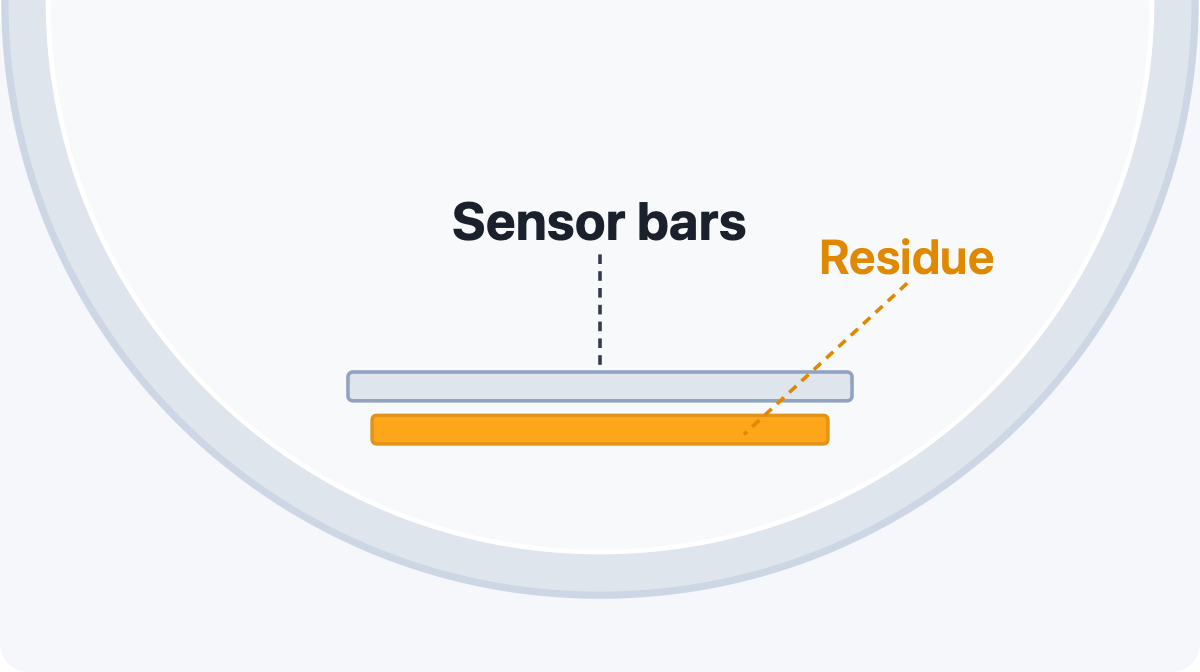
Dryer-sheet residue and mineral buildup coat the bars over time and block conductivity. The board reads dry prematurely and cuts the cycle short. That is the Whirlpool dryer heats but clothes still damp pattern that repeats load after load with no code on the display. Clean the bars with a soft cloth and isopropyl alcohol until no residue transfers to the cloth.
This clears the sensor bar buildup without replacing a single part. The AccuDry moisture sensor system is documented by appliance parts suppliers and confirmed by technicians who service Whirlpool dryers. No step for this specific fix was found on Whirlpool’s producthelp site during our research, so treat the cleaning procedure as industry-confirmed rather than manufacturer-documented.
In my experience on Cabrio top-load dryer calls, this cleaning fix resolves the heats-but-never-finishes complaint more often than any component swap. If the symptom returns within a few weeks, the bars themselves may have corroded past what cleaning can restore. A similar early-shutoff pattern appears on other brands as well; our Samsung dryer not heating guide covers that fault class for comparison.
Four situations on a Whirlpool dryer move the repair past DIY territory. If your diagnostic lands on one of these, the machine needs a technician before the next cycle runs.
Stop using the dryer, unplug it, and book a technician.
The gas train is professional scope, not a homeowner repair.
The fuse is a symptom; the vent restriction behind it needs clearing.
Element or control-board diagnosis past DIY.
Our insured technicians serve Whirlpool dryer owners across Denver, Lakewood, Littleton, Centennial, and Aurora.
If the diagnostic points to a component repair and that wet load is still waiting, our dryer repair page covers what to expect from a W&M service visit.
A Whirlpool dryer not heating most often traces to one of five faults. The top two are a blown thermal fuse on the blower housing and a tripped breaker cutting the 240-volt supply (L2 or F4 E4). A failed heating element, cycling thermostat, or AccuDry sensor bar buildup makes up the rest. Three of the five checks cost nothing before ordering a part.
F4 E4 means low or no line voltage is reaching the heating circuit per Whirlpool’s product support documentation. One leg of the 240-volt supply has been lost, cutting power to the heating element while the drum continues to run. F4 E4 and L2 are the same fault displayed differently across model families. Check both breaker poles at the panel as the first step.
Warm but damp clothes almost always point to the AccuDry moisture sensor bars inside the drum. Dryer-sheet residue coats the bars, reduces conductivity, and causes the control board to read dry before the cycle is complete. Clean the bars with isopropyl alcohol before replacing any parts. This is a technician-confirmed pattern; no official Whirlpool producthelp page was found for this specific fix during our research session.
Yes. The thermal fuse on WED and Cabrio dryers sits on the blower housing and is accessible after removing the back panel. Test it with a multimeter on the Rx1 ohms setting before ordering a replacement. Clear the vent blockage at the same time; a Whirlpool dryer won’t heat for long if the new fuse goes into a restricted duct, and the fuse will blow again within weeks.
Two separate fault classes cause mid-cycle heat shutoff. AccuDry sensor bar buildup causes the board to read dry prematurely and end the cycle early, with no error code. Cycling thermostat failure lets the element overheat, trips the high-limit thermostat, and shuts down heating until the drum cools. Sensor bar cleaning resolves the first; a thermostat replacement resolves the second.
No, unplug the dryer immediately. F4 E1 indicates a problem with the heater or heater relay per Whirlpool’s documentation. Technicians who service this fault report the relay stuck closed, meaning the heating element runs continuously rather than cycling, which is a fire hazard. Do not use the machine until a technician has replaced the control board.
Start with the two free checks: confirm both breaker poles have power, and verify the exhaust duct is not kinked or blocked. If both clear, run the multimeter continuity test on the thermal fuse at the blower housing. If the fuse is intact, check the AccuDry sensor bars for residue. Three of the five fault classes on Whirlpool WED and WGD dryers require no parts to diagnose.
Our insured technicians work on Whirlpool WED and WGD dryers, including Cabrio models, across Denver Metro. One diagnostic visit finds the real fault: blown thermal fuse, failed heating element, or a voltage issue the electrician missed.
Found This Helpful?
A washer that shakes violently during spin traces to one of seven causes, from a bunched load to a failed drum bearing. Here is the order to check them, and th…
You walked into the laundry room and the display is flashing D80. The drum is still turning. You do not know whether to stop the cycle or let it finish. D80 is…
The LG washer UE code means the machine detected an unbalanced load during the spin cycle and stopped to protect the drum and bearings. UE is protection not br…
When the LG washer LE code flashes mid-cycle, the drum stops, and your laundry sits locked inside. Most people's first thought is a broken motor. It usually is…
A dryer not spinning usually traces to one of six faults in the drive system. Spin the drum by hand: drum spins too freely with no resistance means the drive b…
The water appears after the spin cycle ends, or while the machine is still running. A washer leaking from the bottom can mean anything from a loose hose clamp…
Welcome to the community.
You'll receive our next expert update soon.

Wilson & Myers is a verified member of the Denver Metro Chamber of Commerce.