


Need a Professional Hand?
If a DIY fix isn't enough, our insured technicians are just a click away. We’ll diagnose the issue and get your home running right again.
BOOK NOWHas your refrigerator water dispenser stopped delivering water? In my experience, a large share of these calls end before a technician arrives. A child lock activated on the control panel disables the dispenser completely with no failed parts. Knowing how to fix refrigerator water dispenser not working starts with the cheapest check first and moves through six components in order.
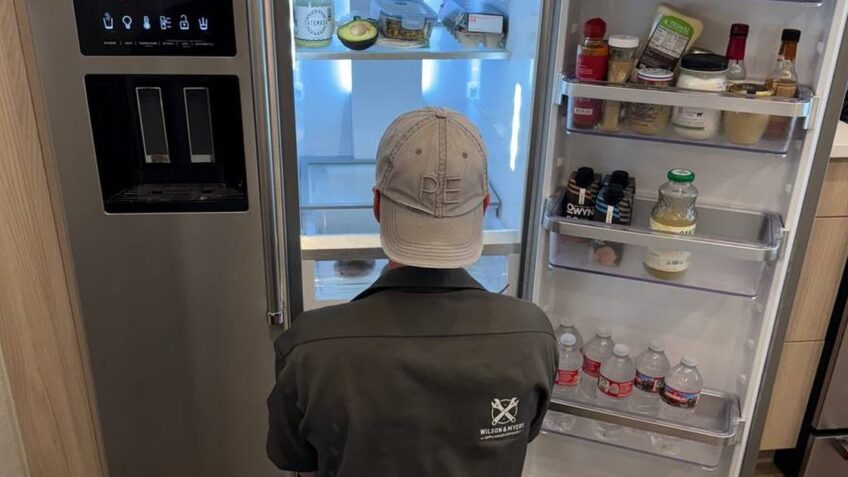
Check the control panel first for a padlock or LOCK symbol. A child lock disables water dispenser operation in an instant; hold the designated button for three seconds to restore it. If the panel shows no lock, disconnect the door water tube at the hinge fitting and blow air through it to rule out a freeze inside the door liner. Both dispenser and ice maker dead at the same time points to the inlet valve body.
| What You Observe | Likely Component | Homeowner Check | Pro Needed |
|---|---|---|---|
| No water, no sound: lock icon on panel | Control lock enabled | Hold lock button 3 sec | No |
| No water, no sound: both dispenser and ice maker dead | Inlet valve body | Confirm water supply is on | Yes |
| No water, no sound: ice maker works | Actuator, switch, or solenoid circuit | Check actuator; blow-test door tube | Maybe |
| Click but no hum: no water | Dispenser solenoid or board | Test solenoid continuity | Yes for solenoid/board |
| Click and hum: trickle or slow water | Filter or supply pressure | Check filter age | No |
| No click: paddle loose or no resistance | Actuator failed | Inspect paddle pivot | Maybe |
The control lock feature disables the dispenser intentionally. Whirlpool describes it plainly: the dispenser can be turned off for easy cleaning or to avoid unintentional dispensing by small children and pets. When the feature is active, a lock symbol appears on the panel. The most common answer to why is my refrigerator water dispenser not working is a button press, not a failed component.
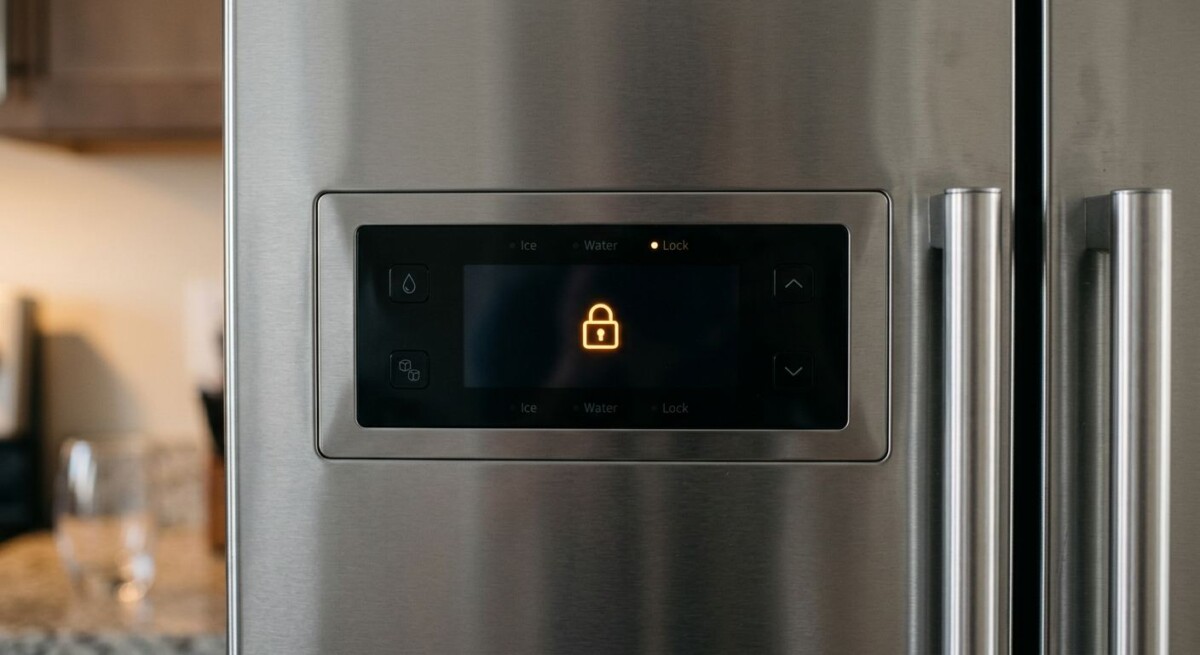
On Whirlpool and Maytag refrigerators, hold the Lock or Control Lock button for three seconds. Samsung and LG models vary by year; your owner’s manual has the exact sequence for your display. GE and Frigidaire owners should look for the padlock icon and check the model manual. This step costs nothing.
Refrigerator water dispenser not working after replacing filter may also reflect a bumped lock panel during the swap.
In a significant portion of the dispenser calls I take, the first thing I check is the lock button. The homeowner feels a little sheepish, but they have saved themselves a service call.
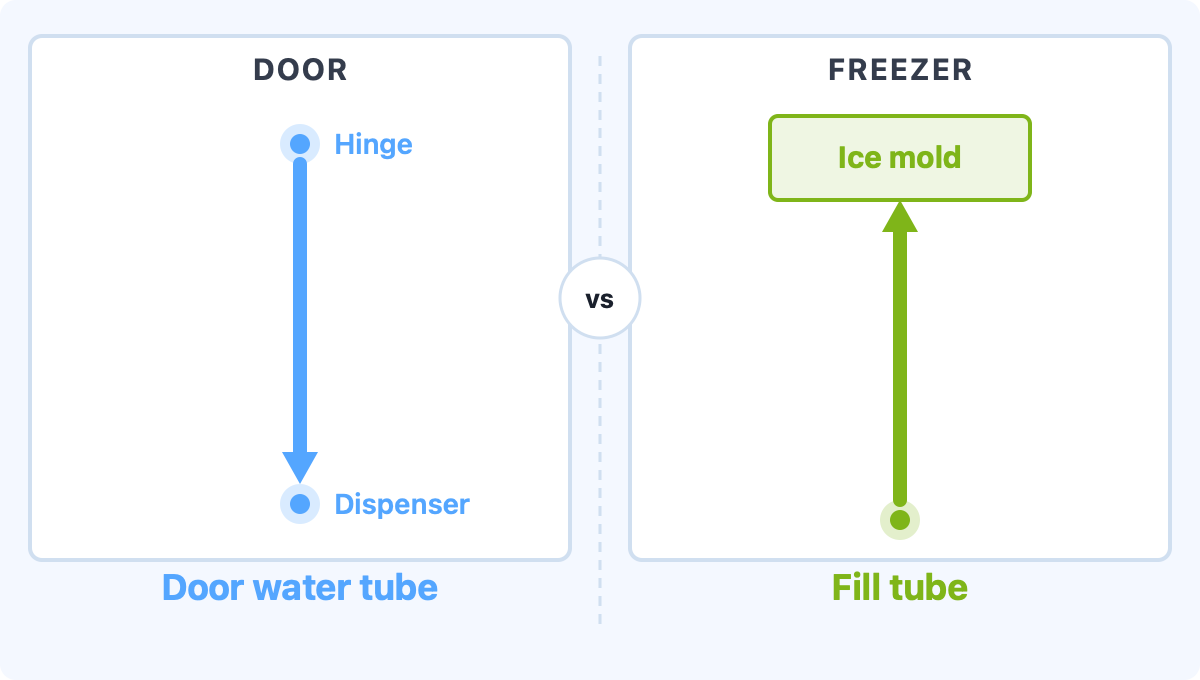
The door water tube runs from the hinge fitting at the base of the door, through the door liner, and out to the dispenser nozzle. The fill tube is a separate component inside the freezer that feeds the ice mold.
A frozen fill tube stops the ice maker. A frozen door water tube stops the dispenser only. The two failures are separate.
Fridge not dispensing water while the ice maker keeps making ice is the hallmark of this fault. A frozen water line in refrigerator door liners almost always means the door water tube has iced over, not the supply line behind the fridge. That is exactly why water not coming out of fridge dispenser with the ice maker still running points here.
If your ice maker has also stopped, see our guides on Frigidaire ice maker not working and Whirlpool ice maker not working for the fill tube procedure.
Disconnect the water tube at the hinge fitting and blow air through it. If air does not pass freely, the door water tube is frozen. Warm the freezer above freezing for 24 hours, then reset the freezer temperature to 0 degrees F and retest the dispenser.
Recurring freezes point to a door gasket letting warm, moist air into the door cavity. Our refrigerator water line installation page covers the supply shut-off valve check, and our ice maker repair service handles the freezer side when the fault recurs.
Press the dispenser paddle and listen. Water not coming out of my fridge sounds like silence, but that silence carries the diagnosis.
A click when you push confirms the dispenser actuator reached the micro switch. A hum right after confirms the solenoid energized. Those two sounds map the electrical path in under three seconds.
Click and hum together mean the switch and solenoid are functioning; if water still does not flow, the fault is a frozen door tube or board failure. Click without a hum means the solenoid did not energize: dispenser solenoid or control board. No click at all means the actuator never reached the switch; inspect the paddle pivot first.
Unplug the refrigerator. Remove the dispenser grille panel to reach the micro switch behind the actuator. Set your multimeter to continuity mode, depress the actuator, and test.
A pass means the switch is working; a fail means the contacts are worn. The actuator lever can crack on older French door models from Whirlpool and Maytag; a visual inspection often catches a broken pivot arm before you need the multimeter.
A click but no hum points to the dispenser solenoid. On many refrigerators the ice maker and dispenser share one water inlet valve. That valve carries a separate coil for each path. One coil can quit while the other keeps running.
Refrigerator water dispenser not working but ice maker is still producing ice is the clearest symptom of a dispenser solenoid fault.
The dispenser solenoid sits inside the inlet valve body at the bottom rear of the refrigerator. Unplug first. Locate the dispenser solenoid terminals on the valve and run a solenoid continuity test; no continuity means the coil has failed.
Dual-solenoid inlet valves are sold expressly for refrigerators that feed both a dispenser and an ice maker. Refrigerator dispenser not working but ice maker is fine points to that dispenser coil, not the valve body.
Our insured Denver Metro technicians diagnose and replace inlet valve coils, actuator switches, and dispenser control boards. We source parts through national supplier networks and manufacturer contracts.
Refrigerator repair service in Denver Metro
Paddle clicks, solenoid hums, refrigerator not dispensing water: the fault lies in the dispenser control board. The switch tests good; the solenoid tests good; yet nothing flows. The board is the path.
The control board energizes the dispenser solenoid by converting the switch signal into the voltage the solenoid needs. When it fails, the signal never reaches the valve.
Board replacement requires specialized diagnostic tools to confirm before committing to the part; this is a pro call on Samsung, LG, Sub-Zero, and every other major brand. Do not guess on the board.
When the dispenser and the ice maker stop at the same time, the water inlet valve body has likely failed. That one valve supplies both systems; when the inlet screen clogs or the main port closes, neither coil can deliver water. When the water dispenser stopped working at the same moment the ice did, the valve body is the signal.
Inlet valve replacement is always a pro call. Our Whirlpool ice maker not working and Frigidaire ice maker not working guides cover the full inlet valve replacement procedure.
Causes three through six on this guide require a technician. The dispenser solenoid and the dispenser control board both demand bottom-rear access, a multimeter, and component replacement. Our EPA-608 certified technicians handle the electrical path from the control board to the solenoid and carry a labor warranty on every repair.
We serve homeowners in Denver, Aurora, Lakewood, Littleton, and Boulder across the Denver Metro Area. For a broader fault picture, our how to fix a refrigerator guide walks the full diagnostic tree. Cooling symptoms alongside a dispenser fault belong in our refrigerator not cooling hub.
Why is my refrigerator dispensing water slowly?
A refrigerator water dispenser that flows slowly most often has a clogged or aged filter restricting flow. Replace the filter if it has been more than six months since the last change. A partially closed water supply valve behind the refrigerator also reduces pressure to the dispenser, and a failing dispenser solenoid can reduce flow to a trickle without stopping it completely.
How do I reset my refrigerator water dispenser?
Most dispensers have no hardware reset button. What homeowners call a reset is almost always disabling the control lock. On Whirlpool and Maytag models, hold the Lock button for three seconds until the indicator turns off. Samsung, LG, GE, and Frigidaire models vary by year; check your owner’s manual for the exact combination.
Why is my fridge water dispenser not working but the ice maker is?
On many refrigerators the ice maker and the dispenser share one water inlet valve, and that valve carries a separate coil for each path. When the dispenser coil fails, the ice maker coil continues working normally. A frozen door water tube inside the door liner can also stop water at the nozzle while leaving the ice maker supply unaffected.
How do I fix a frozen water line in my refrigerator door?
Disconnect the water tube at the hinge fitting, then blow air through it. If air does not pass freely, the door water tube is frozen. Warm the freezer compartment above freezing for 24 hours to clear the ice. Afterward, set the freezer temperature to 0 degrees F to prevent the tube from freezing again.
Why did my refrigerator water dispenser suddenly stop working?
The most common reason a refrigerator water dispenser stopped working suddenly is that the control lock was activated, often during cleaning or by a child pressing the panel. Look for a padlock icon on the display. If no lock indicator is visible, a failed micro switch in the dispenser paddle assembly is the next most likely cause of an abrupt stop.
Is a refrigerator water dispenser worth repairing?
That depends on the fault. If the control lock was the cause the fix is free, and a frozen door water tube or a failed actuator switch costs little in parts. A dispenser control board or inlet valve replacement is a larger investment; the appliance’s age and remaining value should guide that decision. Our technicians diagnose the fault before you commit to anything.
Our Denver Metro technicians diagnose refrigerator water dispensers and replace failed components. Insured, with a labor warranty on every repair.
Found This Helpful?
It is a week before Thanksgiving, and you set the oven to 350 degrees before starting the stuffing. Forty minutes later, the preheat signal fires. That is roug…
You opened the KitchenAid freezer this morning and the bin was empty. In my experience, the arm is the first thing worth checking: the fix costs nothing and ta…
You open the dishwasher after the cycle and the plates look exactly as you loaded them: dry, cold, with last night's dinner still caked on. Your dishwasher is…
A washer that shakes violently during spin traces to one of seven causes, from a bunched load to a failed drum bearing. Here is the order to check them, and th…
A gas smell during oven preheating is normal for about 90 seconds. Here is how Denver technicians tell routine startup odor from a real gas leak…

A Frigidaire refrigerator not cooling is not always a broken refrigerator. The display on the door settles that question in about ten seconds…
Welcome to the community.
You'll receive our next expert update soon.

Wilson & Myers is a verified member of the Denver Metro Chamber of Commerce.


