

Need a Professional Hand?
If a DIY fix isn't enough, our insured technicians are just a click away. We’ll diagnose the issue and get your home running right again.
BOOK NOWMost gas oven failures come down to one part: the hot surface igniter. When a gas oven won't light, that igniter has usually lost enough amp-draw strength to open the gas safety valve. Check the circuit breaker and gas shutoff valve position first. If your oven lights but won't reach temperature, that is a separate problem; see our oven not heating up guide.
If your oven is lighting but you notice a gas smell during or after startup, that is a different situation. The diagnostic path for an oven that lights slowly with a smell is at gas oven smells like gas when preheating.
Set the oven to 350 degrees. Watch through the door crack for 60 seconds. What you see in that minute tells you almost everything.
In most gas oven not lighting situations, the glow and the gas valve operate as two separate systems. An orange glow can look convincing. The safety valve stays completely closed until the igniter draws sufficient current. That gap is what makes this diagnosis click.
| What You See or Hear | Most Likely Cause | DIY or Pro? |
|---|---|---|
| No glow, no display, nothing | Tripped circuit breaker | DIY (reset breaker) |
| Igniter glows orange, no flame | Weakening hot surface igniter | DIY-ish (igniter replacement) |
| Igniter glows white-hot, still no flame | Failed gas safety valve | Pro recommended |
| Clicking from oven cavity, no flame | Dirty spark electrode | DIY (clean electrode) |
| No glow, display works fine | Oven control board relay | Pro call |
| Burners light, oven is dead | Bake igniter or oven safety valve | DIY-ish to Pro |
| Pilot light won’t stay lit | Faulty thermocouple (older oven) | DIY-ish to Pro |
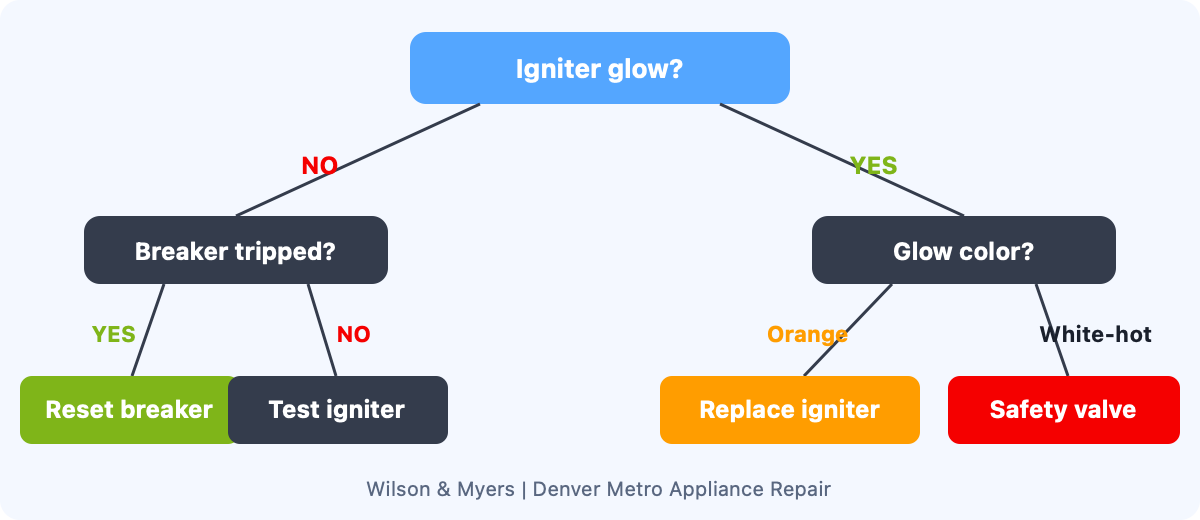
A tripped circuit breaker kills the 120V AC the igniter needs to glow, so the oven produces no flame even when the gas supply is live and flowing. Open your electrical panel and look for a breaker in the middle position between ON and OFF. Reset it fully to OFF, then back to ON.
Gas ovens require electricity. Many homeowners assume a gas appliance runs on gas alone. If the oven display comes back after the reset, run one bake cycle to confirm the breaker holds. A breaker that trips again during operation signals a wiring issue and warrants a service call.
Turn on a surface burner. If the stovetop burners light normally, your main gas supply is flowing and the problem is isolated to the oven’s ignition circuit. If no burners light and the furnace or water heater is also dead, call your gas utility before doing anything else.
The gas shutoff valve handle behind or below the range has one rule: parallel to the pipe means open, perpendicular means closed. On a propane oven, check the tank level and the propane shutoff valve before going further. A propane oven won’t light when the tank runs dry, and the symptom looks identical to an igniter failure.
The hot surface igniter does two jobs simultaneously, and that dual role explains why a glowing igniter can still leave you without a flame. When you set a temperature, the oven control board sends 120V AC to the igniter, heating it to between 1,800 and 2,500 degrees Fahrenheit.
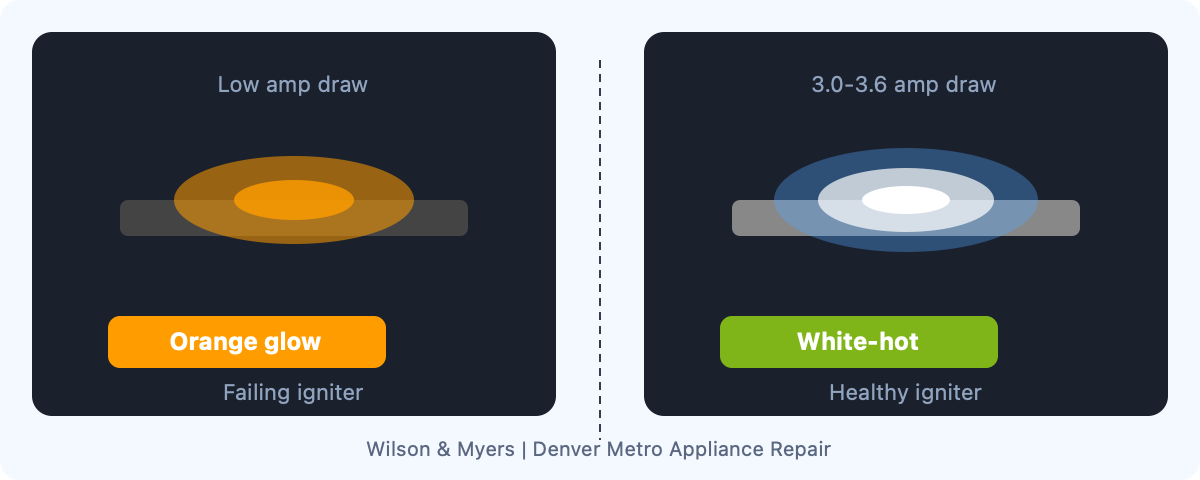
At full operating temperature, a functional bake igniter draws 3.0 to 3.6 amps of current. The gas safety valve contains a bimetal sensor. When the igniter’s amp draw crosses that valve’s threshold, the bimetal warps, the valve opens, and gas flows to the burner. Weaken the igniter and the gas never flows.
The glow looks convincing. The valve stays shut.
“When the igniter glows orange but the oven never lights, the glow is real. The igniter is just not drawing enough current to open the safety valve. The gas stays off on purpose.”
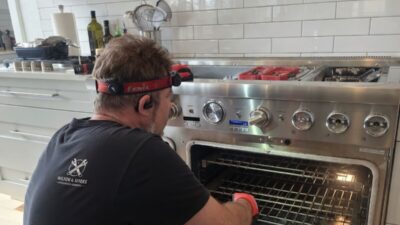
Joe Myers, W&M HotSide Appliances Tech
Watch through the door crack during warm-up. A healthy igniter brightens from orange to a sharp white-hot glow within 30 to 90 seconds, then gas ignites with a soft whomp. An orange glow that stays orange through that 60-second watch, never brightening, never producing a flame, is a weakening igniter pulling too little current to open the safety valve. That is the visual signature for most gas oven won’t ignite calls.
No glow at all is a separate branch. A completely dark igniter means either the element has broken open-circuit, or the control board is not sending voltage. A multimeter test separates them.
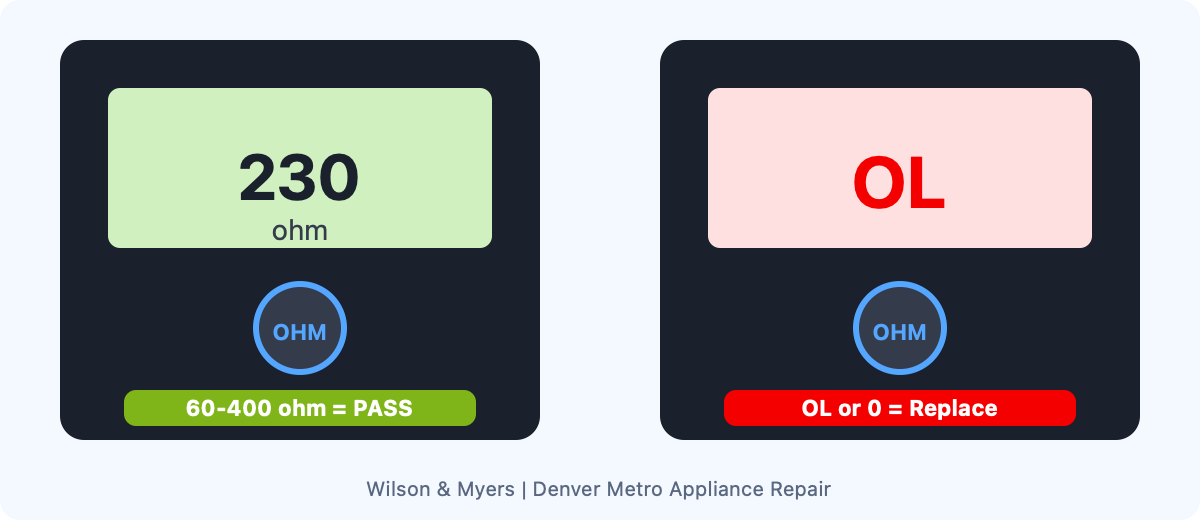
A multimeter confirms gas oven igniter not working. Disconnect power and shut off the gas supply valve before this test. Pull the oven floor panel to access the igniter, disconnect the wiring harness, and set your multimeter to the ohms setting. A resistance reading of 60 to 400 ohms on the igniter terminals is the functional range.
OL or infinite resistance means the element is broken open-circuit; zero ohms means a short circuit. Both results mean replace the igniter.
A reading within range paired with an orange-only glow means the igniter element is intact but the amp draw is too low. Confirm below 3.0 amps with a clamp meter and replace. Note that ohm resistance alone does not verify the amp draw; it only confirms the element is not broken.
Most gas range ovens have two separate igniters. The bake igniter serves the bottom bake burner; the broil igniter serves the top broil burner. They are not interchangeable in most models.
If only the bake function is dead but the broil works, the bake igniter is your target. That matters before ordering parts.
For Frigidaire gas range owners, the glow bar is the dominant igniter type across most model lines. Whirlpool gas ovens commonly use a square flat-style HSI. GE and GE Monogram ranges follow their own part specifications. Our Frigidaire service, Whirlpool service, GE service, and GE Monogram service pages cover brand-specific repair options.
Our techs see a weakened bake igniter on roughly 7 out of 10 gas oven not lighting calls across Denver Metro Area. It fails first on most brands. The lifespan shortens when the oven’s self-clean cycle runs frequently, because the extreme heat stresses the ceramic element over time.
The valve opens only when the igniter draws enough current to warp the bimetal sensor inside it. This is a thermal-safety interlock, not a separate electrical switch. Confirmed white-hot glow with adequate amp draw and still no flame means the safety valve itself has failed mechanically. Gas stays off.
Never replace the gas valve before confirming the igniter amp draw is adequate. Replacing the valve when the real problem is an underpowered igniter wastes time and money. The igniter is cheaper and far more commonly the cause.
Set a multimeter to the RX1 setting and probe the gas valve terminals with power and gas disconnected. A reading of 0 to 50 ohms indicates a functional valve. Outside that range, the valve has failed and needs replacement.
Safety valve replacement involves disconnecting a gas line fitting. If you detect any gas odor during that process, stop, ventilate, and call a pro. Our insured technicians handle gas valve work across Denver Metro Area as a standard gas oven repair call.
No power means no ignition. A gas oven won’t turn on at all with a tripped breaker: no display, no clock, no igniter glow. Reset it per the check above. If the oven comes back fully, run one bake cycle to confirm it holds.
Surge events and power outages are common triggers for tripped oven breakers in Denver Metro Area, particularly after summer thunderstorms. A breaker that trips again signals an underlying wiring issue, which warrants a service call, not another reset.
Gas oven not lighting but clicking is a distinct symptom branch from the silent-igniter failure in Cause 1. The gas oven not lighting diagnosis splits here: silent failure and clicking failure call for different steps. Clicking from inside the oven cavity during a bake cycle means the oven uses a spark electrode for ignition. Gas stove clicking but not lighting refers to surface burners, but the same mechanism applies to spark-ignition oven cavities.
Moisture, food debris, or grease on the spark electrode tip prevents a clean spark from reaching the gas. The electrode sits near the bake burner under the oven floor panel. Remove the panel, locate the ceramic spark electrode, and wipe the tip with a dry cloth. Clear debris from the ignition port as well.
Most spark electrode issues on this oven type are resolved by cleaning, not replacement. If the tip is cracked or visibly damaged, replacement is a straightforward part swap.
Older Denver Metro Area homes with original appliances sometimes still run standing pilot gas ranges, those roughly 35 years old or older. Check under the oven floor panel near the bake burner assembly. A tiny continuous flame or a small pilot opening confirms a standing pilot oven.
Modern ovens, anything manufactured after about 1990, use an electronic hot surface igniter instead. The thermocouple holds the main gas valve open as long as the pilot flame is present.
Hold a long match or lighter to the pilot opening. Slowly introduce gas by turning the oven control to the PILOT position, or by pressing the burner knob in slightly on older designs. Once the pilot catches, hold the knob for 30 to 60 seconds to let the thermocouple heat up before releasing.
If the pilot lights but goes out when you release the knob, the thermocouple is failing and needs replacement. That repair is manageable on accessible designs but can require disassembly of the burner assembly on older models, which is better handled by an insured technician.
The oven control board sends 120V AC to the hot surface igniter every time you set a temperature. When the board’s relay fails, the igniter receives no power and produces no glow. The display works, but the igniter stays dark.
How does this differ from a broken igniter? Test it with a multimeter: a reading within 60 to 400 ohms confirms the element is intact. Signal is just not reaching it. Control board diagnosis is always a pro call; live-circuit voltage testing at the igniter terminals while powered is not a homeowner task.
Working surface burners confirm the main gas supply is flowing. Gas oven not lighting but burners are working isolates the fault to the oven circuit.
The oven bake burner has a separate gas safety valve from the surface burner valves. Surface burners use individual knob-controlled valves with no electronic interlock. The oven bake burner requires the bake igniter to draw sufficient amperage before its safety valve opens.
Start with the visual test: watch the bake igniter glow. Orange means the bake igniter is weakening. No glow means check the breaker, then test the igniter with a multimeter. White glow with no flame points to the safety valve.
For freestanding gas ranges, our stove and cooktop service covers the full range. For built-in installations, our wall oven repair service handles the oven circuit separately from the cooktop.
Some fixes are obvious. Checking the circuit breaker is always DIY. Confirming the gas shutoff valve position is always DIY. Cleaning a spark electrode takes five minutes and requires no tools.
Igniter replacement on most freestanding gas ranges involves removing the oven floor panel, disconnecting a two-wire harness, swapping the igniter, and reconnecting. Shut off both the wall outlet power and the gas supply valve before starting. A handy homeowner can complete this on most Frigidaire, Whirlpool, and GE models in under an hour.
The pro threshold shifts when the gas safety valve is involved. Valve replacement requires disconnecting a threaded gas line fitting inside the range body. Any gas odor during that process means stop immediately and ventilate.
Control board failure is always a pro call. Any gas smell situation is always a pro call before anything else. For every gas oven not lighting scenario, our insured technicians cover all six causes in a single diagnostic visit.
If your oven lights but fails to reach temperature, that is a different problem. See our guide to oven not heating up for the temperature-failure path, covering sensor drift, calibration, and element issues.
The most common reason a gas oven not lighting is a weakened or failed hot surface igniter. The igniter glows but cannot draw enough amperage to open the gas safety valve, so gas never flows. Check the circuit breaker and confirm the gas shutoff valve is fully open first. Those two steps eliminate a significant slice of calls before any parts work begins.
Gas oven not heating up can mean either the oven never ignites at all, or it ignites but fails to reach temperature. If no flame appears, the cause is an igniter or safety valve failure, covered above. If the oven lights but runs cold, see our guide to oven not heating up for the temperature-failure path, which covers sensor drift, calibration, and element issues.
Clicking from the surface burner area is the surface burner igniter, unrelated to the oven cavity. If that is your symptom, our guide to a gas stove clicking but not lighting covers the surface-burner repair path. Clicking from inside the oven cavity itself means the oven uses spark ignition rather than a hot surface igniter. Check the spark electrode for moisture or debris and clean it with a dry cloth. If the ignition port is blocked, clear it and test again before replacing the electrode.
Older gas ovens, those manufactured before about 1990, used a standing pilot light: a small always-burning flame that ignited the bake burner on demand. The pilot used a thermocouple as a safety sensor. Modern gas ovens use an electronic hot surface igniter instead. If your oven is newer than roughly 35 years, it uses a glow bar, not a pilot light.
An orange glow without a flame means the igniter is drawing too little current to open the gas safety valve. This is the classic gas oven not lighting but glow-present pattern. A healthy igniter brightens to white-hot and triggers the valve at 3.0 to 3.6 amps. An orange-only glow means the igniter is weakening and needs replacement.
Gas stays off by design, not because of a supply issue. The burners do not share this ignition circuit, which is why they can work fine while the oven fails.
A gas range oven igniter typically lasts five to ten years, depending on how frequently the oven is used and whether the self-clean cycle runs regularly. Self-clean cycles expose the igniter to extreme temperatures that accelerate ceramic element degradation. Ovens used daily will often need an igniter replacement closer to the five-year end of that range.
Working surface burners confirm the main gas supply is flowing. Start with the bake igniter visual test: watch whether it glows orange, white-hot, or not at all. Orange means the bake igniter is failing. No glow means check the breaker and test the igniter with a multimeter.
White glow with no flame points to the oven safety valve as the failed component. The burners do operate on separate valves with no electronic interlock, which is why they light independently of the oven.
Wilson & Myers provides gas oven repair and oven repair service across Denver Metro Area, including Denver, Boulder, Lakewood, Aurora, Littleton, Englewood, Sheridan, Wheat Ridge, Edgewater, Golden, Arvada, Westminster, Thornton, Northglenn, Commerce City, Brighton, Broomfield, Superior, Louisville, Lafayette, Longmont, Erie, Centennial, Greenwood Village, Cherry Hills Village, Glendale, Parker, Castle Rock, Highlands Ranch, Lone Tree, and Morrison. Book online to confirm availability in your area.
If the igniter stayed orange through that 60-second watch, or never glowed at all, it is time for a hands-on diagnosis. Our insured technicians serve the full Denver Metro Area.
Found This Helpful?
A gas smell during oven preheating is normal for about 90 seconds. Here is how Denver technicians tell routine startup odor from a real gas leak…
A gas stove clicking but not lighting follows one of three failure patterns. Each one has a different fix. Knowing which one applies tells you whether this is…
The display is dark. Every button gets no response. Dinner is planned and the oven won't turn on. Why won't my oven turn on? Before you call anyone, know this:…
Your oven isn't heating because one of seven components failed: bake element, igniter, thermal fuse, temperature sensor, control board, gas safety valve, or a…
A Wolf oven not heating up is one of the more stressful appliance failures a homeowner can face. The unit is expensive, integrated into your kitchen, and not s…
Welcome to the community.
You'll receive our next expert update soon.

Wilson & Myers is a verified member of the Denver Metro Chamber of Commerce.