

Need a Professional Hand?
If a DIY fix isn't enough, our insured technicians are just a click away. We’ll diagnose the issue and get your home running right again.
BOOK NOWA GE dishwasher not draining usually shows FTD or F56, and the pump is rarely the first cause. GE's own troubleshooting sequence starts with the Ultra Fine filter and the sump, working toward components only when the basic checks fail. This guide walks GE's diagnostic steps in order and explains what each error code actually points to.
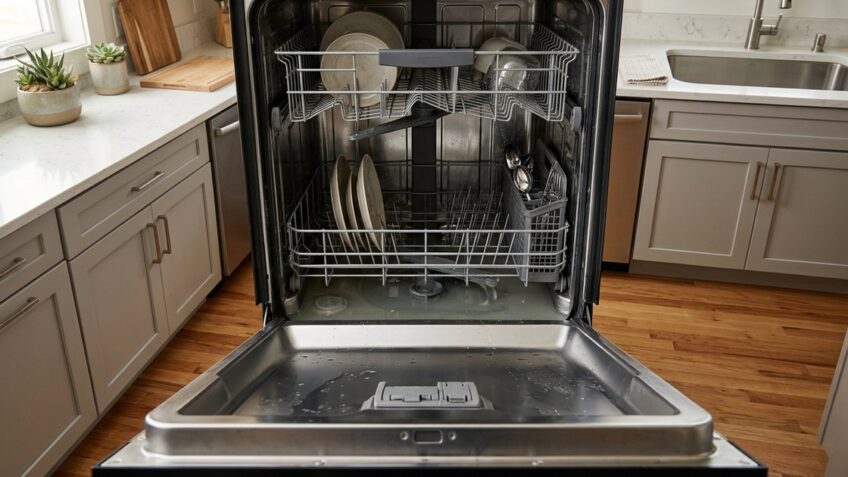
GE dishwasher standing water is normal up to a point. Clean, minimal water in the rear sump is not a drain failure, and the threshold depends on whether your model has the Ultra Fine filter. The filter type decides it.
On Ultra Fine filter models, sump water is normal. GE requires only that it not cover the bottom of the tub. GE calls this the Ultra Fine water test: open the door after the cycle and look at the rear sump.
Ultra Fine filter water that does not cover the tub floor is working as designed. GE dishwasher water in bottom after cycle at this level is not a problem.
On Ultra Fine filter models, we see this misread often: the homeowner calls because the sump holds water, but the dishwasher drained fine. If the water level is below the floor of the tub, the machine is doing its job. Nothing needs attention.
GE Profile and GE Cafe models typically include the Ultra Fine filter. Base GDF models often do not.
GE sets a clear threshold. Up to two cups of clean water on the tub floor is normal for models without the Ultra Fine filter. Base GE models in the GDF series often fall into this category. When the water is dirty, sudsy, or visibly more than two cups, the drain path has a problem.
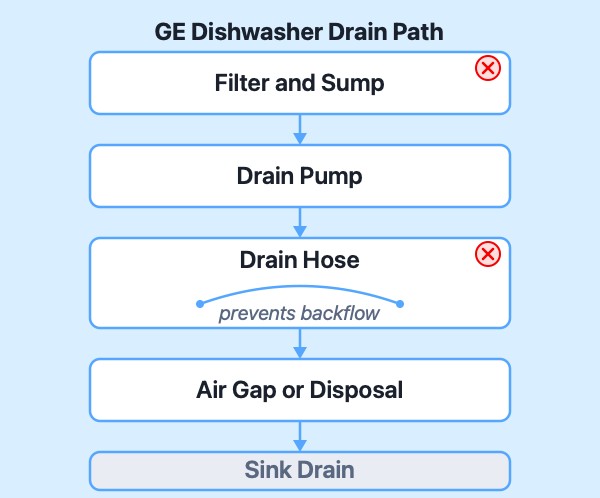
The GE dishwasher FTD error code stands for failure to drain; on some models GE instead shows the GE dishwasher F56 error code. Both codes mean the same thing. Both fire whenever the dishwasher cannot complete a drain cycle. That can happen at the filter, the hose, the air gap, or in rarer cases, the drain pump.
The C-code set covers the same range of causes in a different display format.
FTD and F56 both fire on GE Profile, GE Cafe, and GE Monogram models with a digital display. FTD and F56 mean exactly the same thing; GE uses both names across different model generations. Neither tells you which part caused the fault. That is what GE’s diagnostic sequence in the next section resolves.
C3 is a third display form: the dishwasher will not drain at all. For C3, turn off the dishwasher at the circuit breaker, wait 30 seconds, restore power, and reset the control. Pressing Start/Reset twice resets the control and lets the 90-second drain cycle run to completion. If C3 returns after the power cycle, the fault goes deeper than a control reset and GE’s full drain diagnostic applies.
The C1 pump overtime code means the drain pump ran for over two minutes without clearing the water. This usually means the hose or air gap is restricting flow, not that the pump is failing. C2 fires when the pump has been running more than seven minutes without emptying the tub; pressing Start/Reset stops the beep and resets the cycle. A stuck flood float, a clogged sump, or a machine that filled twice during a power outage triggers C4.
C5 points to a water supply issue, not the drain itself. A GE dishwasher not draining and beeping will display one of these codes on the panel.
| Code | GE Meaning | First Check |
|---|---|---|
| FTD | Failure to drain | Clean filter and sump; check drain hose and air gap |
| F56 | Failure to drain (same as FTD) | Same checks as FTD |
| C1 | Pump ran over 2 minutes | Clean air gap; check drain hose position |
| C2 | Pump out exceeds 7 minutes | Press Start/Reset to stop beeping and reset the cycle |
| C3 | Will not drain | Turn off at the breaker for 30 seconds, restore power |
| C4 | Machine filled twice after power outage; float stuck or sump clogged | After outage: turn off at breaker 30 sec. No outage: tap float cover; check sump |
| C5 | Pump out time too short | Confirm water supply is on; tap float cover |
When a GE shows FTD, the Ultra Fine filter is the first place to look, and it is usually where the problem is.
GE’s official drain diagnostic runs eight steps. The simplest checks come first; plumbing checks come last. Steps one and two clear the most common causes without touching a single component. If you need to know how to fix GE dishwasher not draining, start here before touching any component.
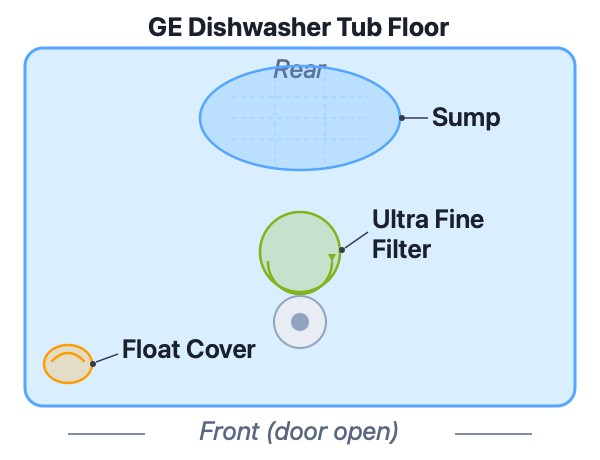
GE dishwasher filter cleaning is step one. Turn the Ultra Fine filter counterclockwise and lift the two-piece sump assembly out of the tub bottom. Rinse under warm running water and check for fine food particles, noodles, or lettuce. Rinse both pieces.
The sump at the rear can trap pasta, bones, and paper. GE says it looks like an upside-down silverware basket. Clear any debris before reinstalling.
If the dishwasher still shows FTD or F56 after a clean filter and sump, the drain path check continues. Our guide to dishwashers not draining carries the full filter walkthrough along with the air gap, check valve, and disposal steps that apply to any brand.
GE recommends the white corrugated hose supplied with new dishwashers. A reused hose often kinks inside without looking blocked. Aftermarket hoses have the same problem. Check the hose runs from the dishwasher to the disposal or drain tailpiece without tight bends.
Without an air gap, the drain hose needs a high loop. Secure it to the underside of the counter at its highest point. This prevents contaminated sink wastewater from siphoning back into the tub.
The disposal and air gap follow the same steps as any dishwasher. For a new disposal, also confirm the knockout plug is out before the dishwasher can drain to it. See our dishwasher drain guide for both steps.
Too much detergent, or the wrong type, also stops drainage. Detergent over-sudsing produces foam that blocks the drain path and can trigger FTD even when the filter is spotless. GE names this explicitly in their troubleshooting sequence.
If the GE dishwasher won’t drain after all these checks, the flood float and pump section below covers what comes next.
If you have worked through the filter, sump, and hose checks and the code persists, our Denver Metro team can run a full drain diagnostic. Book online and we will schedule service around your week.
On a GE dishwasher, the wash pump circulates water through the spray arms while the drain pump clears the tub when the cycle ends. When a GE dishwasher is not draining, the drain pump is the suspect, not the wash pump. That distinction also changes how you read the sounds from under the door.
The C4 code has two distinct triggers. If C4 appeared after a power outage, the machine filled twice. Turn off the dishwasher at the circuit breaker for 30 seconds and restore power. No float tap needed in that case.
If there was no outage, C4 points to a stuck flood float or clogged sump. GE’s float cover looks like a small upside-down cup. It sits front-left on the tub floor. Tap this cover firmly before concluding the pump has failed.
If C4 clears and the dishwasher drains, the float was the cause; a persistent C4 or visible cover damage means the flood float assembly likely needs replacement. The GDF and GDT models have accessible tub floors; GE Monogram’s integrated panel takes more time.
Buzzing or rushing during the drain cycle is normal. Two other sounds signal trouble. Loud rattling or grinding means a hard object has lodged in the impeller, and fruit pits, olive seeds and glass shards are the most common culprits. Persistent high-pitched squealing or groaning may indicate that the pump motor bearings or wash pump assembly require replacement.
Rattling is the one to chase yourself. Turn off power, reach into the pump area to clear the pump impeller debris, and GE dishwasher drain pump not working problems at this level usually resolve without replacing any parts.
A squeal that survives every other check is the sign that pump motor work is needed. I see this pattern on GE dishwashers that have been draining slowly for several weeks before the code locks on. By that point the diagnostic sequence has reached the pump, and the work requires a service call.
The same drain path runs through a base GE, a Profile, a Cafe, and a Monogram, so GE’s diagnostic sequence applies to all four of them without model-specific drain steps.
The main difference is display type. GE Profile, GE Cafe, and Monogram models with digital displays show FTD or F56. Base GE models on the GDF series often show C-codes, or in older models, no code at all. The GDT series varies by production year.
Filter access varies across the lineup. Profile and Cafe models commonly include the Ultra Fine filter. Older GDF models often do not. If you see the two-piece twist-out assembly at the rear of the sump, your model has the Ultra Fine filter.
For a GE Profile dishwasher not draining after cycle, the diagnostic is the same eight-step sequence above.
GE Monogram (ZDT series) uses the same drain components, though the panel-ready integration adds time to kickplate access; the diagnostic sequence is identical. GE Cafe dishwasher standing water in bottom follows the same Ultra Fine water test as Profile. For GE Cafe dishwasher not draining, run the same eight-step sequence described above.
For a full service profile on each sub-brand: GE Profile, GE Monogram, and GE appliance repair pages on our site cover each line.
Call our team when the filter is clean, the hose and air gap are clear, and the code returns after every cycle. A motor that hums without moving water needs a service call. So does a motor that is completely silent.
Flood float replacement and pump impeller work involve reaching into the sump with the power off. An insured technician is the safer path if you are not comfortable with that.
We service GE dishwashers across the Denver Metro Area, including Denver, Thornton, Lakewood, Aurora, and Westminster. For GE-specific expertise, our GE dishwasher repair page covers what we diagnose and what that work involves. Our dishwasher repair service covers GE and every other brand we work on across the region. When GE’s diagnostic sequence is exhausted and FTD persists, a service call confirms whether the fault is the pump motor, the control board, or a stubborn obstruction.
Why is my GE dishwasher not draining?
Most GE drain failures start with the filter and sump assembly. Remove and clean the Fine and Ultra Fine filters, then check for debris in the sump at the rear of the tub. If the filters are clean, check the drain hose for kinks, confirm the garbage disposal is running before the cycle starts, and clean the air gap if one is installed.
What does FTD mean on a GE dishwasher?
FTD stands for failure to drain. GE also shows this as F56 on some models; both codes mean the same thing. The code fires whenever the dishwasher cannot complete a drain cycle, which can happen because of a clogged filter, a kinked hose, or in rarer cases, a pump fault.
Is water in the bottom of a GE dishwasher normal?
It depends on the filter type. On models with an Ultra Fine filter, some water in the sump is normal, but it should not cover the bottom of the tub. On models without an Ultra Fine filter, one to two cups of clean water covering the bottom is normal. More than that, or dirty water, points to a drain problem.
How do I reset my GE dishwasher drain?
Press the Start/Reset pad twice to reset the control and allow the 90-second drain cycle to finish. If the dishwasher shows C3, turn it off at the circuit breaker for about 30 seconds, then restore power. If FTD or F56 persists after the reset, start GE’s diagnostic sequence at the filter.
Why does my GE dishwasher keep showing FTD after I clean the filter?
A clean filter that still triggers FTD usually points to the drain hose, the air gap, or the garbage disposal. Check the hose for kinks, clean the air gap if installed, and run the disposal before the cycle. If the disposal is new, confirm the knockout plug inside has been removed. A pump fault is possible if none of these clears the code.
When should I call a technician for a GE dishwasher not draining?
Call a technician when the filter is clean, the hose and air gap are clear, and the code persists. A pump motor that hums but does not move water, or a motor that is completely silent, usually requires a service call. We cover GE dishwasher repair across the Denver Metro Area, including Denver, Thornton, Lakewood, Aurora, and Westminster.
What does C3 mean on a GE dishwasher?
C3 means the dishwasher will not drain. GE’s recommended step is to turn off power at the circuit breaker for about 30 seconds, then restore power and reset the dishwasher. If C3 returns after the power cycle, the fault is deeper than a control glitch and GE’s full drain diagnostic steps apply.
Our insured technicians work GE drain faults in the order GE does, starting at the Ultra Fine filter and the sump before anything is taken apart. We source parts through national supplier networks and manufacturer contracts.
Found This Helpful?
When an LG freezer stops freezing, most homeowners assume the worst: a compressor failure. In practice, an LG refrigerator freezer not freezing usually traces…
A dishwasher not draining after a full cycle leaves standing water on the floor of the tub. If the machine filled and ran its wash program normally, that poole…
An LG dryer not heating traces to one of three systems depending on your model. Electric DLE and DLEX models use a resistance element and thermal fuse; gas DLG…
A Whirlpool oven not heating can mean a failed bake element, a weak gas igniter, or one sensor reading the cold circuit wrong. Before any part costs money, two…
Most cases of a Maytag dryer not heating split at the model prefix on the door: MGDC is gas, MEDC is electric, and the path diverges from there. On a Centennia…
You open the freezer Friday night and the GE side-by-side ice bin is empty, but the food is cold and the water dispenser works fine. Most GE refrigerator ice m…
Welcome to the community.
You'll receive our next expert update soon.

Wilson & Myers is a verified member of the Denver Metro Chamber of Commerce.


