


Need a Professional Hand?
If a DIY fix isn't enough, our insured technicians are just a click away. We’ll diagnose the issue and get your home running right again.
BOOK NOWA Whirlpool oven not heating can mean a failed bake element, a weak gas igniter, or one sensor reading the cold circuit wrong. Before any part costs money, two free checks clear the majority of calls: the circuit breaker and Demo Mode. This guide works through electric and gas models in the order a technician diagnoses them, then covers the fault codes your display may already be showing.
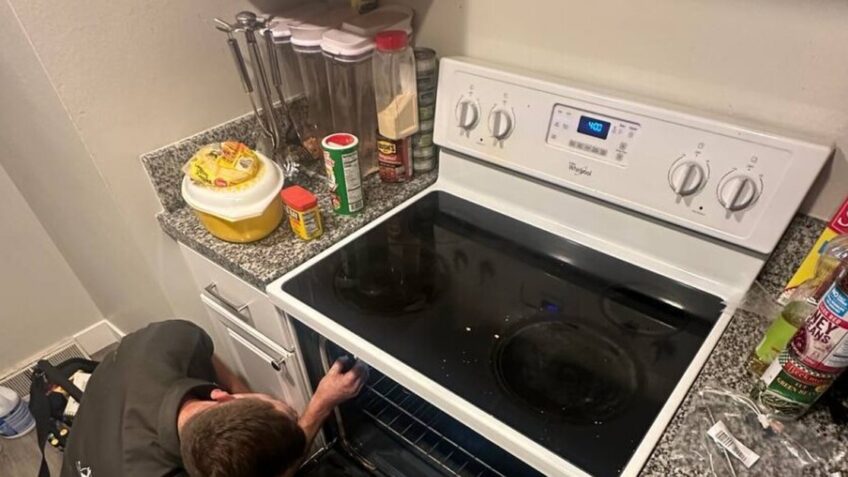
When a homeowner asks why is my Whirlpool oven not heating, the answer often costs nothing. Four free checks cover WOS, WFE, and WEE models, including a Whirlpool wall oven not heating. The circuit breaker, Demo Mode, a cleared clock, and an unreleased self-clean door lock together account for more no-heat calls than all component failures combined.
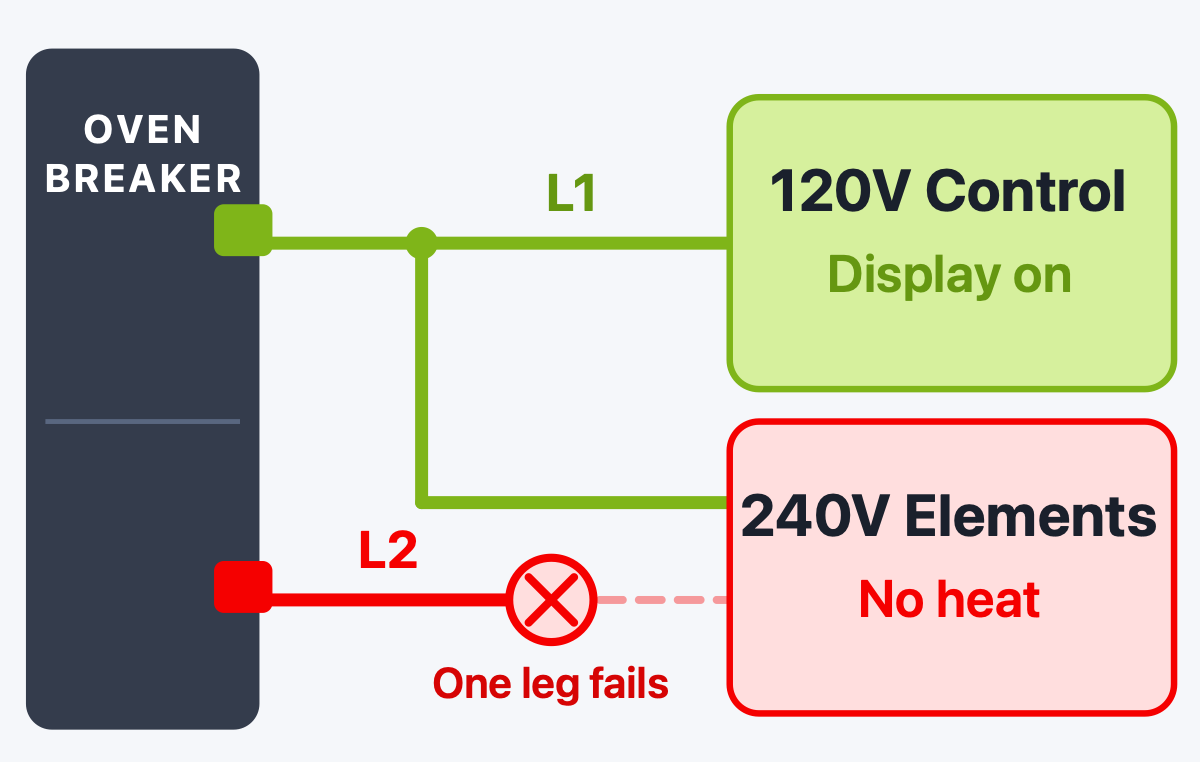
The 120-volt display circuit in Whirlpool wall ovens and ranges runs independently from the 240-volt element circuit. Both legs of a double-pole breaker feed the bake and broil elements. A lost breaker leg keeps the 120-volt display circuit alive while both elements go cold.
Both the clock and touchpad respond normally. The oven produces no heat at all.
Homeowners describe this as “the oven looks on but nothing heats.” It is the most counter-intuitive fault in the electric range category, and it is entirely free to fix.
Locate the double-pole breaker labeled OVEN or RANGE in your panel. A tripped leg can sit between ON and OFF visually, making it look fine. Move it fully to OFF, then fully back to ON before doing anything else.
If the oven still does not heat after a full breaker reset, the problem is inside the appliance. If the display was blank before you started, that is a different situation: our oven not turning on guide covers no-power diagnosis separately.
Always run the Demo Mode check first before testing any component. Whirlpool ranges and wall ovens ship with a showroom feature that accepts every button press and lights the display while cutting power to every heating element. A Whirlpool oven won’t heat at all in Demo Mode, and the control board produces no fault code to explain why.
Demo Mode can be activated by accident during cleaning or by a child pressing the control panel. The Demo Mode check first step differs across WFE slide-in ranges, WOS wall ovens, WEE single-door electric models, and WEG gas models. Check your model’s owner manual or visit producthelp.whirlpool.com with your model number for the correct exit procedure.
On many Whirlpool range and wall oven models, the appliance will not accept a preheat command until the clock is set. A power outage, even a brief flicker, resets the clock to 12:00 and holds the control in a waiting state.
The display works. The keypad responds. Nothing heats.
Set the clock first. If that restores the heat, you found a free fix. If the clock was never cleared, this check cost you ten seconds.
Traditional pyrolytic self-clean cycles lock the oven door at the start and release it only after the cavity cools below roughly 550F. If the oven stopped heating and you ran a self-clean in the past day or two, verify that the door lock motor has released fully. An oven with the lock engaged will not accept a bake command on most WOS and WFE models.
Do not force the door. The model’s owner manual covers the manual lock release procedure, which differs by generation. A Whirlpool oven not heating after self-clean that also shows the lock indicator is likely a lock-motor fault, not a heating-element fault. If all four free checks come back clean, the fault is inside the appliance.
On a Whirlpool electric oven not heating, the fault falls in four components nearly every time. Those components are the bake element, the temperature sensor, the thermal fuse, and the appliance control unit relay. Start with the element because it fails most visibly. Work through each in order; the appliance control unit comes last, diagnosed only after the other three test clean.
A healthy bake element measures roughly 20 to 50 ohms at room temperature. An open reading, meaning infinite resistance, confirms the element has burned through. The element sits at the bottom of the oven cavity on most WFE and WEE models. Whirlpool oven heating element not working is the most common component repair call we receive on electric ranges across the Denver Metro area.
Set the oven to Bake at 350F and watch through the door glass for five minutes. A good element glows red-hot. No glow points to a failed element or a blown thermal fuse. Do not interpret an unlit element as proof of failure until you account for the hidden bake tray.
Many WFE and WEE models use a hidden bake tray, a porcelain or aluminum floor panel that covers the element completely. On those models, the element cannot be seen glowing from outside even when the oven works perfectly. Whirlpool oven bake not working on a model with a hidden bake tray is often misdiagnosed at this stage. Remove the tray floor first to inspect the element directly before concluding it has failed.
Whirlpool oven temperature sensor failure expresses itself in one of two ways: F3E0 on the display means an open sensor circuit, and F3E1 means a shorted one. The sensor is a two-wire probe at the rear of the oven cavity.
A healthy sensor reads approximately 1,080 ohms at room temperature. Resistance rises about two ohms per degree Fahrenheit as the oven heats, reaching roughly 1,654 ohms at 350F. To test: disconnect power at the breaker, locate the sensor probe behind the rear cavity bracket, unplug the two-wire connector, and measure across the leads with an ohmmeter.
A reading far above 1,080, or no reading at all, confirms an F3E0 open sensor circuit. Anyone searching the Whirlpool oven F3E0 error is almost always looking at an open temperature sensor circuit; replacing the sensor resolves most F3E0 faults. If F3E0 returns after replacement, look for a break in the sensor wiring harness.
AccuBake temperature control relies entirely on this same sensor to hold cavity heat within a narrow band. A sensor that drifts without crossing the F3E0 threshold still causes a Whirlpool oven not reaching temperature consistently, producing undercooked food without any code on the display. In my experience, sensor drift is the most underdiagnosed cause of chronic under-baking on AccuBake-equipped WFE and WOS models.
The thermal fuse is a one-time safety device in the bake element circuit. When it blows, all heat stops. The clock still runs and controls remain responsive. The AquaLift thermal pattern differs from traditional self-clean failure in a critical way, and understanding the thermal fuse self-clean link helps you diagnose which component actually failed.
Traditional pyrolytic self-clean cycles raise the oven cavity to 800 to 900F. That extreme heat can overstress a fuse that was already weakening. AquaLift self-clean runs at approximately 190 to 200F, well below the temperature needed to trip a healthy fuse. A fuse that blows after an AquaLift cycle was almost certainly degrading before the cycle started.
AquaLift runs cool enough that a healthy thermal fuse survives it. When a fuse blows during that cycle, it was already failing before the cleaning started. Replace it, then test the temperature sensor before the next clean cycle.
The thermal fuse sits on the rear panel of the oven, behind a metal cover, requiring you to pull the oven from the cabinet. Test it with a continuity check after disconnecting power. A healthy fuse reads near zero ohms.
An open circuit confirms it has blown. Find the cause of the overheat before installing a replacement, or the new fuse will blow within the next high-heat cycle. We source parts through national supplier networks and manufacturer contracts.
The appliance control unit relays power to the bake and broil circuits on every Whirlpool electric model. A relay failure inside the board leaves the element with no power even when the element itself tests perfectly healthy. Board-level failures are real, but they are always the last item on the diagnostic list.
Control boards most often fail after a voltage surge or after a homeowner replaces a failed component without fixing the root cause first. Test the bake element, the temperature sensor, and the thermal fuse first. When all three pass but the oven still produces no heat, the appliance control unit relay is the likely answer. That diagnosis requires a technician.
On a Whirlpool gas oven not heating, the slow-glow igniter fails far more often than any other single component. The igniter must draw enough current to open the gas safety valve electromagnetically. If it glows dim orange and takes 90 seconds or longer to call a flame, the amperage draw is the number that matters, not the visual appearance.
A healthy slow-glow igniter on WEG and WFG gas ranges draws 3.2 to 3.6 amps while the oven calls for heat. The igniter amperage threshold is the defining test. An igniter drawing under roughly 3.2 amps may not open the gas safety valve reliably. One drawing under 3.0 amps will not open the valve at all.
Both igniters glow orange. Only the amperage draw separates a functional igniter from a failing one. The WEG gas model’s service documentation carries the exact specification; verify against it before concluding the igniter has failed.
The Whirlpool oven igniter not working symptom most often presents as an oven where the igniter glows for 60 to 90 seconds and the burner never lights. A healthy igniter brightens to orange-white within about 60 seconds. A dim orange glow that stays dim is almost always a weak igniter drawing below the critical threshold.
Resistance testing alone does not catch a weak igniter. The slow-glow igniter test requires a clamp ammeter on one igniter wire while the oven calls for heat. That is the definitive test. If the igniter tests within the healthy amperage range but the burner still will not light, the gas safety valve itself has likely failed.
The gas safety valve opens only when the igniter draws sufficient current. A valve that fails mechanically will not open even when the igniter tests healthy. Gas safety valve replacement requires working inside the gas circuit past the shutoff valve, which is licensed professional work in Colorado.
We diagnose the igniter on every Whirlpool gas oven not heating call. If that tests good, the valve is the next step. We handle it directly.
If you smell gas at any point during diagnosis, stop. Leave the building, leave the door open, and call the gas company from outside. Do not operate any switch or electronic device inside the home until the utility has cleared the area.
For ignition failures specifically, where the gas burner won’t light rather than won’t heat consistently, our gas oven not lighting guide covers the stovetop and broiler ignition circuits in detail.
When a Whirlpool oven won’t heat and an F-prefix code is already on the display, the code names the circuit at fault before you test anything. Whirlpool’s code set runs consistently across WFE, WOS, WEE, WEG, and WFG models. It differs from Frigidaire’s PCA codes (covered in our Frigidaire oven not heating guide) and from Wolf’s E-series (covered in our Wolf oven not heating guide). Some Whirlpool models display codes as E# F# rather than F#E#; the meaning is identical, just reversed order.
| Code | Meaning | First Step |
|---|---|---|
| F3E0 | Temperature sensor open circuit | Test sensor resistance at room temp (should read ~1,080 ohms); replace sensor if open |
| F3E1 | Temperature sensor shorted | Test sensor; a reading far below 550 ohms confirms a shorted sensor |
| F2E0 | Keypad or probe circuit shorted | Reseat the keypad connector; replace keypad or board if the code persists |
| F9E0 | Door lock failure or house wiring fault | Check house wiring at the junction box; electrician territory |
| F8E0 | Airflow restriction or cooling fan fault | Check oven venting; may indicate a failed cooling fan |
Chronic under-baking, or a Whirlpool oven not getting hot to the set point without any display code, is the AccuBake sensor drift scenario. The electric causes section above covers it.
For a broader look at no-heat causes across all brands, the oven not heating up pillar covers the universal seven-cause framework. If your oven heats but takes far longer than it should, see our oven slow to preheat guide. A Whirlpool oven not reaching temperature at all is different from one that eventually gets there.
The Maytag shared platform with Whirlpool means identical fault codes. F3E0, F3E1, F2E0, F9E0, and F8E0 read the same way on a Maytag range as on any WFE or WOS Whirlpool model. If you own a Maytag range or wall oven with the same no-heat symptom, the Maytag oven repair page is the right starting point for service scheduling.
Whether you own a WFE slide-in range or a WOS wall oven, a Whirlpool oven not getting hot after two or three free checks means a component needs attention. Four situations call for an insured technician rather than a DIY attempt. These include live 240-volt testing, gas circuit work past the shutoff valve, an F9E0 code pointing to house wiring, and a failed appliance control unit relay. Our team services Whirlpool ovens across the Denver Metro area, including wall oven repair on built-in WOS models.
We serve homeowners across the Denver Metro area. If your oven is in Denver, Lakewood, Aurora, or Arvada, book a diagnostic appointment online and our technician will work through the same sequence this article describes. We source parts through national supplier networks and manufacturer contracts.
Why is my Whirlpool oven not heating up?
A Whirlpool oven not heating up usually starts with a settings cause, not a failed part. Demo Mode or a cleared clock accounts for more calls than most homeowners expect. Check those first.
Once cleared, the most common failures on electric models are the bake element, the temperature sensor, and the thermal fuse. Gas models point to a weak slow-glow igniter first.
What does F3E0 mean on a Whirlpool oven?
F3E0 on a Whirlpool oven means the temperature sensor circuit is reading open. The sensor should measure approximately 1,080 ohms at room temperature. A reading far above that, or no reading at all, confirms a failed sensor or a break in the sensor wiring. Replacing the sensor resolves most F3E0 faults.
Why won't my Whirlpool oven heat after self-clean?
A Whirlpool oven not heating after self-clean usually means the thermal fuse has blown. Traditional high-temperature pyrolytic cycles can overstress the fuse directly. On AquaLift models, the steam cycle runs too cool to blow a healthy fuse, so a post-AquaLift failure means the fuse was already weakening. Find the root cause before installing a replacement.
How do I fix a Whirlpool gas oven that won't heat?
A Whirlpool gas oven not heating most often points to a weak slow-glow igniter. The igniter must draw 3.2 to 3.6 amps; below roughly 3.2 the valve may not open reliably, and below 3.0 it will not open at all. Replacing the igniter resolves most cases. Work past the shutoff valve requires a licensed professional in Colorado.
Can a Whirlpool oven stop heating because of a tripped breaker?
Yes. A Whirlpool oven uses a double-pole breaker to supply both legs of the 240-volt element circuit. A tripped breaker can lose one leg while the 120-volt display circuit stays intact, so the oven appears powered but produces no heat. Reset the breaker fully by moving it to off, then back to on.
What is AccuBake and does it affect oven temperature?
AccuBake is Whirlpool’s temperature management system, which relies on the oven temperature sensor to maintain consistent cavity heat. A drifting sensor can cause an AccuBake oven to underheat or overheat without triggering an F3E0 or F3E1 error code. If baking results are consistently off, calibration verification or sensor replacement is the first step.
Our insured technicians diagnose Whirlpool ovens across the Denver Metro Area. We source parts through national supplier networks and manufacturer contracts.
Found This Helpful?
Most cases of a Maytag dryer not heating split at the model prefix on the door: MGDC is gas, MEDC is electric, and the path diverges from there. On a Centennia…
You open the freezer Friday night and the GE side-by-side ice bin is empty, but the food is cold and the water dispenser works fine. Most GE refrigerator ice m…
A residential dishwasher leaking from bottom rarely fails where the dishwasher puddle on floor tiles appears. Pull the kick panel; the highest wet surface mark…
A Samsung washer not spinning leaves clothes wet in the drum and the dryer waiting. Samsung's four platforms handle this differently: WF front-load, WA top-loa…
It is a week before Thanksgiving, and you set the oven to 350 degrees before starting the stuffing. Forty minutes later, the preheat signal fires. That is roug…
You opened the KitchenAid freezer this morning and the bin was empty. In my experience, the arm is the first thing worth checking: the fix costs nothing and ta…
Welcome to the community.
You'll receive our next expert update soon.

Wilson & Myers is a verified member of the Denver Metro Chamber of Commerce.


