


Need a Professional Hand?
If a DIY fix isn't enough, our insured technicians are just a click away. We’ll diagnose the issue and get your home running right again.
BOOK NOWYou open the freezer Friday night and the GE side-by-side ice bin is empty, but the food is cold and the water dispenser works fine. Most GE refrigerator ice maker failures trace to six causes. The first four need no tools. If all four pass, GE's forced-harvest test on the ice maker module tells you in minutes whether the fault is in the water path or the module itself.
Use the table below to match your symptom to a cause. The sections below answer why is my GE ice maker not making ice. They show how to fix a GE ice maker, from most likely fault to least.
| What You See | Most Likely Cause | First Step |
|---|---|---|
| Empty bin, machine not cycling | Ice maker switch off or panel setting changed | Check the switch and display panel |
| Empty bin, cycling sounds but no output | Feeler arm stuck in the up position | Inspect the feeler arm inside the bin |
| Water dispenser works, no ice | Ice maker solenoid in the inlet valve | Run the water path checks below |
| Cycling sounds, no water in the mold | Frozen fill tube | Fill tube section below |
| GE Profile: green indicator light flashing | Ice level control board false-full signal | GE Profile and Café section below |
| No cycles, no activity at all | Module failure or wiring fault | Professional diagnosis required |
When the bin fills on a GE side-by-side or bottom-freezer model, ice pushes the ice maker module’s feeler arm up. That trips the hall-effect sensor to stop production. Most GE ice maker stopped working calls start with this check.
The feeler arm can freeze at the pivot point. Ice accumulates around the hinge and locks it while the arm still points down. The module reads the bin as empty and keeps cycling. Thaw the hinge with a warm damp cloth, then test again.
Many GE ice makers carry an on/off switch on the module face. GE Profile and GE Café models use the display panel. A GE fridge ice maker not working after no apparent change is most often a bumped switch or a panel setting change. Confirm both before any further diagnosis.
GE recommends replacing the water filter every six months. For a GE refrigerator not making ice but water works fine at the door, try the filter first: it is the cheapest fix. Replace the filter and run the door dispenser for two minutes to purge the line. If those supply line and shutoff valve checks on our GE ice maker repair page pass, move to the inlet valve.
The dual-solenoid water inlet valve on many GE models has two solenoids: one for the ice maker and one for the door dispenser. That design is why the dispenser keeps working when ice production stops. GE’s documentation states the valve requires at least 20 psi of water pressure to open fully. Denver Metro homes typically run well above that threshold, but clogged inlet screens can still cut effective pressure.
A technician tests this by unplugging the refrigerator and probing across the solenoid terminals. The expected reading is on the data sheet attached to the valve body. An open-loop (OL) reading means the solenoid coil has failed. If a click comes from the valve during a fill but no water follows, the solenoid opens mechanically but the screen is blocked.
Place a thermometer inside the freezer rather than trusting the display reading. The ice maker requires the freezer at 0°F or below to run a harvest cycle. The mold thermostat fires the harvest heater only after the mold drops to approximately 16°F.
A freezer running above 10°F slows production significantly; above 15°F, no ice ejects. If the freezer reads warm, check whether the GE refrigerator is also not cooling before focusing on the ice maker.
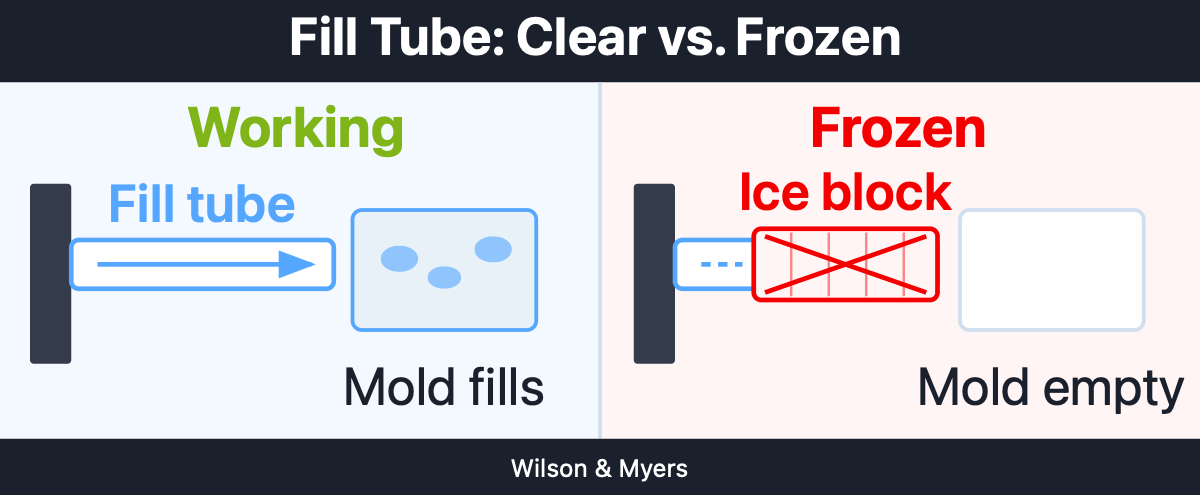
The fill tube carries water into the ice maker mold. When it freezes, the ejection mechanism cycles but no water enters. GE side by side ice maker not working and GE french door ice maker not working calls share this fault equally. Thaw the tube with a hair dryer on the lowest heat setting, held at least six inches from plastic and wiring.
If the fill tube freezes again within a few weeks, the fill tube heater has worn out. The replacement is the foil-type fill tube heater assembly, used on many French door GE models, replacing the wire-type design GE documented as uneven. A GE ice maker stopped making ice repeatedly after a thaw is almost always this heater, not the module itself.
In my experience, doing the tube and the heater on the same visit is how you avoid a callback two weeks later.
On a GE side-by-side, a frozen fill tube is the call we take more than any other ice maker complaint. Most times, the heater has given out: not the ice maker itself.
A GE ice maker reset clears the module’s stored fault state and starts a fresh self-test. The entry method varies by platform: side-by-side units with the top-mount module use a feeler arm sequence; GE Profile and GE Café models use the control panel. The full procedure for each model family is on our GE ice maker repair page, in GE’s own wording.
After a correct GE ice maker reset, the indicator light flashes for up to three minutes, which is normal. Persistent flashing past three minutes means the module found a fault it cannot resolve.
GE Profile and GE Café French door refrigerators use an in-door ice maker. It differs from the top-mount feeler arm design in standard GE side-by-side and bottom-freezer units. These platforms use an optical ice level sensor rather than a hall-effect sensor. A GE Profile ice maker not working diagnosis starts with the green indicator light: steady green means normal operation; a flashing light points to a fill fault or a failed ice level control board.
| Model Family | Ice Maker Type | Most Common Fault | Reset Entry |
|---|---|---|---|
| GE Standard (side-by-side) | Top-mount feeler arm module | Frozen fill tube, arm stuck up | Feeler arm sequence |
| GE Profile (French door) | In-door, optical ice level sensor | False full signal, flashing green light | Panel reset or 30-second power cycle |
| GE Café (French door) | In-door, similar to GE Profile | Same as GE Profile | Panel reset or 30-second power cycle |
| GE Standard (bottom freezer) | In-freezer, feeler arm module | Temperature sensitivity, fill tube freeze | Power cycle |
| GE Standard (top-freezer) | Small feeler-arm module | Arm stuck, water filter overdue | Power cycle |
A GE refrigerator stopped making ice: no clicking, no motion from the ice ejector arm, no partial fills. That usually means the ice maker module has failed. A technician confirms by ruling out the water and temperature causes first, then testing the heater circuit directly.
On GE Profile models with optical ice level sensing, a failed ice level control board sends a continuous false full-bin signal that blocks the water valve; the flashing green indicator is the key sign. A technician tests the board by bypassing the sensor signal and checking whether the unit then fills the mold.
Unplug the refrigerator. Shut off the water supply. Then open any panel or disconnect any line. Use a hair dryer on the lowest heat setting to thaw the fill tube, held at least six inches from plastic and wiring.
Never use boiling water. It warps the tube and risks burns. Any repair touching the sealed refrigeration system requires an EPA-608 certified technician. Never attempt it as a DIY job.
Call Wilson and Myers when every free check has passed and a GE refrigerator ice maker not working still needs a cause. Component diagnosis from that point requires a multimeter and knowledge of GE’s platform-specific fault logic. Our EPA-608 certified technicians service GE refrigerators throughout Denver, Littleton, Highlands Ranch, Parker, and Centennial.
Our technicians also service other refrigerator brands when the ice maker is a different model. That includes LG ice maker not working, Samsung fridge not making ice, Frigidaire ice maker not working, Whirlpool ice maker not working, and KitchenAid ice maker not working.
For ice maker repair service across Denver Metro, we source parts through national supplier networks. Book online and our team confirms availability for your GE model, or see our GE appliance repair page for the full service range.
How do I reset my GE ice maker?
GE ice maker resets vary by model. Side-by-side models with the top-mount module use a feeler arm sequence; GE Profile and GE Café models use the control panel. The full platform-specific procedure is on our GE ice maker repair page. After any reset, expect the indicator light to flash briefly and allow 24 hours before the first harvest completes.
Why did my GE ice maker stop working?
A GE ice maker not producing ice typically traces to four causes: the feeler arm stuck up, an overdue water filter, a freezer running above 10°F, or a frozen fill tube. On GE Profile and GE Café models, a failed ice level control board sends a false full-bin signal. Check them in order before replacing any parts.
How long does it take a GE ice maker to make ice?
Allow 24 hours after a reset or new installation before expecting ice. The ice maker module runs a self-test first; the mold then needs to drop to 16°F before the mold thermostat fires the harvest heater. Normal production after the first harvest runs at approximately eight to ten cubes per cycle in a correctly cold freezer.
How do I run a test cycle on my GE ice maker?
GE ice makers with the top-mount module support a forced-harvest test mode that runs a complete harvest cycle without waiting for temperature. The entry procedure differs by model family; the full instructions are on our GE ice maker repair page. The forced harvest confirms whether water is reaching the mold and whether the ejector motor completes a full cycle.
Can a clogged water filter stop a GE ice maker?
Yes. A filter past the six-month interval can drop effective water pressure below the 20 psi minimum the GE inlet valve needs. The ice maker solenoid stalls while the door dispenser still works on its momentary draw. Replace the filter and run the dispenser for two minutes to purge the line.
Our EPA-608 certified technicians diagnose GE ice makers across Denver Metro. We source parts through national supplier networks and manufacturer contracts.
Found This Helpful?
A residential dishwasher leaking from bottom rarely fails where the dishwasher puddle on floor tiles appears. Pull the kick panel; the highest wet surface mark…
A Samsung washer not spinning leaves clothes wet in the drum and the dryer waiting. Samsung's four platforms handle this differently: WF front-load, WA top-loa…
It is a week before Thanksgiving, and you set the oven to 350 degrees before starting the stuffing. Forty minutes later, the preheat signal fires. That is roug…
You opened the KitchenAid freezer this morning and the bin was empty. In my experience, the arm is the first thing worth checking: the fix costs nothing and ta…
A Frigidaire oven not heating can come down to a setting rather than a part. Before you book a repair, two checks cost nothing and take under a minute: the clo…
Has your refrigerator water dispenser stopped delivering water? In my experience, a large share of these calls end before a technician arrives. A child lock ac…
Welcome to the community.
You'll receive our next expert update soon.

Wilson & Myers is a verified member of the Denver Metro Chamber of Commerce.


