


Need a Professional Hand?
If a DIY fix isn't enough, our insured technicians are just a click away. We’ll diagnose the issue and get your home running right again.
BOOK NOWAn LG dryer not heating traces to one of three systems depending on your model. Electric DLE and DLEX models use a resistance element and thermal fuse; gas DLG and DLGX models rely on the burner train; DLHC and DLHX heat pump models have no resistance element at all. The prefix on the door-frame rating plate tells you which path is yours in about thirty seconds, and a D80 code on the display points to airflow, not a heating component.
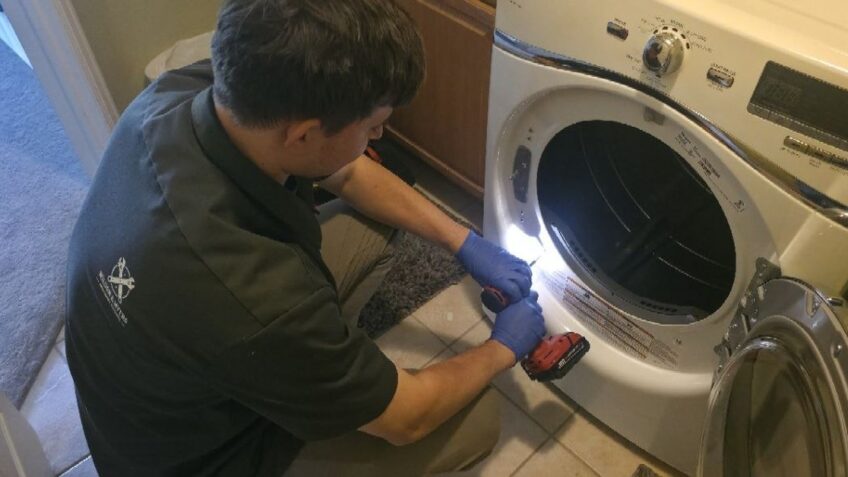
An LG dryer no heat complaint always starts with the same question: which of three fuel systems does your model run? The model prefix on your LG dryer’s door-frame rating plate answers that in thirty seconds, because the three LG fuel types share almost nothing in their heating systems.
Electric DLE and DLEX models use a resistance coil and a thermal fuse. Gas DLG and DLGX models rely on an igniter, solenoid coils, and a flame sensor. Heat pump DLHC and DLHX models have no resistance element at all.
Diagnosing them with electric-dryer steps sends homeowners on expensive dead ends. The answer to why is my LG dryer not heating depends entirely on which of these three systems your machine runs.
The first three characters of your model number tell you the fuel type. Open the dryer door and look for the rating plate on the door frame or the door opening rim. The model number is printed there along with the serial number and electrical specifications.
DLE and DLEX are electric; DLG and DLGX are gas; DLHC and DLHX are heat pump. LG front load dryer not heating issues follow the same prefix logic regardless of model generation or series.
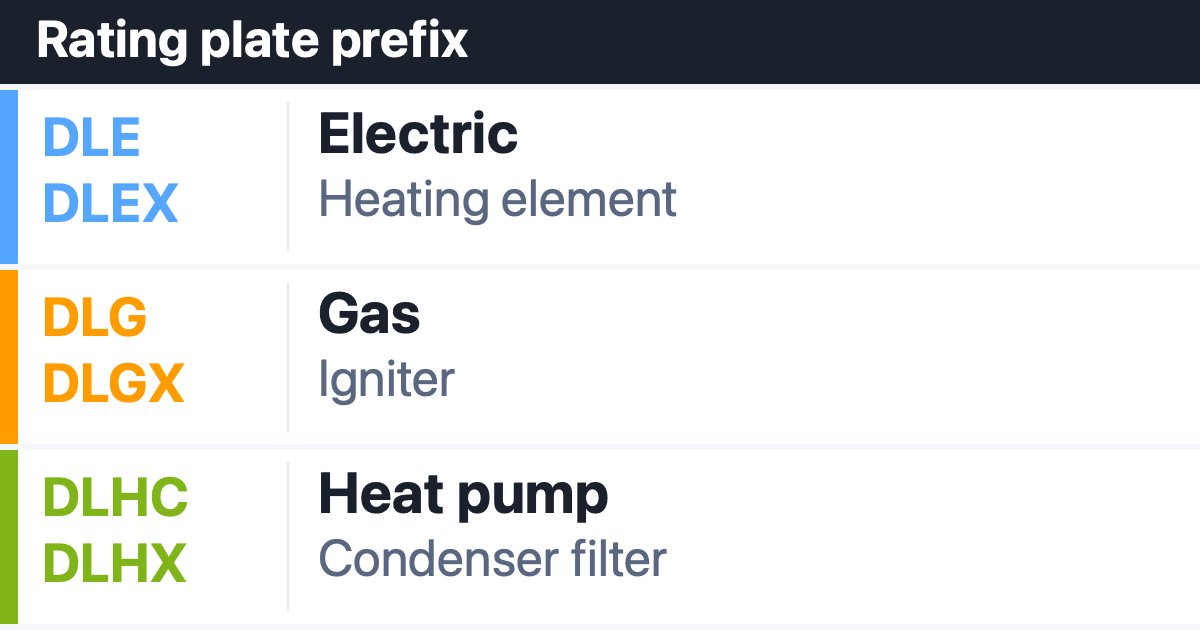
TROMM is an older LG brand name for drum-style laundry appliances. The same prefix rules apply: a TROMM model starting with DLE or DLEX is electric; one starting with DLG or DLGX is gas. The diagnostic paths below cover all generations under these prefix families. LG ThinQ dryers in the current DLE, DLEX, DLHC, and DLHX lineup follow the same prefix convention.
If your LG’s display shows a D80, D90, or D95 code, that is an airflow reading from LG’s Flow Sense system, not a heating component fault. Our LG D80 code guide covers the duct restriction diagnostic in full. If the display is clear and the LG dryer not heating no code situation is confirmed, the heating system is the right place to look. Your model type’s section is below.
Electric dryers run on 240 volts, delivered through two 120-volt legs from a double-pole breaker. When one leg of that breaker trips, the drum motor keeps running on the surviving leg. The heating element loses power completely. The dryer runs the full cycle.
The drum spins. The clothes come out exactly as wet as they went in. This is the classic LG dryer runs but no heat scenario. The check costs nothing.
Open your breaker panel and look for the double-pole breaker labeled “dryer.” If one side of the toggle is tripped, reset both sides fully. A single-leg trip that keeps returning points to a wiring fault or an element drawing excess current.
An insured technician should diagnose it. This free check resolves a surprising share of calls, so do it first on any electric model.
An LG dryer not heating up on a DLE or DLEX model almost always traces to one of four components: the thermal fuse, the heating element, the cycling thermostat, or the hi-limit thermostat. The thermal fuse fails most often because it is a one-shot safety device with no reset path. When it opens, the heating circuit is dead until the fuse is replaced and the root cause is identified and fixed. This is true whether the model is a DLE or a DLEX.
Overheating trips the thermal fuse permanently. Drum air temperature climbs past the fuse’s rated limit and the fuse opens to protect the drum and cabinet. It never resets.
An open fuse kills heating entirely. Clothes come out damp whether the cycle ran 30 minutes or 90.
Testing the fuse requires a multimeter set to continuity mode. Disconnect the dryer from power and trip its dedicated breaker before opening any panels. Remove the rear panel, locate the thermal fuse on the exhaust duct near the heating element housing, disconnect the leads, and touch the multimeter probes to the fuse terminals. No continuity means the fuse is blown and must be replaced.
Here is the rule most DIY guides skip: a blown thermal fuse is a symptom, not a root cause. Understanding the thermal fuse root cause is what separates a one-time repair from a recurring failure pattern. Something caused drum air temperature to exceed the rated threshold.
Three culprits account for most repeat failures. Those are a blocked duct, a failing hi-limit thermostat that allowed temperature to run high, or a thermistor misreading drum temperature. Each one runs the element longer than it should.
LG dryer not heating after replacing thermal fuse is almost always this root-cause failure repeating. Our dryer vent cleaning service clears restricted ducts before they blow the next fuse.
No heat on any cycle, with a breaker that tests good and a thermal fuse that tests good, points toward the heating element. The element is a coiled resistance wire inside the heating chamber behind the rear panel. When the coil breaks, the circuit opens and no heat is produced. When the coil sags and touches the chamber housing, the hi-limit thermostat trips on every cycle, eventually blowing the thermal fuse as a secondary failure.
LG dryer getting hot sometimes but not always is a hallmark of a partial element break. The coil is cracked in a way that works under some conditions and fails under heat stress or vibration. Continuity at the element’s terminals with the dryer disconnected confirms or rules out an open circuit.
Resistance testing adds useful information when continuity is present but the element is under suspicion. LG elements commonly read 7 to 20 ohms. The exact range varies by model; check LG’s service documentation for the authoritative specification. If your reading falls outside that typical range, consult your model’s service documentation before concluding the element is acceptable.
We see LG electric dryer not heating calls where the element is in that high range. It draws excess current and trips the hi-limit every cycle.
Two thermostats regulate temperature on DLE and DLEX dryers. The cycling thermostat tracks drum temperature. It opens and closes to manage the window the element operates in.
When the cycling thermostat fails open, the element receives no signal to run and the dryer produces no heat. When it fails shorted, the element runs continuously, overheating the drum and eventually tripping the hi-limit or the thermal fuse.
The hi-limit thermostat is a safety cutoff below the thermal fuse threshold. Unlike the fuse, it resets when the temperature drops. A hi-limit thermostat tripping on every cycle means something is preventing the drum from cooling properly: a restricted duct, inadequate room airflow, or the cycling thermostat allowing the element to run too long.
Test both thermostats with a multimeter in continuity mode at room temperature. Both should show continuity when cold. For the full brand-agnostic framework, the dryer not heating guide covers thermostat testing across all dryer makes.
An LG gas dryer not heating shares the thermal fuse failure path with electric models. That is where the diagnosis starts.
Gas DLG and DLGX dryers also carry an igniter, solenoid coils, and a flame sensor. Any one can stop the burner from firing. Any repair past the gas shutoff valve on a DLG or DLGX dryer is licensed professional work in Colorado. Turn the dedicated supply valve to the closed position before calling for service.
The ceramic igniter starts the gas cycle on DLG and DLGX dryers. It glows bright orange. That heat signal opens the solenoid coils so gas can flow.
When the igniter cracks from thermal cycling, it cannot reach the temperature required to open the valve. No gas reaches the burner. The dryer runs the full cycle in complete silence from the burner chamber.
Visual inspection often reveals the problem: look through the burner access panel for a cracked igniter element. Resistance testing with a multimeter confirms it. An igniter that glows but never triggers gas ignition points to the solenoid coils, not the igniter itself. That distinction prevents an unnecessary part replacement and is a common diagnostic confusion on gas models.
Solenoid coils hold the gas valve open once the igniter has heated the burner chamber to operating temperature. LG gas dryers use two or three coils. All must work for the valve to open.
When one coil fails, the valve stays closed. Gas does not reach the burner, and the igniter glows briefly before going dark.
The symptom is distinct if you can observe the cycle through the burner access panel: the igniter glows, then goes out without the characteristic soft whomp of gas igniting. Coil resistance testing with a multimeter identifies the failed coil. Each coil should read a consistent resistance. A coil reading open or outside its specification needs replacement by an insured technician familiar with LG gas dryer repair.
Solenoid replacement and any work involving the burner assembly, gas valve, or fuel line connections requires a licensed professional in Colorado. The gas shutoff valve on the wall or at the appliance connection is the homeowner’s boundary. Turn it off before calling us.
The flame sensor monitors the burner flame and signals the valve to stay open during the cycle. When it fails, it prevents ignition even when the igniter is working. Diagnosing and replacing it is part of a professional gas visit; our insured technicians handle LG dryer repair across the DLG and DLGX lineup.
LG heat pump dryer not heating calls are almost always not what they appear to be. The condenser filter, not any electrical component, is the leading cause of reduced or absent drying on DLHC and DLHX models. Homeowners and even some DIY guides try to diagnose a thermal fuse on these machines.
No thermal fuse exists on a heat pump dryer. No resistance element exists. The drying problem DLHX owners report is a fundamentally different system. DLE and DLG heating paths do not apply.
A DLE or DLEX dryer burns electricity to generate heat directly.
A DLHX dryer works differently. It moves heat using a refrigerant cycle, the same principle as an air conditioner working in reverse, delivering warm air to the drum rather than removing it from a room. This makes the DLHC and DLHX fully ventless: no duct, no exhaust run to the exterior. The tradeoff is a condenser and evaporator that must stay clean to transfer heat efficiently across the cycle.
When the condenser becomes clogged with lint, heat transfer across the exchanger drops. The drum runs and air circulates, but the air temperature stays too low to dry clothes efficiently. The cycle runs to completion with clothes still damp. It takes significantly longer than the rated time.
LG dryer not drying clothes calls on DLHX and DLHC models almost always trace to a clogged condenser filter. Most owners do not know it exists. That is usually the whole problem.
The condenser filter lives behind the lower front access panel on DLHC and DLHX models. Open the panel at the bottom of the dryer front face, pull the filter out, and rinse it under running water until the water runs clear. Let it dry completely before reinstalling.
LG recommends cleaning the condenser filter monthly. Run it more often in households that handle many cycles per week or dry heavy loads of towels and bedding.
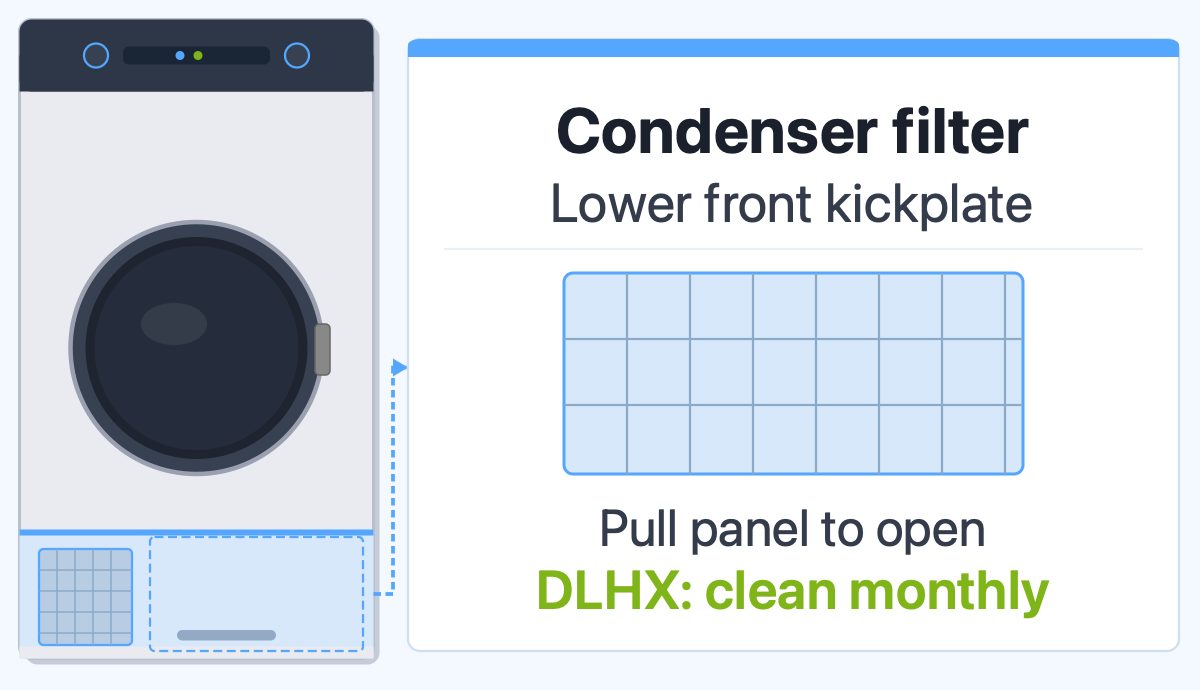
LG ThinQ models offer a Condenser Care cycle in the app that runs approximately one liter of water through the filter housing to clear fine lint buildup between manual rinses. This complements but does not replace the monthly hands-on cleaning for heavier accumulation. If cleaning the condenser filter restores normal drying, the job is done. If the DLHX still fails to dry after a thorough filter clean and a full dry cycle to confirm, the refrigerant system is the next suspect.
The refrigerant system in a DLHC or DLHX dryer is a sealed system. Refrigerant handling and sealed-system diagnosis require professional service equipment. This is not a DIY path. Attempting to service it without the right tools risks injury and machine damage.
On LG heat pump dryers, the condenser filter causes more no-heat calls than anything else. Clean it monthly and most of those calls stop coming in.
When your LG displays a tE code, the thermistor, the sensor that monitors drum air temperature, is reporting a fault. The control board uses thermistor readings to regulate heating output. A faulty thermistor confuses the control board. It may run heating too long, too short, or not at all.
Factory reset is the first step for tE1, tE2, and tE3; TE4 requires service without a reset path. These confirmed tE codes only are the four verified against LG’s official help library. The circulating tS and standalone tE labels do not appear on LG’s official error code page and are not covered here.
LG’s first step for tE1, tE2, and tE3 is a factory reset; the exact procedure for your model is in its owner manual or at LG’s support site. If the tE1, tE2, or tE3 code returns within that first cycle, the thermistor needs replacement. That requires accurate resistance testing against the model’s service specification, which is a professional diagnostic step.
TE4 has no reset path. Call for service directly.
LG’s installation self-test measures temperature rise during a test cycle and confirms the heating circuit is functional. If you recently installed or serviced the dryer, run the self-test first. It rules out a setup issue before concluding a tE code means a failed thermistor.
The procedure is in your model’s installation guide. A confirmed temperature rise during the test means the heating circuit is working and the fault may be intermittent rather than a hard component failure.
The thermal fuse on an electric DLE or DLEX dryer is the most accessible homeowner repair in this list. With the dryer disconnected from power and the dedicated breaker tripped, the rear panel comes off with a handful of screws. The fuse sits on the exhaust path near the heating chamber.
Continuity testing confirms the diagnosis before you source a replacement. The repair time is typically 30 to 45 minutes for someone comfortable with a screwdriver and a multimeter. Order the replacement fuse from an appliance parts supplier. We source the same components through national supplier networks and manufacturer contracts.
The heating element on DLE and DLEX models is in the same rear panel area as the thermal fuse. If the element tests open with the multimeter, replacement is a DIY-accessible repair on the same disassembly path. Plan for the same 30 to 45 minutes. The same caution applies: fix whatever caused the element to fail, or the replacement runs on borrowed time.
The condenser filter on a DLHC or DLHX heat pump dryer is the easiest fix on this entire list. No tools. No panels.
Monthly cleaning from the front of the machine. If the filter is the cause, the repair costs nothing and takes five minutes.
Call our insured technicians for gas models past the shutoff valve and heat pump sealed-system faults. Thermistor replacement requiring full drum removal warrants a professional visit. Any returning breaker trip does too.
I find that the calls reaching us are almost always the ones where a part was replaced and the dryer is still not heating. The root cause was not addressed in that first repair. We trace the root cause on the first visit. For dryer repair outside the LG-specific scope, the general service page covers all brands.
Wilson & Myers sends insured LG dryer technicians across the Denver Metro Area. We cover Denver and Lakewood, and regularly schedule visits in Aurora and Littleton. For homeowners in Boulder County, service is available with lead times that vary by schedule and distance.
Colorado winters affect heat pump DLHX and DLHC models differently from electric DLE or gas DLG dryers. When ambient temperatures in the laundry room drop, the heat pump system works harder to maintain drum temperature. If your heat pump dryer is in an attached garage or a utility room on an exterior wall on the Front Range, it feels Colorado’s cold more acutely. A resistance-element electric dryer would not.
We factor that in when diagnosing DLHC and DLHX models during winter months.
Denver’s altitude matters more for gas DLG and DLGX dryers than electric models. Combustion performance at altitude depends on gas pressure and air-fuel mixture settings calibrated for Colorado installations. This is one more reason gas burner work needs a licensed professional familiar with the Front Range environment, not a generic repair guide written at sea level.
When to call Wilson & Myers: when the breaker check, condenser filter clean, and thermal fuse test have not resolved it. That is the threshold for the component diagnosis we run on the first visit. Our insured technicians carry LG dryer experience across the DLE, DLEX, DLG, DLGX, DLHC, and DLHX model families. We source parts through national supplier networks and manufacturer contracts, and we trace the root cause before replacing components so the same fuse does not come back in three weeks.
Book your LG dryer repair online and our Denver Metro team will confirm availability for your location. For anything involving the gas system past the shutoff valve or the heat pump sealed system, we route those directly to our licensed and insured technicians.
How do I reset my LG dryer when it is not heating?
A tE1, tE2, or tE3 code on the display is the most common reason to reset. The factory reset procedure varies by model; find the exact steps in your model’s owner manual or at LG’s support site. If the code returns within the first cycle after the reset, the thermistor is faulty and needs replacement; for TE4, skip the reset and call for service directly.
Why does my LG dryer run but produce no heat?
When an LG dryer runs but no heat is produced, the most common cause on electric DLE and DLEX models is a blown thermal fuse. On gas DLG and DLGX models, a cracked igniter or failed solenoid coil stops gas from reaching the burner. Heat pump DLHC and DLHX models most often trace the fault to a blocked condenser filter.
Can a clogged vent cause an LG dryer not to heat?
Yes. LG’s Flow Sense system shows a D80, D90, or D95 code when the duct is blocked enough to trigger the sensor, which means airflow, not a component fault. Even without a code, a restricted duct can cause overheating that trips the thermal fuse. Clear the duct and replace the fuse on the same visit to prevent repeat failure.
What does tE1 mean on an LG dryer?
tE1 is a thermistor fault code confirmed against LG’s official help library: the sensor is not reading drum air temperature correctly. LG’s first step is a factory reset; find the exact procedure for your model in the owner manual or at LG’s support site. If tE1 returns in the next cycle, the sensor needs replacement by an insured technician.
How long does an LG dryer heating element last?
LG heating elements on DLE and DLEX models commonly last eight to twelve years under normal use. Restricted airflow shortens element life because it forces the element to run longer and hotter per cycle. A dryer vented through a long run to a roof cap accumulates lint faster than one with a short wall run.
Is it worth repairing an LG dryer that stopped heating?
For LG electric models under twelve years old, a thermal fuse or heating element repair almost always makes financial sense. LG builds durable drum and motor components, so a dryer that has only lost its heating system often has years of useful life remaining. Heat pump DLHC and DLHX models with refrigerant faults are the exception and may warrant a replacement instead.
If this article did not match your situation, the brand-agnostic dryer not heating guide covers the full cause framework across all manufacturers. The LG D80 code guide is the right destination if D80, D90, or D95 appears on your display. For LG appliances beyond the dryer, the LG appliance repair hub has full service details.
See also our dryer satellite guides: Samsung dryer not heating, Whirlpool dryer not heating, and Maytag dryer not heating.
Your LG dryer stopped heating and the easy checks are behind you. Book online and our Denver Metro team will confirm availability for your address.
Our insured technicians diagnose LG electric, gas, and heat pump dryers across the Denver Metro Area. We source parts through national supplier networks and manufacturer contracts.
Found This Helpful?
A Whirlpool oven not heating can mean a failed bake element, a weak gas igniter, or one sensor reading the cold circuit wrong. Before any part costs money, two…
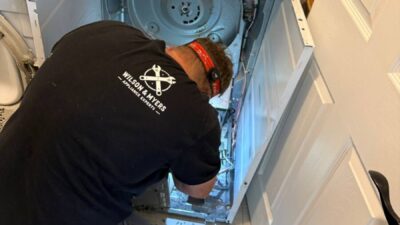
Most cases of a Maytag dryer not heating split at the model prefix on the door: MGDC is gas, MEDC is electric, and the path diverges from there. On a Centennia…
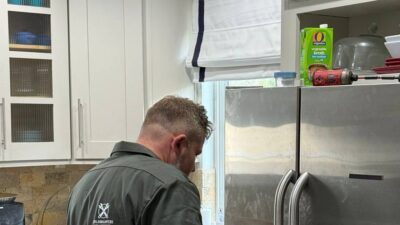
You open the freezer Friday night and the GE side-by-side ice bin is empty, but the food is cold and the water dispenser works fine. Most GE refrigerator ice m…
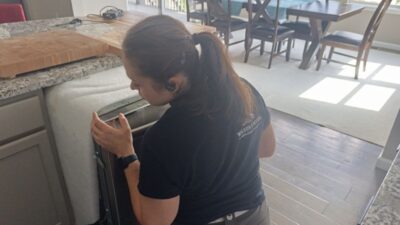
A residential dishwasher leaking from bottom rarely fails where the dishwasher puddle on floor tiles appears. Pull the kick panel; the highest wet surface mark…
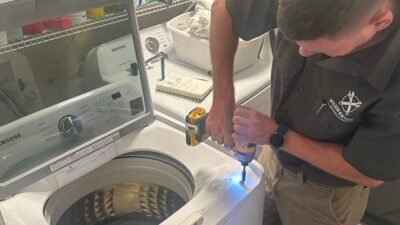
A Samsung washer not spinning leaves clothes wet in the drum and the dryer waiting. Samsung's four platforms handle this differently: WF front-load, WA top-loa…
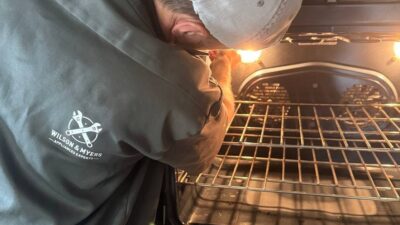
It is a week before Thanksgiving, and you set the oven to 350 degrees before starting the stuffing. Forty minutes later, the preheat signal fires. That is roug…
Welcome to the community.
You'll receive our next expert update soon.

Wilson & Myers is a verified member of the Denver Metro Chamber of Commerce.


