
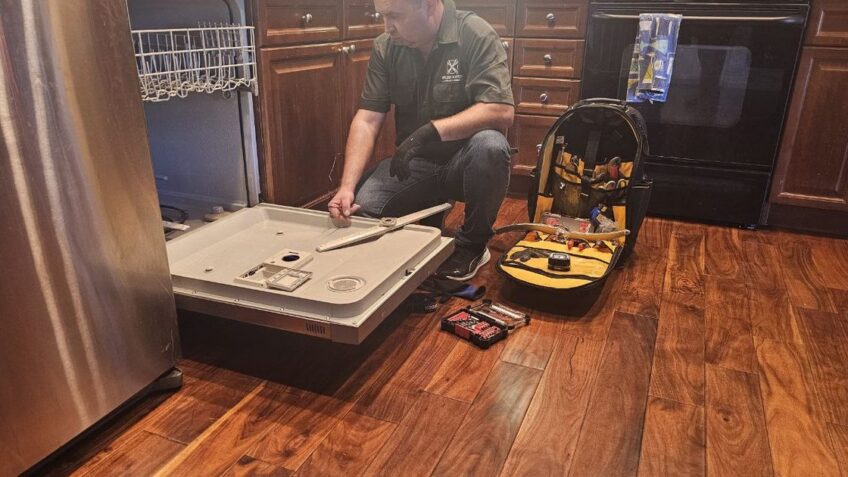


Need a Professional Hand?
If a DIY fix isn't enough, our insured technicians are just a click away. We’ll diagnose the issue and get your home running right again.
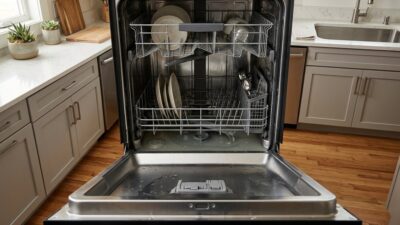
BOOK NOWNot every puddle in the bottom of the tub signals a failure. GE Appliances confirms that a thin film of water in the sump is normal on many models. Not a drain failure. A puddle covering the full tub floor is drain failure, and that is the starting point for this guide.
GE Appliances notes that a thin film in the sump below the flat filter screen is normal behavior on many models. Without an ultra-fine filter installed, one to two cups in the lowest point of the tub is also acceptable. If the floor of the tub is fully visible and only the sump area holds moisture, the dishwasher is draining correctly.
The confusion arises because every dishwasher leaves some water in the sump by design. The dishwasher standing water that is a problem covers the lower spray arm hub, buries the filter stack, and smells of old wash water. That is not residual moisture. That is a drain failure, and it will not clear on its own.
Water in dishwasher not draining scenarios always present the same way: standing water in dishwasher bottom, covering the full tub floor, still present hours after the cycle ended. Same symptom, same starting point. The dishwasher ran, the cycle completed, but the pump did not push water out through the drain hose.
A dishwasher not draining all the way, with two or three inches still visible at cycle end, is also a failure. Partial drain means the pump is running but cannot clear the full sump. The same causes apply, and the same sequence of checks works.
If you are asking why is my dishwasher not draining and the fill cycle ran normally, this guide covers it. If the machine never filled with water in the first place, that is a separate fill-side problem. See our guide on dishwasher not getting water for fill failures.
If the water stayed in the tub and never moved during the drain portion of the cycle, the problem is a blockage in the drain path, not a pump failure. Work through the drain filter, the drain hose, the garbage disposal connection, and the air gap in that order. These four checks resolve the majority of cases without replacing any parts.
If standing water still fills the tub, clear it before you reach for the filter. The removal steps are in the section below.
Filter twist-off access is the same counterclockwise motion on most brands. The filter stack sits at the bottom center of the tub, behind the lower spray arm hub. On GE, Whirlpool, KitchenAid, Frigidaire, Samsung, LG, and Maytag models, the cylindrical filter lifts out after a quarter-turn counterclockwise. Pull the cylinder, then lift the flat mesh screen below it.
Rinse both pieces under warm running water and scrub the mesh with a soft brush. This takes under ten minutes and resolves a dishwasher not draining after cycle in the majority of cases. After reinstalling the filter, run a short drain or cancel cycle to confirm the water clears before calling anyone.
Miele uses a similar concept, though the flat screen locks differently on some models. Check your model’s guide for the removal step if the cylinder does not turn freely. Never force the rotation.
In Denver Metro homes, we see filter clogs more often in households that pre-rinse less, which is correct modern behavior for most machines. Scraping plates rather than rinsing them delivers more food debris to the filter, and a monthly rinse prevents it from becoming a drain issue. If your filter was clogged and clearing it also fixed the washing performance, see our article on dishwasher not cleaning dishes, which shares the same starting point.
A dishwasher not draining after cleaning filter means the obstruction is downstream, inside the hose path, the disposal connection, or the check valve. Homeowners asking why is the water not draining from my dishwasher will find the answer in the same three areas. Work through the checks below before concluding the pump has failed.
My dishwasher is not draining despite a clean filter: if that phrase fits, the filter was not the blockage. The obstruction is downstream, in the hose path, the disposal connection, or the check valve, in that order.
Do not use chemical drain cleaners (Drano, Liquid-Plumr) in a dishwasher. These products damage the pump seals and the plastic drain components inside the machine and can cause a secondary failure on top of the original one. The drain hose is the right next check, not a chemical shortcut.
The drain hose runs from the pump outlet to the high loop, then down to the garbage disposal or standpipe. Run your hand along the hose under the sink. A kink behind a cabinet drawer blocks flow as effectively as a clogged filter and is easy to miss. Internally clogged hoses happen, particularly at the loop apex where grease and soap buildup accumulates.
The knockout plug new install error is the most common post-installation drain complaint we see. Every new garbage disposal ships with a solid plastic plug sitting inside the dishwasher drain port. The plug is there for disposals not connected to a dishwasher. The installer must knock it out from inside the disposal body before connecting the drain hose.
When the plug stays in, drainage is completely blocked on a dishwasher not draining after cycle from the first run. Not a wear failure. It only happens on a new installation or after a disposal replacement.
The garbage disposal knockout plug is the first thing I check on a post-install call. It ships inside the disposal drain port and nothing drains until someone knocks it out.
Disconnect the drain hose from the disposal and unmount the disposal to access the knockout plug. Tap the plug out from the inside with a screwdriver handle. Reinstall the disposal, reconnect the hose, and run the dishwasher. The drain issue resolves immediately if the plug was the cause.
One additional check: run the disposal briefly before you run the dishwasher drain cycle. A jammed disposal prevents the dishwasher drain hose from clearing, because the hose empties into the disposal inlet. A disposal that hums and does not spin is jammed, not broken. Reset it with the reset button on the bottom of the unit, then run it clear before testing the dishwasher.
An air gap is the chrome fitting mounted on the countertop or sink deck next to the faucet. Not every kitchen has one. When its interior clogs, water backs up into the dishwasher drain line instead of clearing to the standpipe.
The visible sign is air gap cap overflow: water spurting from the small vent holes in the top cap during the dishwasher drain cycle. That water did not reach the standpipe. It backed up through the air gap instead. To clear it, unscrew the cap, pull out the inner tube, and flush the debris.
Most clogs are wet food particles and grease packed in over months of use. They compound quietly.
After clearing, run a full drain cycle and confirm the spurting stops. If the air gap overflows on the next drain cycle as well, the clog has re-formed at the disposal end of the outlet hose. Disconnect the hose from the disposal and flush it separately.
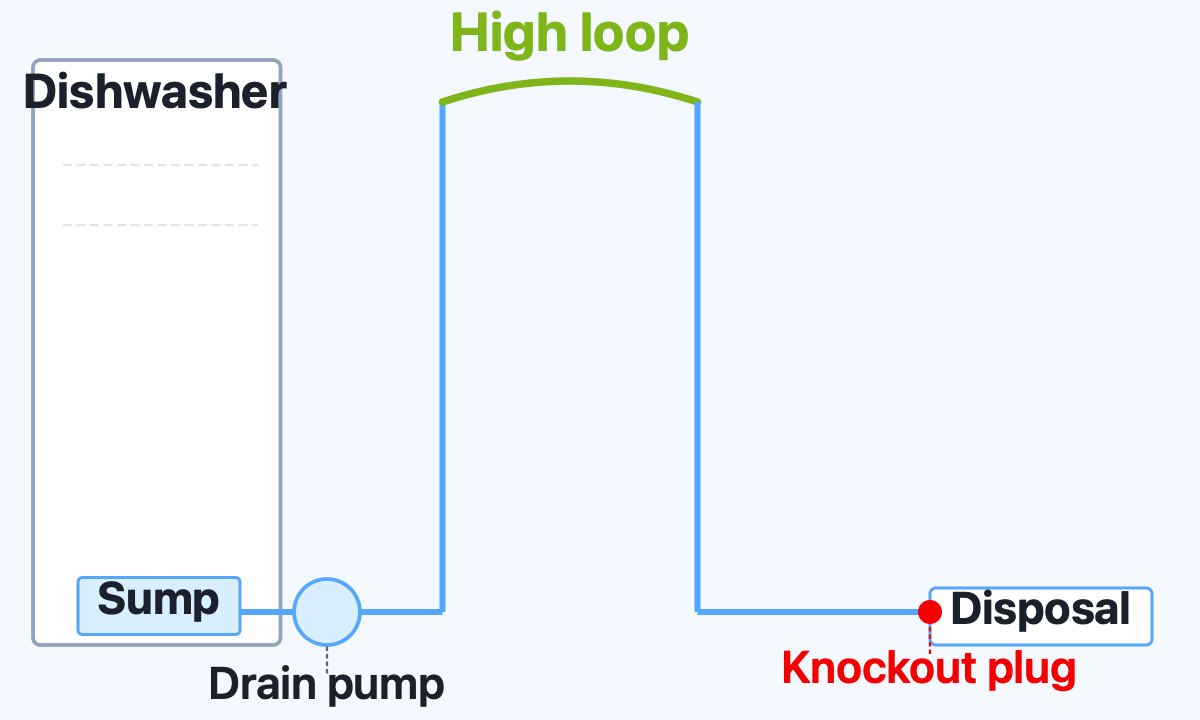
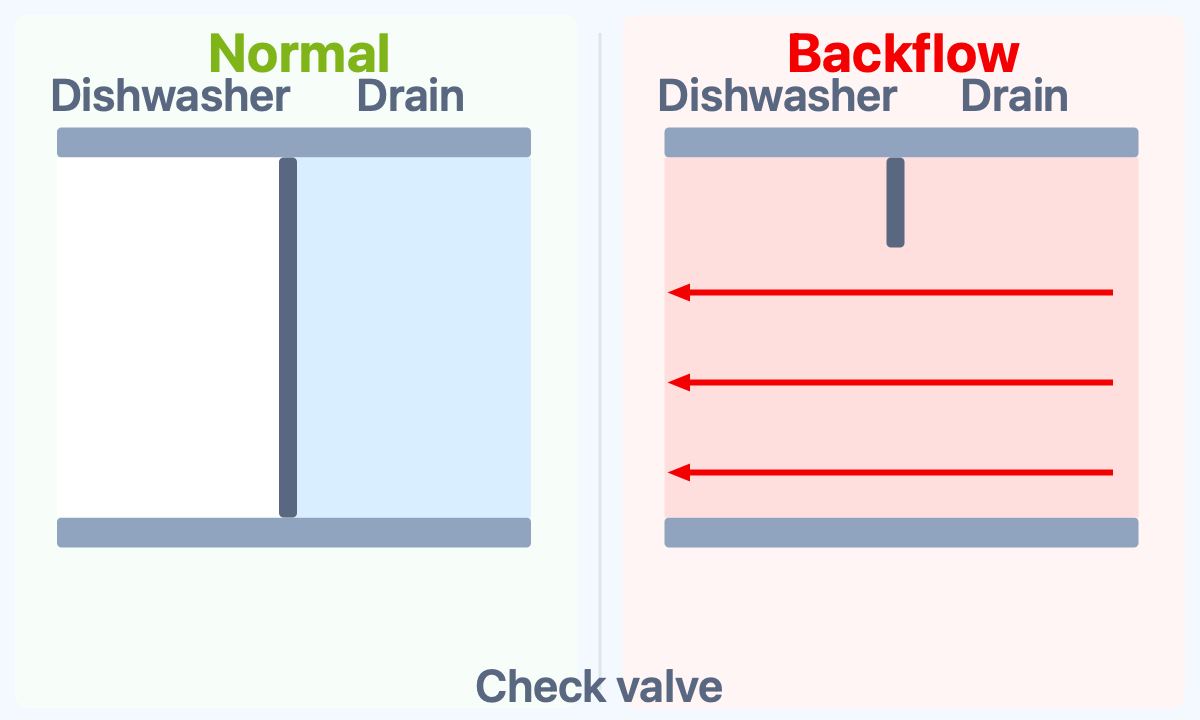
If the dishwasher drains during the cycle but water is back in the tub by the time you open the door, the pump did its job. The problem is backflow. Two causes produce this pattern: a check valve stuck in the open position, and a drain hose high loop that has sagged too low. Each has a distinct fix.
The check valve is a one-way flap inside the drain outlet that closes after the pump stops, keeping drained water out of the tub. Understanding the check valve backflow mechanism makes the symptom clear. When the flap sticks open, the pump drains normally. Water flows back as soon as it stops.
Returning water is not a dishwasher not draining and leaking problem in the usual sense. The pump runs and water exits. The backflow is the used drain water returning instead of staying in the standpipe. Homeowners often describe it as a drain that runs, then water comes back.
The check valve is stuck open. Replace it.
Stuck closed is the other failure mode. The rubber flap warps over time and seals against the pump housing, blocking the outlet even when the pump runs. This presents as a dishwasher not draining water despite an audible pump. The homeowner hears the pump running but sees no water movement at all.
The fix in both cases is a check valve replacement, which requires pump housing access.
A high loop is an installation step that routes the drain hose up behind the cabinet wall before it drops to the disposal or standpipe. The high loop sag siphon is what happens when the drain hose droops back toward the cabinet floor. Water siphons back into the tub as soon as the pump stops, without any check valve failure.
Most jurisdictions allow the high loop as the standard drain installation. Some require an air gap by code. The hose apex should be secured at or near the top of the cabinet with a hose clamp or zip-tie.
If the loop apex drops below the disposal inlet, re-secure the hose. That fixes the backflow.
No parts needed.
Not draining standing water in dishwasher situations after a confirmed drain cycle are almost always the check valve or the slipped high loop. Confirm which by watching whether the drain completes fully, then checking for water return within five to ten minutes of cycle end. High loop sag is the simpler fix. Check it first.
Before you can inspect any of the components that cause standing water, you need to clear the tub floor. Standing water makes the filter inaccessible and prevents you from running a test drain cycle with any confidence about what the result means. This step takes five minutes.
Remove the lower rack entirely and set it aside. Use a measuring cup or small plastic cup to scoop out the bulk of the standing water, one cup at a time, into a bucket or the sink. When the water is too shallow to scoop, press old towels against the remaining puddle until the floor of the tub is damp but not standing.
Pulling the filter clears the sump and filter stack for visual inspection. You will now see whether debris is packing against the filter from above. Heavy debris can restrict drainage even when the filter itself is not fully clogged. Remove any visible food waste from the sump before reinstalling the filter.
Reaching the flat mesh screen below the filter cylinder is easier with the tub clear. The mesh is where fine-particle buildup accumulates. Rinse it under running water until water passes through freely. Replace it if the mesh is damaged or torn.
A torn mesh lets debris reach the sump and pump area unchecked. Replace it promptly.
Most dishwashers offer a cancel-and-drain option from the control panel that runs only the drain pump without a full wash program. After clearing standing water and cleaning the filter, run this cycle to test whether the drain path is now clear. The result tells you whether the fix worked before you reassemble and run a full load.
The exact button sequence varies by brand and model. Check your model’s guide for the specific step, since button sequences vary between families. If the cycle runs and water exits the machine, the fix worked. If the hum continues with no water movement, or nothing happens, move to the pump section.
Before checking the pump area, unplug the dishwasher. The motor has electrical connections that remain live even when the cycle is not running. Confirm the drain filter is clean, the hose is clear, and the disposal connection is correct before proceeding. The pump is the last mechanical suspect after the full drain path is verified clear.
An impeller jam pump hum during the drain cycle, with no water movement, means the motor is energized but cannot turn freely. The most common reason is debris. Glass shards, label stickers, and small bone fragments are common culprits.
Each jams the impeller. The impeller is a small plastic wheel on the motor shaft. Even a small fragment locks it completely.
A cracked impeller produces the same symptom. The motor turns, the impeller spins on the shaft, but the cracked blade has lost its ability to push water. Both the impeller jam and a cracked blade produce the same external sound: a steady hum with no drain progress. The hum versus silent pump distinction is the first diagnostic split, and hum means the motor is running.
Clearing visible debris from the pump area sometimes resolves a jammed impeller without replacing any parts. A cracked impeller requires pump replacement. If you remove visible debris and the pump still hums without draining, the impeller blade has failed and the pump needs service.
Complete silence during the drain cycle means the motor is not energized. The motor winding may have failed or the wiring harness connection may be loose. The control board may not be sending the drain signal at cycle end. These are distinct faults with different fixes, and distinguishing them requires a diagnostic test.
Run a manual cancel-and-drain cycle (see the section above) and compare it to the automatic drain at cycle end. If the manual drain also produces silence, the pump motor has failed or the wiring connection is broken. If the manual drain runs correctly but the end-of-cycle drain does not, the control board’s drain relay is the suspect rather than the pump motor itself.
Work through the full sequence one more time before concluding the pump has failed. Skipping steps is expensive.
If all six are verified and the dishwasher still won’t drain, run two more drain cycles. Hum with no movement means the impeller is jammed. Silence means the motor has failed.
Our insured technicians have seen pumps replaced on dishwashers that only needed a glass shard cleared. Clearing the drain path first avoids that outcome and saves the cost of a part that was not needed.
Why dishwasher not draining persists after a pump replacement in some cases: the original cause was a hose kink or knockout plug that was never removed. The new pump fails under the same blocked-drain load. The sequence in this guide prevents that outcome by clearing every upstream cause before confirming the pump.
If the pump is confirmed as the fault, schedule dishwasher repair with an insured technician. Pump replacement involves electrical connections inside the machine and water together. That is an insured technician’s job.
Many modern dishwashers display a drain-related error code when the pump fails to clear the sump within the expected cycle time. Whirlpool uses F9E1 for a drain-not-completing fault, the most common named code in this class. GE labels the same failure FTD or F56, and adds C1 through C5 to narrow down where the drain stopped. If your dishwasher is not showing a code and water is simply standing, the causes above apply regardless of brand.
| Brand | Code | Signal |
|---|---|---|
| Whirlpool | F9E1 | Drain not completing in cycle time |
| GE | FTD, F56, C1 to C5 | Failure to drain; see the GE guide below |
| Samsung | Varies by model | Drain-related fault |
| LG | Varies by model | Drain-related fault |
| Frigidaire | Varies by model | Drain-related fault |
| KitchenAid | Varies by model | Drain-related fault |
| Miele | Varies by model | Drain-related fault |
| Maytag | Varies by model | Drain-related fault |
| Bosch | See brand guide | Use the Bosch-specific guide below |
For brand repair guides: Whirlpool, GE, Samsung, LG, Frigidaire, KitchenAid, Miele, and Maytag dishwasher repair pages.
If your brand does not display an error code, the causes above still apply. Error codes are diagnostic shortcuts, not requirements for diagnosis. A dishwasher that holds water without displaying a code has the same six possible causes as one that shows a code.
Bosch dishwashers have a drain system that differs from the generic brand-agnostic mechanics described in this guide. The filter access path, pump cover design, and drain error code responses are specific to Bosch models. The hub you are reading covers the brand-agnostic causes. Bosch-specific diagnosis has its own dedicated article.
If your Bosch is showing a drain error code, the Bosch dishwasher not draining guide walks through the exact diagnostic steps for your machine, in the order the codes require. That article is a brand-specific guide covering the Bosch drain system: component names and access steps specific to Bosch. Use it.
The article you are reading is the universal hub that covers filter, hose, knockout plug, air gap, check valve, and pump for all other brands. Those six causes produce nearly all dishwasher not draining water situations outside of Bosch-specific faults. Bosch owners who have not yet seen a drain error code may also benefit from working through the first two H2 sections of this guide before moving to the brand-specific article.
For Denver Metro Area Bosch repairs, Wilson and Myers covers the full drain diagnostic. See the Bosch dishwasher repair page.
GE names the drain failure instead of leaving you to guess. FTD and F56 both mean failure to drain, and the C1 through C5 codes narrow down where in the cycle the pump stopped. GE also splits what counts as normal leftover water by whether the tub has an Ultra Fine filter, which changes the first thing worth checking.
The GE dishwasher not draining guide works those codes in GE’s own order, starting at the Ultra Fine filter and the sump before anything comes apart. It also covers GE’s drain reset and the flood float, both of which have GE-specific handling this hub does not describe.
The article you are reading stays brand-agnostic: filter, hose, knockout plug, air gap, check valve, and pump. Those causes hold for a GE as well, so a GE owner with nothing on the display can work through the sections above first.
For Denver Metro Area GE repairs, Wilson and Myers covers the full drain diagnostic. See the GE dishwasher repair page.
Most drain failures that reach this point, with the filter clean, the hose clear, the knockout plug confirmed absent, and the air gap flushed, are pump or check valve issues. These require opening the pump housing and working near electrical connections inside the machine. Getting that repair right on the first visit is what an insured technician brings to the call.
A pump that is confirmed silent after two drain attempts points to a dead motor or wiring fault. Persistent humming with no water movement, even after clearing visible debris from the impeller area, points to a failed impeller or cracked blade. A check valve stuck in the open position, confirmed by water returning to the tub within minutes of draining, is also a component replacement, not a cleaning.
Control board faults show up when the pump runs correctly during a manual cycle. The board fails to drain at the end of a wash program. That points to the drain relay rather than the pump. Confirming the relay takes a technician with the right test equipment.
Running repeated cycles on a dishwasher that is not draining fills the tub with the same water and risks burning out the drain pump motor. Standing water from a stalled drain also promotes mold growth within 24 to 48 hours. Have it serviced before running another full cycle.
Wilson and Myers serves Denver, Littleton, Lakewood, Aurora, and Arvada, covering the full Denver Metro Area. Our insured technicians carry the diagnostic equipment to test drain pump continuity, check valve movement, and control board signal without guessing. Book online and schedule a visit that works around your kitchen.
Whether you found standing water this morning or keep finding it back in the tub after every cycle, start at the filter and work forward. That is what fixing it in the right order means in practice.
Why is my dishwasher not draining?
A dishwasher that won’t drain usually has a clogged filter, a kinked drain hose, or a stuck check valve. If you recently installed a new garbage disposal and the knockout plug was left in the drain port, that is the most likely reason. Pump failure accounts for a smaller share and shows up after the other causes are cleared.
How do I get standing water out of my dishwasher?
Remove the lower rack. Use a cup to scoop out as much standing water as you can, then press old towels against the remaining puddle. That step clears the tub floor. Access the drain filter at the sump base, the first thing to check on any dishwasher not draining after cycle.
Why is my dishwasher not draining after I cleaned the filter?
A clean filter that still does not drain points to the drain hose, the check valve, or the drain pump. Check the hose under the sink for kinks first. If the hose is clear and the dishwasher hums during the drain cycle but no water moves, the check valve or pump impeller may be the problem.
What does it mean when my dishwasher is not draining and leaking?
A drain blockage can force water back through the door gasket or overflow to the floor, so dishwasher not draining and leaking can appear together. Clear the drain issue first by cleaning the filter and checking the hose. If the leak continues after the drain is working, see our dishwasher leaking from the bottom guide for the leak causes.
Can I still use my dishwasher if it is not draining?
Hold off on running cycles until the drain is working again. Running on a blocked drain fills the tub with the same water repeatedly, can burn out the pump motor, and leaves standing water that promotes mold. Have it checked before you run another cycle.
What causes a dishwasher drain pump to fail?
Most drain pump failures fall into two patterns. If the pump hums during the drain cycle but no water moves, the impeller is likely jammed or cracked. Clear the debris first.
If the pump is completely silent, the motor winding has failed or the control board lost the drain signal. Test the control board.
Our insured technicians trace dishwasher drain failures across the Denver Metro Area, from the filter to the pump. We source parts through national supplier networks and manufacturer contracts.
Found This Helpful?
When an LG freezer stops freezing, most homeowners assume the worst: a compressor failure. In practice, an LG refrigerator freezer not freezing usually traces…
A GE dishwasher not draining usually shows FTD or F56, and the pump is rarely the first cause. GE's own troubleshooting sequence starts with the Ultra Fine fil…
An LG dryer not heating traces to one of three systems depending on your model. Electric DLE and DLEX models use a resistance element and thermal fuse; gas DLG…
A Whirlpool oven not heating can mean a failed bake element, a weak gas igniter, or one sensor reading the cold circuit wrong. Before any part costs money, two…
Most cases of a Maytag dryer not heating split at the model prefix on the door: MGDC is gas, MEDC is electric, and the path diverges from there. On a Centennia…
You open the freezer Friday night and the GE side-by-side ice bin is empty, but the food is cold and the water dispenser works fine. Most GE refrigerator ice m…
Welcome to the community.
You'll receive our next expert update soon.

Wilson & Myers is a verified member of the Denver Metro Chamber of Commerce.


