

Need a Professional Hand?
If a DIY fix isn't enough, our insured technicians are just a click away. We’ll diagnose the issue and get your home running right again.
BOOK NOWThe shaking pattern points to one branch:
Load imbalance or uneven feet. Check load distribution first.
Suspension component wear. Run the bounce or hand-rock test.
Shipping bolts still in (front-loaders only). Remove immediately.
Drum bearing or spider arm failure. Stop the machine.
A washing machine shakes violently when centrifugal force at spin speed overwhelms the suspension designed to contain it. The force grows with the square of drum speed, so washer violent shaking during spin is never random; any washing machine shaking during spin always traces to a mechanical cause. Seven causes follow a cheapest-first escalation: three cost nothing to fix, two are DIY-feasible parts, and two need a technician. The answer to why does my washer shake violently during spin is always in one of those seven branches.
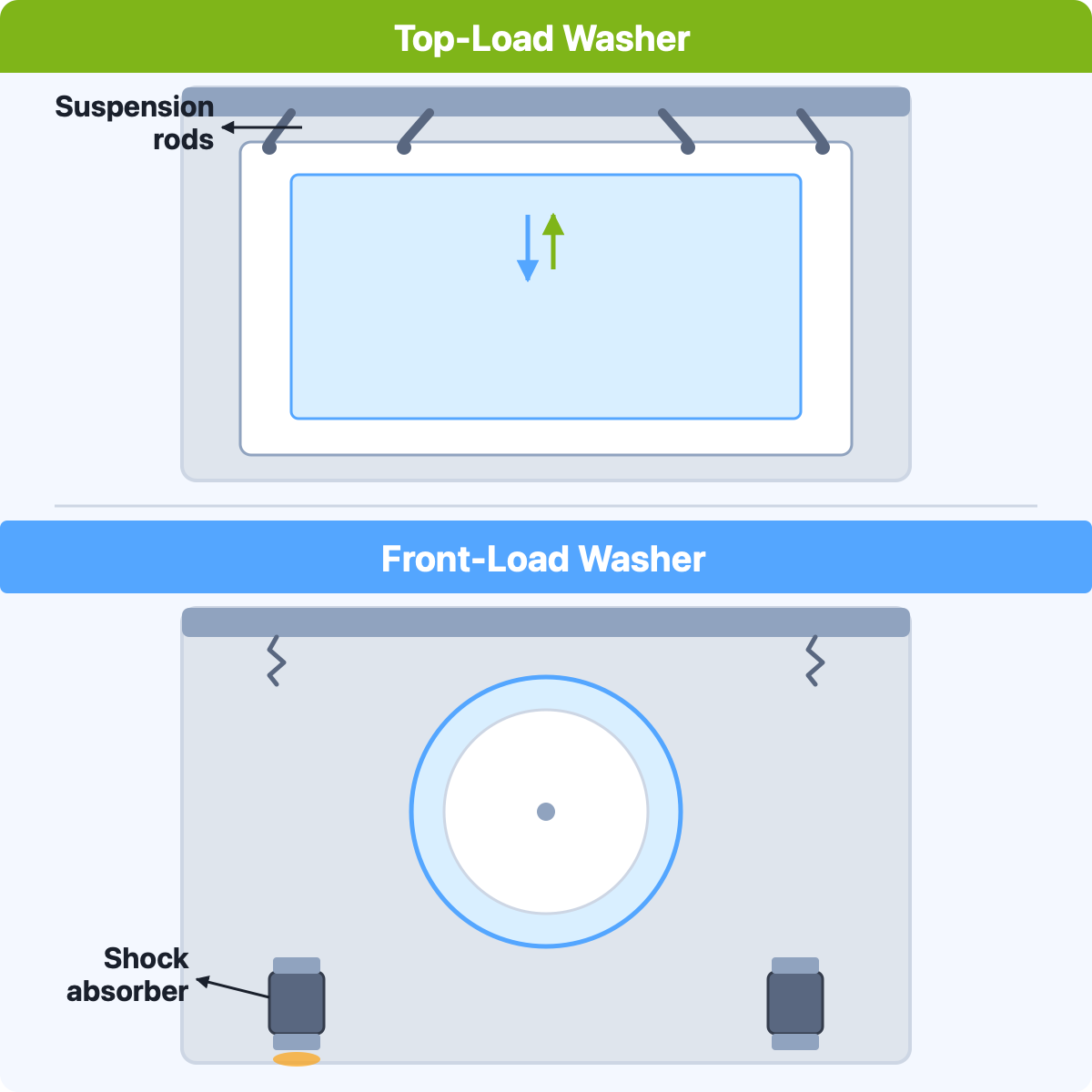
The top-loader vs front-loader suspension difference determines which diagnostic test runs first.
Three or four suspension rods hang from the cabinet frame to the outer tub. Worn rods are the most common mechanical cause on top-loaders.
Two to four hydraulic shock absorbers connect the outer tub to the base frame. Shipping bolts are a front-loader-only cause; shock absorbers are the first mechanical suspect.
Load imbalance is the first thing to check because it is the most common fixable cause; most cases where a washer shakes during spin cycle clear after redistributing the load at no cost. When a single heavy item shifts to one side, spin cycle imbalance creates outward force that grows with every additional RPM and can make the entire cabinet walk across the room.
When laundry bunches to one side of the basket, the force from that offset mass grows with the square of drum speed, manageable at wash speed and violent at peak spin. The machine can handle a small imbalance at lower RPMs but loses that margin as the drum accelerates to its final speed.
Stop the cycle, rearrange heavy items so each has similar-weight laundry opposite, and restart; a balanced load quiets down within thirty seconds. Samsung top-load high-efficiency washers have a built-in rebalancing step before peak spin; a slow tumble before the high-RPM phase is normal, not a fault.
An unlevel machine rocks where floor contact is inconsistent. In post-WWII neighborhoods like Lakewood and Westminster, wood subfloors flex under machine weight; this wood subfloor flex amplifies tub vibration at spin frequencies. Anti-vibration pads under each leveling foot reduce floor coupling without mechanical adjustment.
Press each corner of the machine’s top panel with the machine unplugged and stopped; any corner that rocks confirms that leveling foot lacks floor contact. This is the four-point leveling check. Check with a bubble level front-to-back and left-to-right: passing is within a quarter bubble of center.
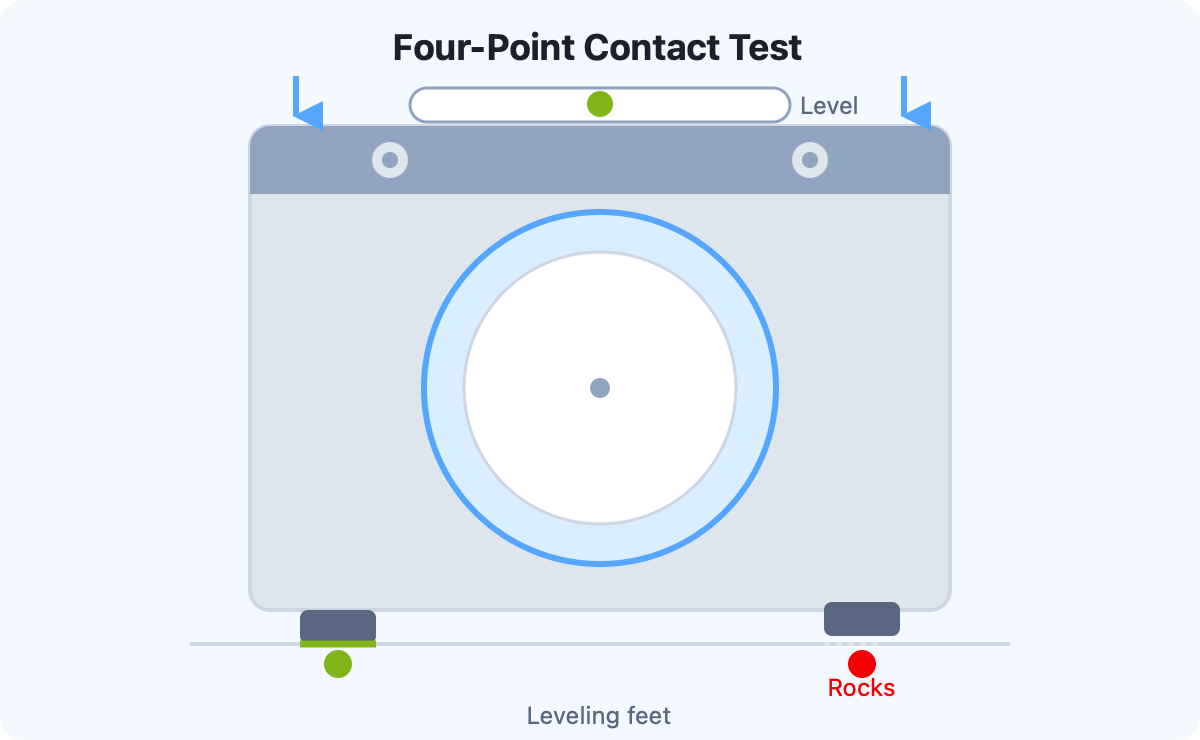
Each foot threads into the base and locks with a nut. Unplug the machine first:
The shipping bolt installation trap catches most new front-load washer owners: washers ship with steel transit bolts through the rear panel into the outer tub. Maytag warns that the bolts must come out before first use to avoid serious vibration, noise, and potentially permanent damage. With those bolts holding the tub rigid against the frame, the centrifugal force has nowhere to be absorbed, and washing machine banging during spin cycle follows from the first load.
Worn suspension rods or shock absorbers are the most common mechanical cause of violent shaking on machines more than five years old, with each component type specific to one loader design.
A plastic cup at the base of each rod wears down over time, and when it does, the outer tub can swing further on every spin before anything stops it. A Frigidaire or Electrolux top-loader runs three rods in a triangular arrangement; a top load washer shaking during spin cycle that worsens over weeks usually points here.
Run the suspension rod bounce test: unplug the machine, push the center of the tub straight down, and release. A working set bounces once and returns to center; a worn set oscillates multiple times. LG owners who notice an LG UE code during spin may find worn suspension rods triggering that error.
A washer that starts walking across the floor during spin has usually already bent a leveling foot or strained a hose connection. Stop the cycle before you open the door to redistribute the load.
A GE front-loader mounts its shock absorbers at the lower corners of the base frame, and a Bosch front-loader is built the same way, with two to four fitted depending on the model. When absorber oil leaks past the piston seal, a front load washer shaking violently during spin follows. The first accessible sign is an oil stain on the finished floor under the front of the machine, and this test is not available if the machine sits in a laundry pan. A technician confirms failure with the shock absorber compression test after the panel is removed, and they replace in matched pairs.
Drum springs hold the outer tub; when one rusts or loses its hook, the tub sags and spin cycle imbalance begins. Dampening straps on some top-loaders serve the same role as suspension pads.
The balance ring is a fluid-filled counterweight that dynamically offsets the load mass. Rotate the inner tub slowly and listen for liquid sloshing inside the ring; silence on a machine that previously made that sound means the fluid is gone.
If suspension tests point to worn components, our washer repair service covers suspension rod and shock absorber replacement across Denver Metro. Book a washer diagnostic online.
Drum bearing failure produces a washer shaking and making loud noise: a deep grinding or rumbling under spin, sometimes with a tub sitting off-center at rest. The drum bearing grind test is to rotate the inner drum by hand and listen for grinding that increases under downward pressure.
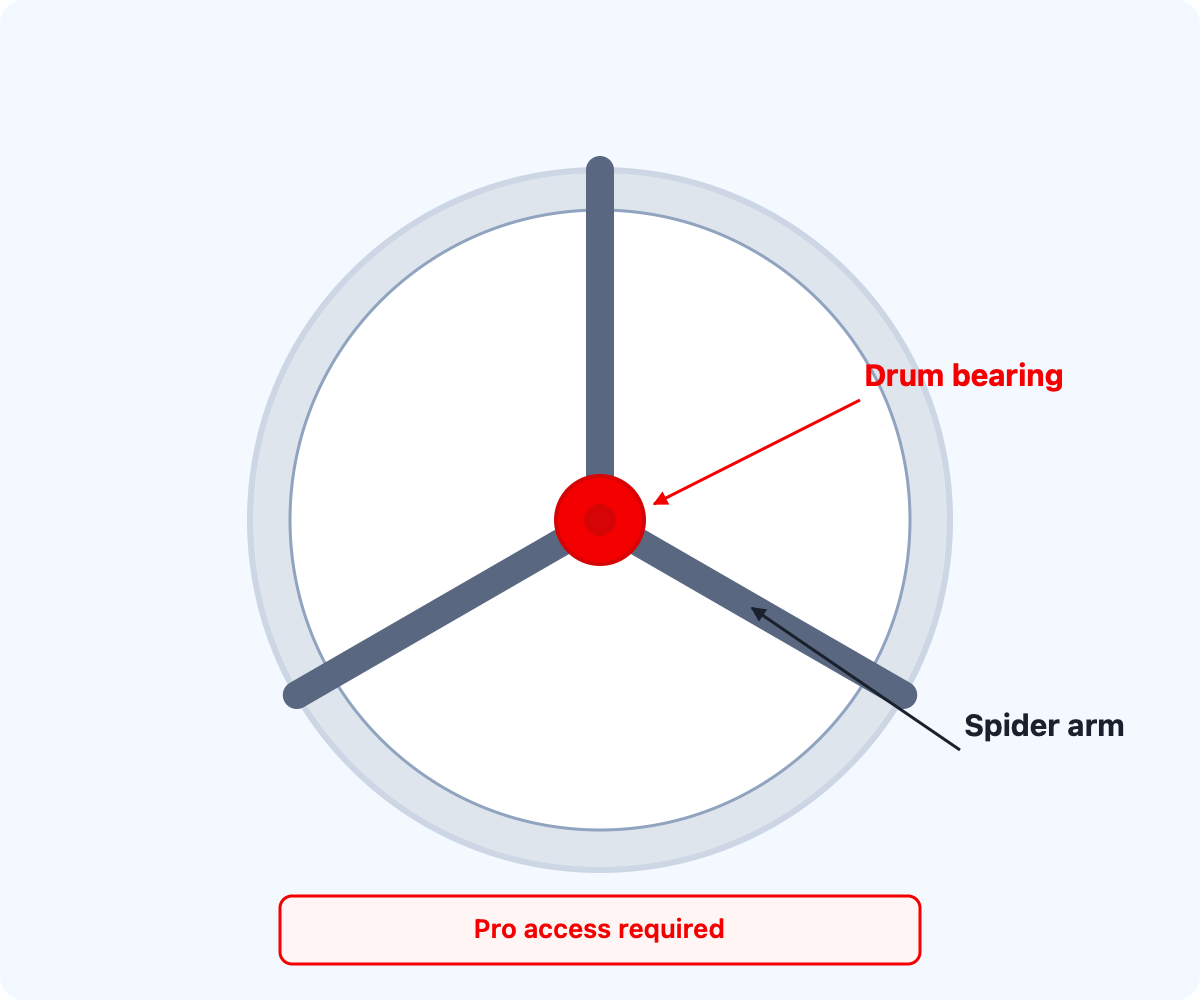
The spider arm connects the drum to the rear bearing shaft on front-loaders and cracks under heat and spin forces on machines past ten years. In my experience, drum bearing failure and spider arm cracking arrive together, because vibration from a failing bearing progressively stresses the spider until it fractures. The spider arm clicking sign is a clicking or rattle when you manually rotate the drum.
Stop using the machine. Maytag is unambiguous: any solution requiring disassembly should go to a qualified professional. A failing drum bearing frequently damages the tub seal, which is why water leaking from the bottom often accompanies shaking. A washer not draining also forces repeated heavy spin attempts that accelerate bearing wear.
Drum bearing failure, spider arm cracks, and suspension repairs requiring panel removal call for an insured technician; walking washer floor damage (bent feet, scored flooring, strained hoses) accumulates with each uncorrected cycle. Load redistribution, leveling, and shipping bolt removal are homeowner-resolvable; when those checks fail and the machine is still walking, the fault is inside.
Our insured technicians diagnose washer vibration across Denver, Lakewood, Westminster, and Highlands Ranch. We source parts through national supplier networks and manufacturer contracts. Book your washer repair visit online.
For Whirlpool and Maytag owners, see our Whirlpool washer repair and Maytag washer repair service pages. If your Maytag washer is also stuck in a sensing loop, the Maytag washer sensing guide covers that separately.
A washing machine shakes violently when centrifugal force at spin speed exceeds what the suspension can absorb. Seven causes cover nearly every case: load imbalance, improper leveling, shipping bolts left in front-loaders, worn suspension rods, worn shock absorbers, failed springs or balance ring, and drum bearing or spider arm failure. The first three are homeowner-resolvable at no cost.
Redistribute the load first: rearrange heavy items so nothing clumps to one side, and restart. If shaking continues, check all four leveling feet for solid floor contact and remove shipping bolts from front-loaders. When those checks fail, worn suspension components need a technician. That covers how to stop washer from shaking during spin and answers why does my washer shake so much on spin in most cases.
Some movement during spin is normal. Maytag puts the line clearly: a washer should not walk across the floor, and you should not hear thumping, banging or loud vibration. Light shaking that stays in place is the machine working. Movement that travels, or noise you can hear in another room, is a fault.
No. Can I use a washer that shakes violently? A washer walking across floor during spin bends leveling feet, scores flooring, and pulls on water-supply hose connections. Stop the cycle, work through this guide’s checks, and book service if the repair is beyond what you can do yourself.
An oil stain on the floor under the front corners of the machine is the first accessible sign, damping fluid that has leaked past the piston seal. If the machine is in a laundry pan, this test is not available there. No homeowner test reliably distinguishes absorber failure from normal drum bearing clearance, so a technician confirms with a compression test after panel removal.
Wilson and Myers insured technicians diagnose washer vibration issues across Denver Metro, from worn suspension rods to failed drum bearings. Book your service visit online.
Found This Helpful?
A gas smell during oven preheating is normal for about 90 seconds. Here is how Denver technicians tell routine startup odor from a real gas leak…
You walked into the laundry room and the display is flashing D80. The drum is still turning. You do not know whether to stop the cycle or let it finish. D80 is…
A GE refrigerator not cooling usually falls into one of two failure paths. The question is simple: is the freezer still cold? If yes, the sealed system is inta…
A gas stove clicking but not lighting follows one of three failure patterns. Each one has a different fix. Knowing which one applies tells you whether this is…
You pull open the freezer on a July evening and find an empty bin. A Frigidaire ice maker not working in peak summer is one of the most frequent calls our Denv…
The LG washer UE code means the machine detected an unbalanced load during the spin cycle and stopped to protect the drum and bearings. UE is protection not br…
Welcome to the community.
You'll receive our next expert update soon.

Wilson & Myers is a verified member of the Denver Metro Chamber of Commerce.

