

Need a Professional Hand?
If a DIY fix isn't enough, our insured technicians are just a click away. We’ll diagnose the issue and get your home running right again.
BOOK NOWFreezer Not Freezing: 7 Causes Your Tech Will Check First A freezer not freezing puts food safety on the clock. In most frost-free units, the culprit is a failed defrost system, not the compressor. A solid block of ice on the rear evaporator panel is the most common cause we find. This guide walks through all seven failure points in order of likelihood so Denver homeowners can act tonight or call a tech tomorrow.
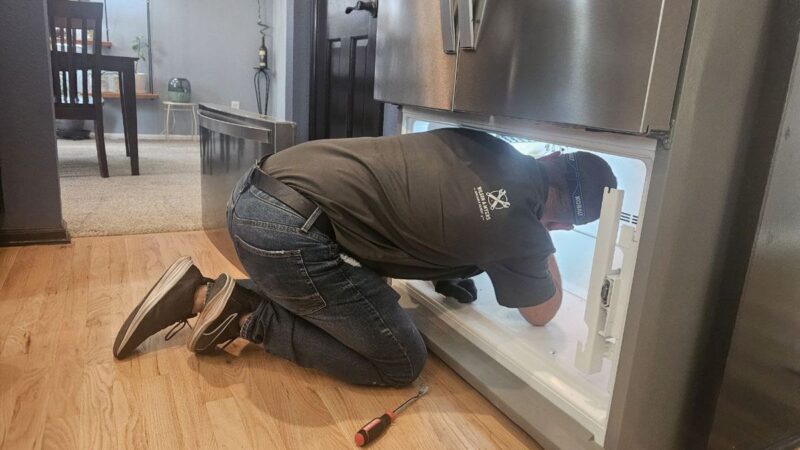
Confirm the temperature setting first. A freezer should sit at 0°F (-18°C). Someone bumping the dial explains more freezer won’t freeze calls than you might expect. Some Samsung units have a “cooling off” mode that can be accidentally activated, leaving the freezer not cold after power outage events or accidental button presses. Check the display and reset if needed.
Run the dollar bill test for door gasket integrity. Close the door on a dollar bill so the bill is half inside, half out. Pull the bill out. If it slides free without resistance, the door gasket has lost its seal and warm air is infiltrating on every kitchen pass.
Hold the door switch to test fan response. Most combo units kill the evaporator fan when you open the door. Hold that switch depressed with your thumb, then open the door and listen. No sound inside the freezer compartment means the fan motor may not be running, or ice has locked the blade.
If the freezer stopped working suddenly after a power outage, try unplugging for 60 seconds and restarting. A surge can trip the start relay or reset the control board.
A heating element wraps around the evaporator coils at the back of the freezer compartment. The defrost system fails first in combo units more often than any other component, making the compressor rarely the culprit when a homeowner calls about a warm freezer. Every 6 to 12 hours, a defrost cycle runs to clear frost buildup on the evaporator coils. When it fails, the ice-encased evaporator blocks all airflow. The unit climbs to 20-25°F, food thaws, and the compressor keeps running fine.
Disconnect the leads and test with a multimeter on resistance. Defrost heater reads 10-150 ohms when good, varying by model. Frigidaire and GE units typically read around 31 ohms. OL means an open circuit and the heater needs replacement. Replace the heater and the defrost cycle restores.
Nine times out of ten when a freezer stops freezing, it is the defrost heater or the evaporator fan, not the compressor. Check the back panel for ice buildup before you assume the worst. Alex Feldman, Senior Refrigeration Technician, Wilson & Myers
Samsung defrost heater failures show up regularly in Denver Metro Area homes. Samsung is known for evaporator ice buildup, and some models offer a forced-defrost mode activated by holding specific buttons simultaneously. Check your model manual for the button combination. For Samsung-specific steps, our Samsung refrigerator not cooling guide covers the full fault tree.
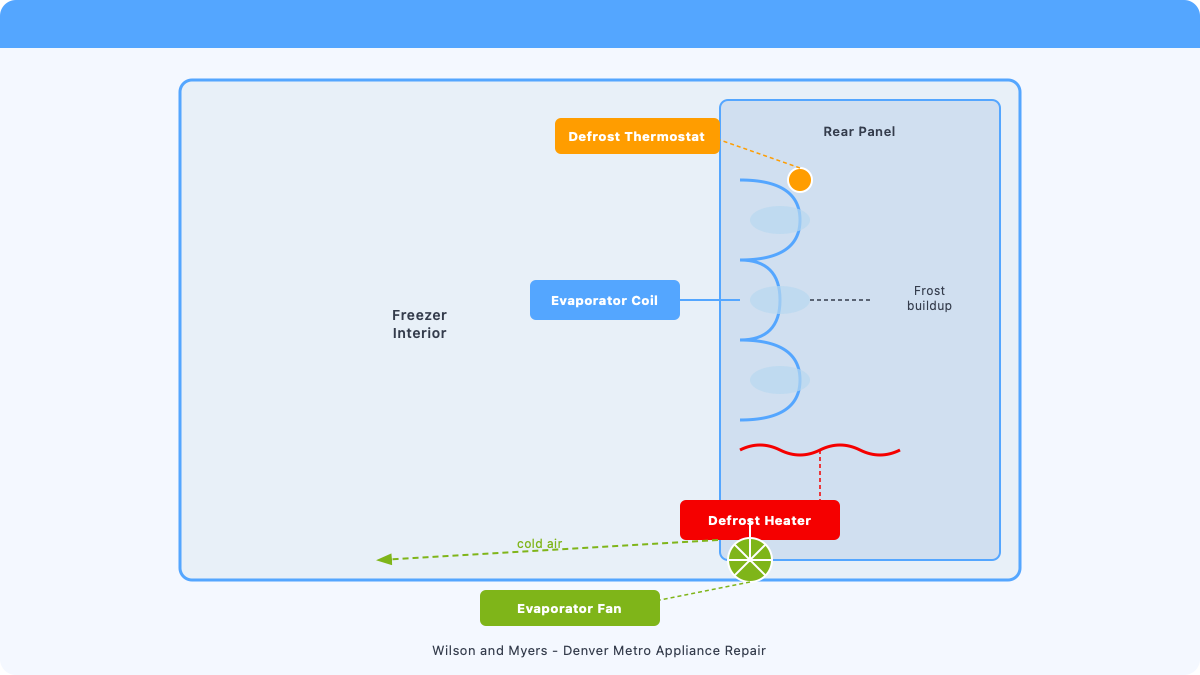
The bi-metal defrost thermostat cuts the heater off when the coil warms to roughly 40 to 60°F. Defrost thermostat closed at 0 ohms when cold is the passing test. Place the part in ice water, probe both terminals. OL while cold means it has failed open.
On modern units with adaptive defrost control, a thermistor reads temperature and sends that data to the control board to schedule defrost cycles. The thermistor reads 13000 ohms at 32F on most platforms. Values outside that range send bad data to the control board and corrupt the defrost schedule, causing frost buildup even when the heater itself is intact.
Turn defrost timer to diagnose it: insert a screwdriver into the timer slot and advance until the compressor stops and the heater activates. If the heater comes on but the timer never returns to cooling mode on its own, replace the timer. Whirlpool, Maytag, and KitchenAid units share the same appliance platform and see defrost timer failures alongside evaporator fan issues more than other components. Modern units use an adaptive control board with a thermistor instead of a mechanical timer.
The evaporator fan circulates cold air from the evaporator coils through both the freezer and refrigerator compartments. When the motor fails, no cold air moves even if the compressor runs fine. The unit warms, the fridge may stay marginally cool by convection, and freezer not freezing food becomes the symptom within 24 hours.
Hold door switch to test fan while the door is open. Most combo units kill the fan when the door opens. Hold that switch in with your thumb to simulate a closed door, then open the door and listen. Silence means the motor has burned out, the blade is ice-locked, or the door switch has failed. Unplug the unit, access the motor behind the rear freezer panel, and test continuity on the motor terminals. OL means replacement. Our LG fridge not cooling guide covers the LG-specific evaporator fan diagnostic for 2016-2020 models affected by the Linear Compressor warranty program.
Condenser coils release the heat absorbed from inside the freezer. Coated in dust and pet hair, they cannot dissipate heat efficiently. The compressor runs longer, the refrigerant stays too warm, and the unit goes from freezing cold to freezer not cold enough over weeks. No sudden freeze-stop; just a slow drift toward failure.
On most modern combo units the condenser coils hide behind the kick plate at the base. Unplug, pull the plate, and vacuum with a brush attachment. Condenser coils clean every 6-12 months is the standard guideline. Denver altitude context: lower air density makes the evaporator fan work harder, and dry Colorado static electricity binds pet hair to condenser coils faster than humid climates. Pet households in Denver Metro Area often need cleaning every three to six months. Our Sub-Zero freezer not working guide covers the condenser cleaning procedure for Sub-Zero units.
A cracked door gasket lets warm, humid air infiltrate continuously. Frost builds faster than the defrost cycle can melt it, and the temperature rises above 0°F. Dollar bill test for door gasket: close the door on a bill and pull it. Slides free at any point around the perimeter means the seal has lost its grip. A leaking door seal can also produce condensate at the unit base. If you have seen water pooling alongside the freeze issue, our refrigerator leaking water guide covers the door seal connection to condensate problems.
Gaskets are model-specific parts. Warm the new gasket in warm water before installation. A cold, stiff gasket will not seat properly and the seal failure recurs.
The start relay helps the compressor motor overcome startup load. When it fails, the compressor tries to start, trips off, and tries again. Every two to five minutes: click, brief hum, silence. Replace it. The unit won’t maintain temperature because no refrigerant circulates.
Shake test identifies failed start relay immediately. Unplug, pull the relay from the compressor terminal, and shake. A rattle means an internal component has burned loose. That sound is the relay dying. No rattle but no continuity between the run and start terminals on a multimeter also means failure. Start relays are inexpensive and replaceable by most homeowners with the correct model-specific part.
The cold-control thermostat signals the compressor when to cycle on and off. This is the user-facing temperature sensor, distinct from the defrost thermostat. When it fails, the compressor runs too infrequently and the freezer not cold enough complaint builds. Modern refrigerators replace the mechanical cold-control with a main control board that processes temperature sensor data and manages all cooling functions. Samsung and LG units display error codes on the panel when the board detects a fault. Inspect the board for burn marks or swollen capacitors. Control board replacement warrants a technician visit.
Compressor failure is the most expensive scenario, and the compressor is rarely the culprit in a frost-free freezer not working call. Age matters less than the failure type. When it fails, the unit is completely warm. Its body feels cold to the touch (not running) or excessively hot (running without refrigerant flow), and none of the defrost or fan tests point elsewhere. A refrigerant leak sometimes leaves an oily residue near the compressor connections.
Refrigerant handling requires an EPA-608 certified technician. Do not attempt to open refrigerant lines yourself.
Sub-Zero dual compressor note: Sub-Zero has two independent compressors, one for the freezer and one for the refrigerator. A freezer failure in a Sub-Zero does not involve the fridge compressor at all. These are separate sealed loops. Most generic repair guides skip this distinction, but it matters significantly for repair scope on premium appliances. Our Sub-Zero freezer guide covers the dual-compressor architecture in full.
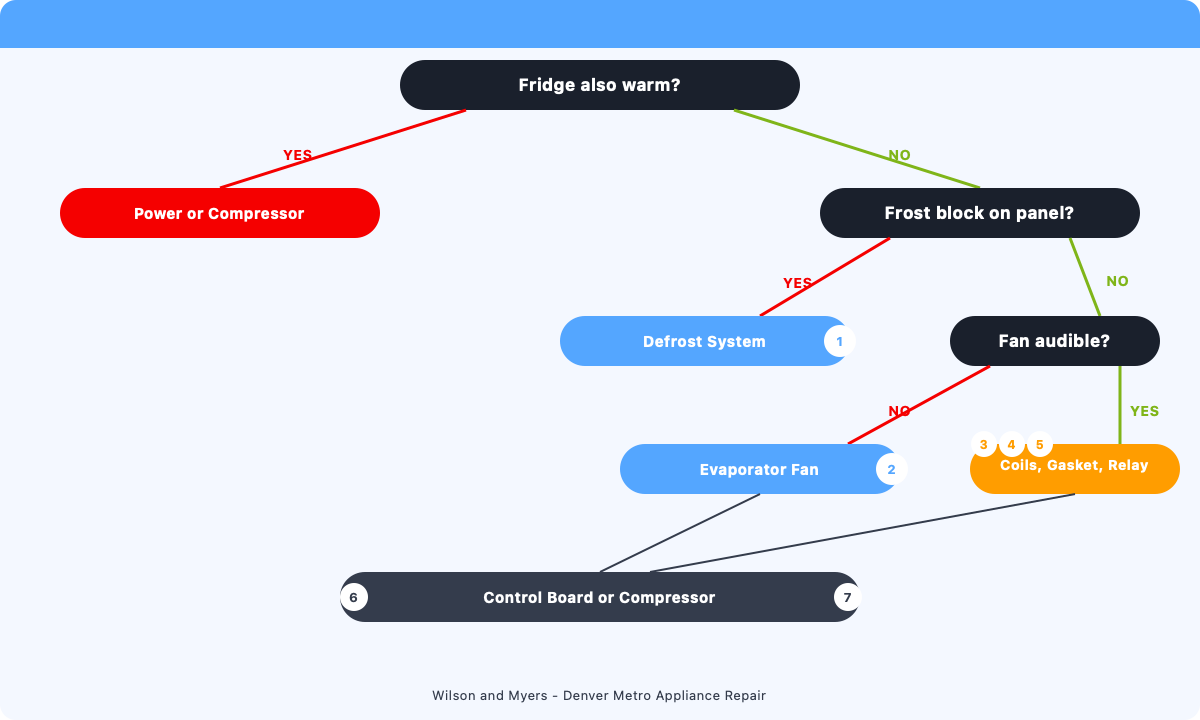
The fridge is cold. The unit is soft. This symptom is the textbook presentation of defrost system failure or evaporator fan failure in a combo unit. Cold air originates in the freezer compartment and moves to the refrigerator through the shared evaporator fan. When the ice-encased evaporator blocks all airflow, the freezer loses cooling first. The refrigerator stays marginally cool because some cold air sinks by convection. Freezer not freezing but refrigerator works points directly to causes 1 and 2 on this list.
Chest freezer has no defrost heater. Manual-defrost chest freezers have no heater to fail, so chest freezer not freezing points to the compressor, start relay, or temperature control thermostat. Upright freezer not freezing in a standalone unit follows the same logic, with the addition of possible evaporator fan failure if the model is frost-free. For Whirlpool and Maytag owners, our Whirlpool refrigerator not cooling guide covers the combo-unit failure modes for those platforms. LG owners can cross-reference our LG refrigerator ice maker not working guide for cold-side context on LG units.
The repair vs replace framework ties two variables: what failed, and how old the unit is. Failure type drives decision more than age alone. Freezers and combo refrigerator-freezers typically last 10 to 15 years. The major-repair threshold is around 8 to 10 years.
Defrost heater or evaporator fan failure at year 12: worth repairing. Parts are inexpensive and the sealed system remains intact. A compressor failure on a 10-year-old mid-range unit: compare repair cost to replacement, because compressor replacement is the most expensive single repair in the sealed system. LG Linear Compressor units from 2016 to 2020 had documented widespread failures with extended warranty coverage on many models. Check coverage before approving a repair on those units.
For Sub-Zero and other premium appliances, the calculus shifts. These units are built for 20-plus-year service lives, and sealed-system repairs on a 12-year-old Sub-Zero are often the right financial choice. Replacement cost for premium appliances easily exceeds compressor repair cost on a well-maintained unit. If that solid ice block on the evaporator panel turned out to be a defrost heater failure, you are looking at the most common and most repairable freezer fault we see in Denver Metro homes.
Wilson & Myers handles freezer repair across all seven failure types. We source parts through national supplier networks and manufacturer contracts. For refrigerator-side failures occurring alongside a freezer issue, our refrigerator repair page covers that scope.
The most common reason a freezer stops freezing in a frost-free unit is defrost system failure. When the heater, thermostat, or timer in that circuit fails, frost builds on the evaporator coils, airflow stops, and freezer temperature climbs above 0°F. Evaporator fan motor failure is the second most likely cause. Compressor failure is possible but the compressor is rarely the culprit in a frost-free unit.
Start with three checks tonight: verify the temperature setting is at 0°F, run the dollar bill test on the door seal, and hold the door switch to test evaporator fan operation. If a frost block on the rear panel is visible, unplugging for 24 to 48 hours can restore temporary cooling. The underlying defrost system component still needs repair to prevent recurrence.
In a combo fridge-freezer, the evaporator coils and fan serve both compartments. Defrost system failure ices over the coils in the freezer first. The refrigerator stays cool by convection. The fridge feeling cool is not evidence the system is healthy. Refrigerator working but freezer not freezing is the textbook sign of defrost system failure or evaporator fan failure. This is a common cold-side failure pattern we see across brands.
Sudden freeze-stops point to start relay failure, a power-outage event, or an ice-locked evaporator fan blade. A start relay failure produces the click-restart-click pattern every two to five minutes. After a power outage, unplug for 60 seconds and restart. If the freezer stopped freezing with no clicking and no recent outage, pull the rear panel and check for a frost block on the evaporator coils.
A failed compressor leaves the unit completely warm, not just the freezer. Its body feels cold (not running) or excessively hot (running without refrigerant flow). A click-restart-click pattern every few minutes points to the start relay rather than the compressor itself. A frozen-solid evaporator coil with the compressor running normally points to the defrost system, not compressor failure.
Failure type drives decision more than age alone. A defrost heater or evaporator fan motor failure is worth repairing even on a 12-year-old unit. A compressor failure on a unit older than 10 years warrants a cost comparison with replacement. Sub-Zero and premium appliances are built for 20-plus-year lifespans; sealed-system repairs on those units are almost always the right financial choice.
A freezer should hold 0°F (-18°C). A unit running at 10 to 20°F may feel cold but is not cold enough to keep food safely frozen over time. If your thermometer reads above 0°F and food is soft or partially thawed, follow the USDA guideline: food held above 40°F for more than four hours should be discarded.
Unplug the unit from the wall outlet and wait 60 seconds. This resets the control board and clears temporary fault states. Plug it back in; most units take 24 hours to return to target temperature from a warm state. Samsung models with adaptive defrost boards may also respond to a forced-defrost mode. Consult your model manual for the button combination, as Samsung varies the sequence across generations.
Wilson & Myers provides freezer repair across the Denver Metro Area, including Denver, Boulder, Lakewood, Aurora, Littleton, Englewood, Sheridan, Wheat Ridge, Edgewater, Golden, Arvada, Westminster, Thornton, Northglenn, Commerce City, Brighton, Castle Pines, Castle Rock, Broomfield, Superior, Louisville, Lafayette, Longmont, Erie, Centennial, Greenwood Village, Cherry Hills Village, Glendale, Parker, Highlands Ranch, Lone Tree, and Morrison. Book online or call to confirm availability in your area.
From defrost heater and fan motor faults to sealed-system repairs, Wilson & Myers handles all seven causes. We source parts through national supplier networks and manufacturer contracts.
Found This Helpful?
A residential dishwasher leaking from bottom rarely fails where the dishwasher puddle on floor tiles appears. Pull the kick panel; the highest wet surface mark…
It is a week before Thanksgiving, and you set the oven to 350 degrees before starting the stuffing. Forty minutes later, the preheat signal fires. That is roug…
You opened the KitchenAid freezer this morning and the bin was empty. In my experience, the arm is the first thing worth checking: the fix costs nothing and ta…
Has your refrigerator water dispenser stopped delivering water? In my experience, a large share of these calls end before a technician arrives. A child lock ac…
You open the dishwasher after the cycle and the plates look exactly as you loaded them: dry, cold, with last night's dinner still caked on. Your dishwasher is…
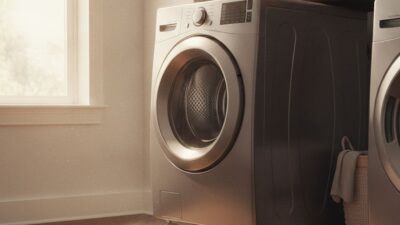
A washer that shakes violently during spin traces to one of seven causes, from a bunched load to a failed drum bearing. Here is the order to check them, and th…
Welcome to the community.
You'll receive our next expert update soon.

Wilson & Myers is a verified member of the Denver Metro Chamber of Commerce.


