


Need a Professional Hand?
If a DIY fix isn't enough, our insured technicians are just a click away. We’ll diagnose the issue and get your home running right again.
BOOK NOWEach path leads to a different set of causes and a different repair. Start with that question and this guide does the rest.
If your refrigerator is running too cold and freezing food instead, that is the opposite problem, covered in our refrigerator freezing food guide.
The single biggest mistake homeowners make is assuming a warm fridge means the whole system failed. Half the time, the freezer is still cold and the fix is an inexpensive fan motor or a low-cost relay.
Alex Feldman, Senior Refrigeration Tech, Wilson & Myers
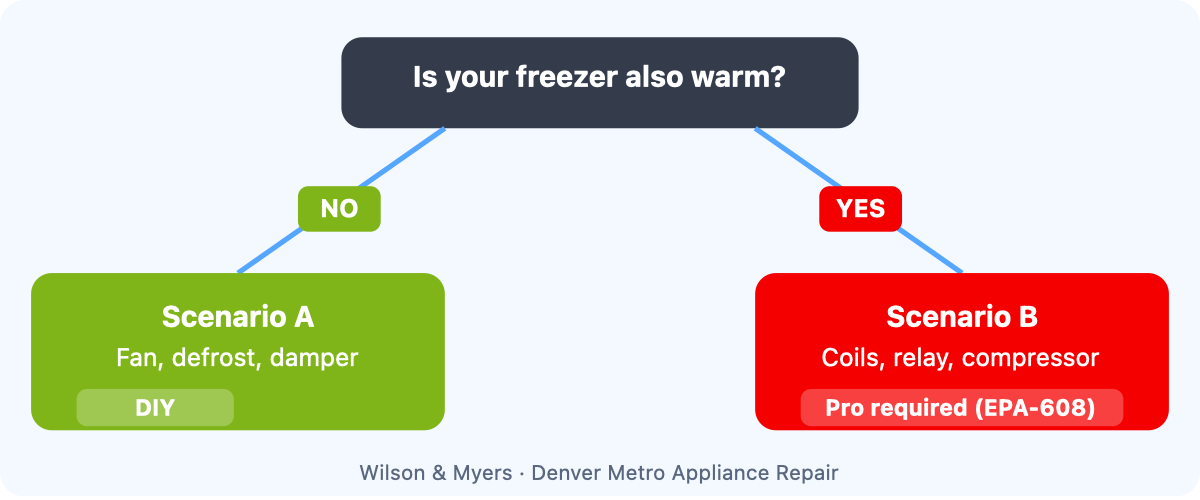
A fridge not getting cold, or a refrigerator not getting cold at all, may not need a repair. Three free checks resolve about one in five service calls before any component is touched. Work through these in order before opening any panels.
1. Evaporator fan motor (most common)
2. Defrost system frost-over
3. Blocked air vents or stuck damper
4. Thermistor failure
When only the fridge is warm and the freezer stays cold, this fridge warm freezer cold scenario is the most counterintuitive failure pattern we see. Four causes account for almost every Scenario A call, and the 60-second diagnostic split at the top of this guide narrows them down in under a minute. Both compartments share the same cooling source but rely on a separate fan and airflow path to keep the fresh-food side cold. When that path is interrupted, the freezer stays cold while the fridge warms to room temperature.
The evaporator fan behind back panel of the freezer compartment pushes cold air through a duct into the fridge section. That fan motor drives the entire airflow path between the two compartments. When the motor burns out or the fan blade jams on a frost buildup, cold air stops reaching the fresh-food side. The freezer may still feel cold because the evaporator coils are right there, but the fridge warms steadily.
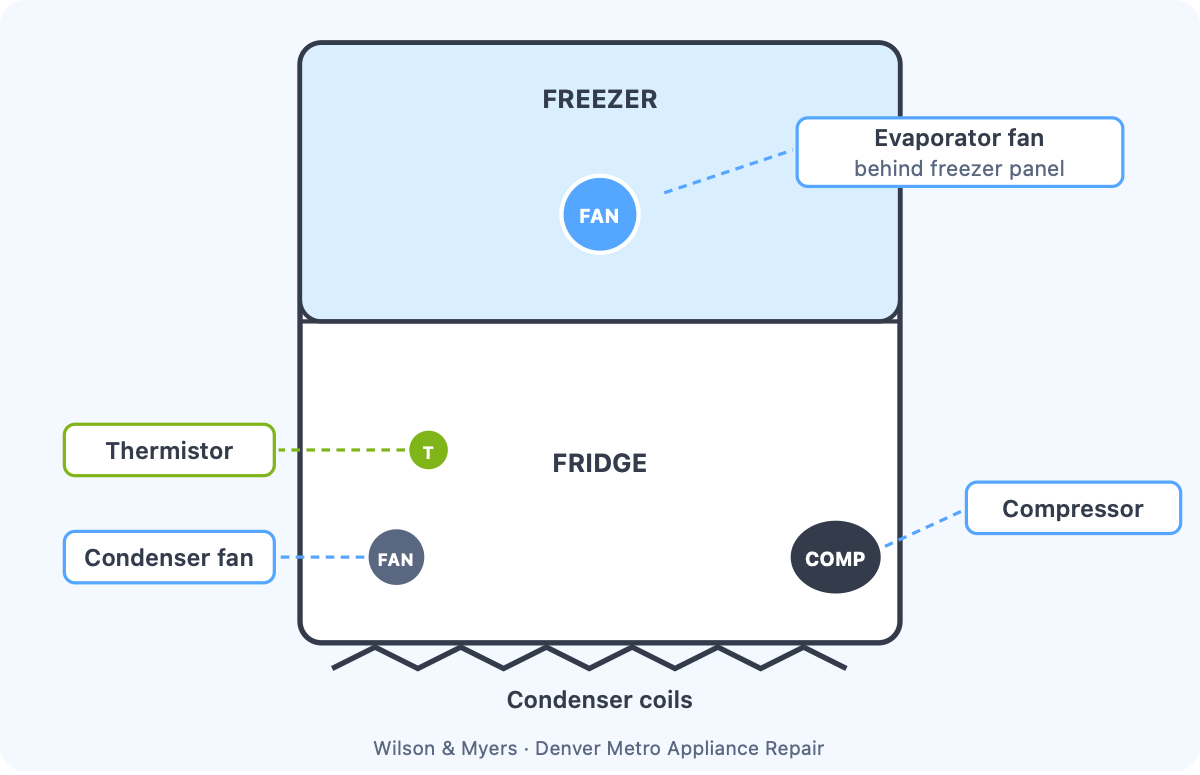
Open the freezer and depress the door switch manually. You should hear a hum and feel airflow from the back panel. Silence means the fan is not running, which is usually a motor replacement requiring the back panel and wiring harness. If you have a Whirlpool, our Whirlpool refrigerator not cooling guide covers model-specific steps for this exact failure.
A thick layer of frost on the evaporator coils behind the freezer back panel blocks cold airflow just as completely as a dead fan motor. The defrost system is supposed to prevent this by melting ice automatically several times per day. When the defrost heater, defrost thermostat, or defrost timer fails, that ice builds up unchecked.
Look for frost on back wall of freezer sections: that visible ice coat tells you the auto-thaw cycle has failed. Defrost heater resistance for a healthy unit runs typically 50 to 120 ohms; outside that range, the heater is done. Manual defrost 24 to 48 hours, with the fridge unplugged and doors open, will temporarily restore cooling.
If the freeze-up returns after a few days, the defrost system needs proper repair, not just another manual thaw. A refrigerator leaking water from the drain pan area is another sign the defrost drain is blocked, which often accompanies this failure. See our refrigerator leaking water guide if you are seeing pooling water alongside the temperature problem.
A damper stuck between freezer and fridge compartments controls how much cold air flows from the freezer side into the fresh-food section. On most models it sits at the junction between the two compartments, either at the top of the fridge section or along the shared wall. When it gets stuck closed or frozen shut with a layer of ice, the fridge section receives little or no cold air.
The fix depends on what caused it to stick. A frozen damper often clears with manual defrost. A mechanically failed damper needs replacement.
Inspect the air vents on the back wall and ceiling of the fridge section first. If they are packed with frozen debris or sealed with ice, that is your culprit before you suspect the damper itself.
The thermistor is the temperature sensor that tells the control board how cold the fridge section actually is. At room temperature, a healthy thermistor reads roughly 10,000 to 11,000 ohms. When it fails, it sends a false reading to the board, which responds by not calling for additional cooling even when the section is warm.
Verifying thermistor resistance room temperature values correctly requires a multimeter and the tech sheet for your specific model. If the other Scenario A causes have been ruled out and the freezer is clearly still cold, thermistor failure is what to suspect. This is almost always a pro repair.
1. Dirty condenser coils (easiest DIY fix)
2. Condenser fan motor
3. Start relay (shake test DIY)
4. Compressor or sealed system (EPA-608 required)
5. Control board
When fridge and freezer not cooling is your situation, the compressor or its supporting components have stopped doing their job. No cold air is being generated anywhere in the unit. This path has more DIY-accessible fixes than Scenario A, and the easiest one to try first costs nothing.
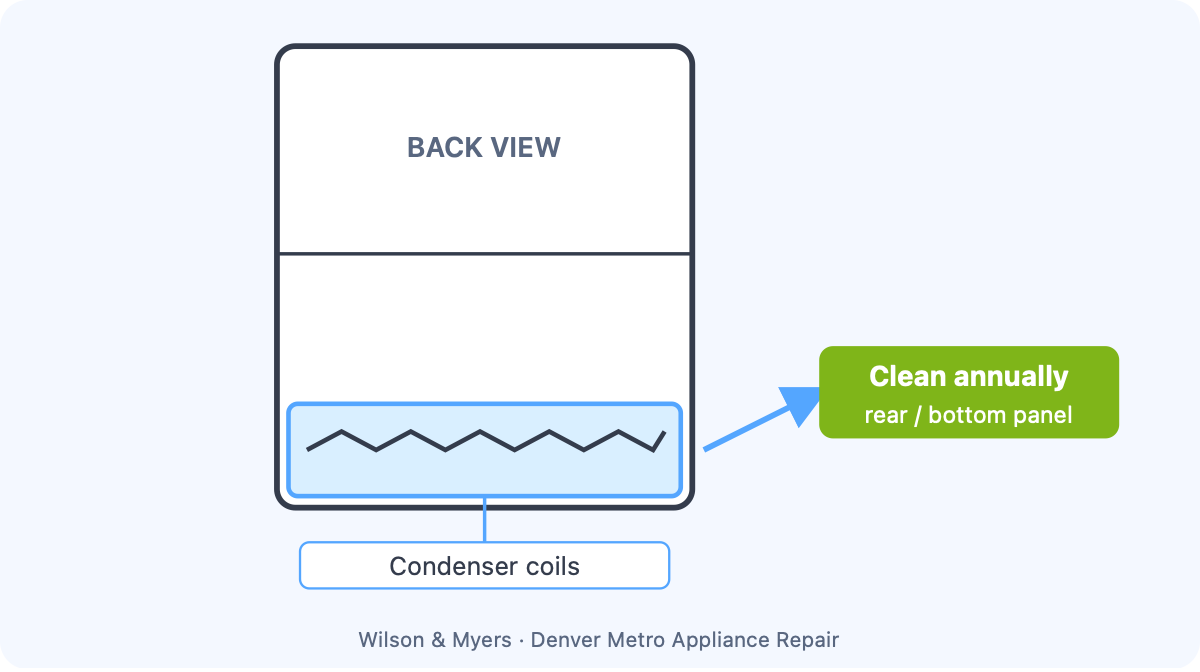
Heat from the refrigerant circuit has to go somewhere, and these coils are what release it. They sit at the back of older units as an exposed grid or along the bottom-front behind the kick plate on newer units. When coated with dust, pet hair, and lint, they cannot shed heat efficiently. The compressor overheats and shuts down on its thermal protector, leaving both sections warm.
Condenser coils dust buildup is the single most common DIY-fixable cause of a refrigerator stopped cooling. Pull the fridge six inches from the wall. If you see a thick gray or brown mat on the coils, that is the problem.
A vacuum with a brush attachment plus a coil brush clears them in under 20 minutes. Annual cleaning prevents this entirely. Denver Metro summer heat makes dirty coils fail faster because the kitchen ambient temperature pushes the condenser harder.
At the rear bottom of the unit, this fan pulls air over the condenser coils to help them shed heat. The condenser fan pulls air over coils continuously when the compressor runs, so if the motor fails, the coils overheat even when they are clean. Spin the fan blade manually with the fridge unplugged. It should rotate freely.
If it is stiff, the motor bearings are worn. Plug the fridge back in and listen: the fan should run whenever the compressor runs. No sound from that area when the compressor is running means the motor is done.
Replacement requires pulling the rear access panel, disconnecting the motor leads, and swapping the motor. Most brands have the motor held by two to four screws.
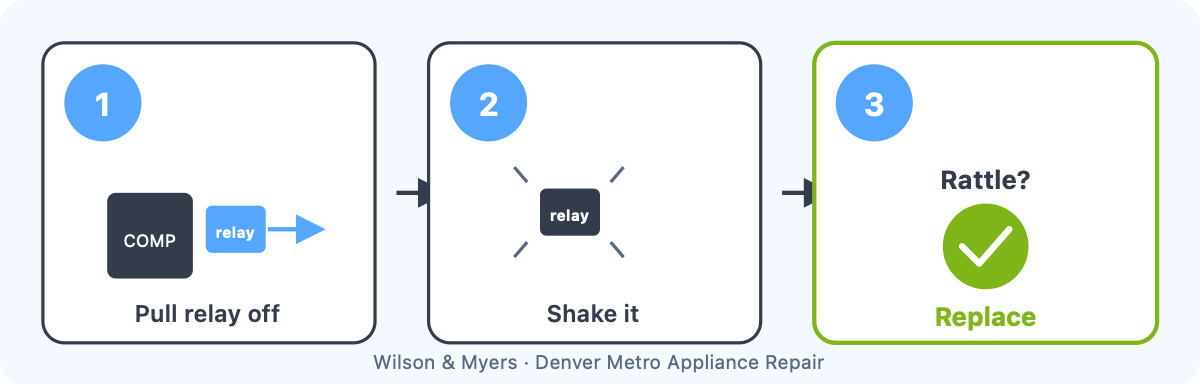
A matchbox-sized component plugged into the side of the compressor, its job is to kick-start the motor each time the cooling cycle begins. When it fails, the compressor never starts, and the refrigerator running but not cooling pattern emerges on models where the compressor motor spins slightly before stalling.
The start relay shake test is the fastest diagnostic in refrigerator repair. Pull the unit from the wall, reach behind to the compressor, and remove the relay by sliding it off the compressor terminal. Shake it next to your ear. A rattle means the internal components have broken apart; a silent relay is healthy.
Replacement is inexpensive and takes about five minutes. We see this repair on Frigidaire, GE, Whirlpool, and Samsung units frequently, though a failed relay can occur on any brand. For LG-specific behavior around the start relay and the linear compressor system, see our LG fridge not cooling guide.
The compressor is the pump that circulates refrigerant through the sealed system. A compressor warm not hot to the touch, humming steadily, is operating normally. Stone cold and silent means it is not running at all.
One that burns hot and cycles off every few minutes is overheating, which indicates a sealed system problem. Refrigerant leaks fall into this category too. Signs include the compressor running continuously but unable to cool, and sometimes an oily residue on the coils or tubing where the leak has occurred. Both sections warm compressor calls are the primary reason Denver Metro homeowners need to book a diagnostic rather than attempt a DIY fix.
Sealed-system work on a compressor or refrigerant circuit falls under EPA Section 608, which restricts this work to licensed technicians. This is federal law, not a preference.
Sub-Zero sealed systems require manufacturer-specific procedures that differ significantly from standard residential brands. Our Sub-Zero refrigerator not cooling guide covers the sealed-system diagnostic path for that brand. Samsung owners with compressor-related symptoms should check our Samsung refrigerator not cooling guide for model-specific context. GE owners should check our GE refrigerator not cooling guide for model-specific context. Frigidaire owners should check our Frigidaire refrigerator not cooling guide for model-specific context.
Defrost cycles, fan timing, compressor starts, and temperature regulation all run through this single board. When it fails, any or all of those systems can stop responding. A control board failure usually shows up as erratic behavior before total cooling loss: fans cycling at wrong intervals, defrost running constantly, or compressor not starting even with a good relay and clean coils.
Diagnosing the board requires ruling out every other component first. Replacement boards are proprietary to each brand and model, and programming requirements vary. This is firmly in professional repair territory.
Clean the condenser coils if they are dirty. This is the highest-return DIY action in refrigerator repair. Pull the fridge out, vacuum the coils at the back or remove the kick plate at the front-bottom, and brush the debris free. A clean coil set restores cooling in two to four hours if that was the only problem.
Run the start relay shake test next. If the relay rattles, replace it. We source parts through national supplier networks and manufacturer contracts, but a relay is also available at most appliance parts stores or online by searching the model number.
Check the door seal using the dollar bill seal test: close a dollar bill in the door and pull. Resistance should be firm. If the bill slides out easily, the gasket is weak and warm air is leaking in. Rearranging food to clear the air vents costs nothing and takes two minutes.
Manual defrost is worth trying if frost on the back wall of the freezer is visible. Unplug the fridge, remove all food to coolers, leave the doors open, and give it 24 to 48 hours. Put towels at the base for the melt water. If cooling returns after the defrost, the defrost system has failed and will need professional repair before the frost builds back up.
Any work on the sealed refrigerant system is legally restricted to EPA-608 certified technicians under EPA Section 608. Refrigerant venting is a federal violation, not just a safety risk. Compressor replacement falls into this category. So does any refrigerant leak repair, refrigerant recharge, or evaporator coil replacement on a sealed system.
Control board replacement and evaporator fan motor replacement are not legally restricted, but the wiring complexity and proprietary part programming make them better suited to a tech on most models. If you have ruled out condenser coils, start relay, power, and settings, book a diagnostic. At that point every remaining cause on this list requires tools or professional expertise that goes beyond DIY range.
Denver Metro Area summers run warmer every year, and your refrigerator feels it. Denver summer heat amplifies every cause on this list: dirty coils that would have limped through winter hit their limit by July. Condenser coils that are 60 percent clogged may keep the fridge cold enough through March. By July, when ambient kitchen temperatures push into the upper 70s and 80s, those same coils hit their thermal limit.
The compressor overheats, trips its protector, and the whole unit warms in a matter of hours. Summer is the single peak period for refrigerator not cooling calls in the Denver Metro Area, and the cause is condenser coils in most cases.
A refrigerator not cold enough to keep food safe, rather than completely failing, is the most common heat-season pattern. The coils are working but barely. Clean them now before a hot weekend turns a partial problem into a full failure with a fridge full of food at stake.
Evaporator fan and defrost system failures also accelerate during summer because the unit is running longer cycles to compensate for ambient heat, putting more hours on components that may already be aging.
Wilson & Myers provides appliance repair across Denver Metro Area, including refrigerator repair and freezer repair for standalone units. Our service area covers Denver, Lakewood, Aurora, Littleton, Englewood, Arvada, Westminster, Thornton, Centennial, Highlands Ranch, Parker, Castle Rock, Broomfield, Superior, Louisville, Lafayette, Longmont, Erie, Brighton, Commerce City, Northglenn, Wheat Ridge, Edgewater, Golden, Cherry Hills Village, Greenwood Village, Glendale, Lone Tree, Sheridan, Boulder, and Morrison. Our insured technicians handle every major brand from Whirlpool and GE to Sub-Zero and LG. Book online to schedule your diagnostic visit.
When only the freezer is affected and the fridge compartment is fine, see our separate freezer not freezing guide for that specific symptom path.
A refrigerator not cooling traces to one of two scenarios. If only the fridge section is warm while the freezer stays cold, the evaporator fan motor or defrost system is the most likely cause. If both sections are warm, start with condenser coils, the start relay, and then the compressor. Identify which scenario you have first, and the cause list narrows immediately.
The four most common causes when my fridge is not cooling are a failed evaporator fan motor, frost blocking the evaporator coils, a stuck damper, and a failed start relay. Check the freezer temperature first. That freezer question splits the diagnostic tree and immediately rules out half the causes on this list.
Fridge not cooling but light is on means the power supply is intact; the failure is in the cooling components, not the electrical circuit. A lit interior confirms the fridge has power and rules out a tripped circuit breaker or dead outlet. Pull the start relay from the compressor, shake it, and listen for a rattle. A rattling relay is the fastest and least expensive fix to try first.
How to fix refrigerator not cooling depends on which scenario you have. Start with the free checks: reset the circuit breaker, verify temperature control settings, clear any blocked air vents, and power-cycle the fridge. If it is still warm, clean the condenser coils and run the start relay shake test. Those five steps resolve roughly half of all refrigerator not cooling calls without a service visit.
Refrigerator running but not cooling means the compressor is operating but the sealed system cannot build enough pressure to produce cold, or a heavy frost-over on the evaporator coils is blocking all airflow. If the compressor hums and the unit runs but neither section cools, this is almost always EPA-608 territory. Sealed-system pressure loss requires a certified technician with recovery equipment.
Fridge not cooling but freezer works means cold air is being generated but not reaching the fresh-food section. The evaporator fan motor is the most likely cause: it moves cold air from the evaporator coils through the duct into the fridge. A defrost system failure that allows frost to build up on the evaporator coils will block that same airflow. A stuck damper or a failed thermistor can also produce this pattern.
Yes, fridge and freezer not cooling together, or refrigerator and freezer not cooling at the same time, has a completely different cause set than fridge-only warm. When both sections are warm, no cold air is being generated anywhere in the unit.
Start with dirty condenser coils, which are the most common and easiest fix. Then check the start relay with the shake test. Compressor failure and refrigerant loss also produce this pattern, but those require professional diagnosis and EPA-608 certified repair.
Refrigerator stopped cooling what to check first: start with four free steps. Check the circuit breaker at the electrical panel, the temperature control dial inside both sections, whether food is blocking the rear air vents, and run a five-minute power cycle. These free checks close most non-mechanical cases before any component is touched.
The freezer test at the start of this guide still applies when your fridge has been warm for a day and you are deciding whether to call for help. Freezer still cold means you have a Scenario A problem: the sealed system is intact, the repair is typically a fan motor or defrost component, and the food in your freezer is still safe.
Both sections warm means the entire cooling circuit has failed. Get food into coolers quickly. The two scenarios lead to different repairs, different urgency levels, and different costs. Knowing which one you are dealing with is the most useful thing this guide can give you. When cooling itself is fine but the ice bin stays empty, the fault sits in the ice maker circuit instead; Frigidaire owners should start with Frigidaire ice maker not working.
Wilson & Myers services every major refrigerator brand across Denver Metro Area. We source parts through national supplier networks and manufacturer contracts. Our insured, EPA-608 certified technicians handle sealed-system work legally and correctly. Book online to schedule your diagnostic visit.
Found This Helpful?
A residential dishwasher leaking from bottom rarely fails where the dishwasher puddle on floor tiles appears. Pull the kick panel; the highest wet surface mark…
It is a week before Thanksgiving, and you set the oven to 350 degrees before starting the stuffing. Forty minutes later, the preheat signal fires. That is roug…
You opened the KitchenAid freezer this morning and the bin was empty. In my experience, the arm is the first thing worth checking: the fix costs nothing and ta…
Has your refrigerator water dispenser stopped delivering water? In my experience, a large share of these calls end before a technician arrives. A child lock ac…
You open the dishwasher after the cycle and the plates look exactly as you loaded them: dry, cold, with last night's dinner still caked on. Your dishwasher is…
A washer that shakes violently during spin traces to one of seven causes, from a bunched load to a failed drum bearing. Here is the order to check them, and th…
Welcome to the community.
You'll receive our next expert update soon.

Wilson & Myers is a verified member of the Denver Metro Chamber of Commerce.


