


Need a Professional Hand?
If a DIY fix isn't enough, our insured technicians are just a click away. We’ll diagnose the issue and get your home running right again.
BOOK NOWThis guide covers how to fix a refrigerator when it stops cooling, makes noise, leaks, or will not start. Start with a 60-second power check: outlet live, breaker on, GFCI reset? Once power is confirmed, find your symptom below and follow the triage note. When a refrigerator is not working, most problems fit one of seven patterns. Some clear in minutes. Others need a technician.
| Symptom | First Check | Guide |
|---|---|---|
| Not cooling at all | Condenser coils clogged? | Guide: Refrigerator not cooling |
| Freezer fine, fridge warm | Evaporator fan running? | Guide: Refrigerator not cooling |
| Fridge too cold, freezing food | Damper stuck open or thermistor misreading? | Guide: Refrigerator freezing food |
| Making unusual noise | Start relay clicking? | See guide: Refrigerator noise |
| Water on floor or inside | Defrost drain clogged? | Guide: Refrigerator leaking water |
| Freezer not freezing | Freezer overpacked? | Guide: Freezer not freezing |
| Ice maker not producing | Ice maker arm in off position? | Samsung / LG ice maker guides |
| Not running at all | GFCI outlet reset? | See the power triage section below |
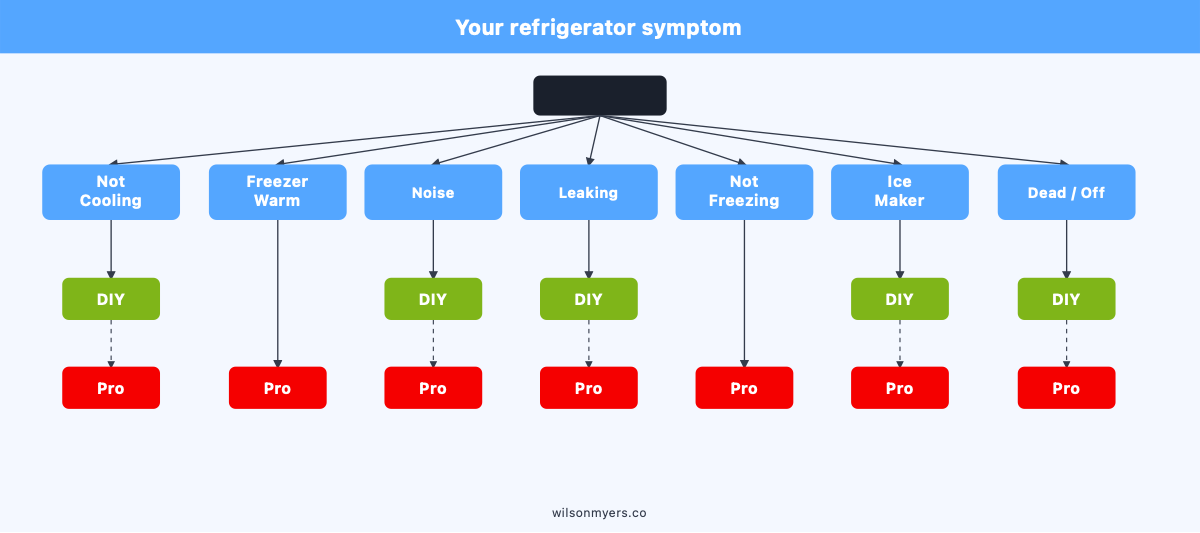
Before diagnosing any symptom, confirm the fridge is actually receiving power. A dead outlet or a tripped breaker accounts for a surprising share of “refrigerator not working” calls, and both take under a minute to rule out. Check the power cord first. Then test the outlet with a phone charger or small appliance. If the outlet is dead, look for a GFCI outlet nearby with a reset button, especially in kitchens and garages. Then check your breaker panel.
After a power outage, the compressor’s thermal protector may lock out for three to five minutes before it attempts a restart. If your refrigerator stopped working right after an outage, unplug it, wait five minutes, and plug it back in. Many homeowners call before the fridge even has a chance to restart. Give it five minutes.
Warning: If the breaker trips again within a few minutes of being reset, the circuit may be overloaded or there may be a wiring problem. Stop resetting it and contact a licensed electrician before assuming the refrigerator is at fault.
The first thing I tell homeowners who call in a panic is: pull the phone charger test first. Plug something else into the same outlet. Half the time the outlet is dead, not the fridge.
The most common question we hear is “why is my refrigerator not working.” Most refrigerator problems and solutions map to a single recognizable symptom. The reason a refrigerator is not working almost always fits one of the seven patterns below. Use this section to confirm which pattern your fridge is showing, get a DIY-or-pro verdict, and follow the link to the full diagnosis guide. Knowing your symptom before calling a technician also saves time and gives you a clearer picture of what the repair involves.
The fridge section is warm and getting warmer, but the compressor sounds like it is running. This is the most common refrigerator problem we see in Denver Metro homes, and it has several distinct causes with very different repair paths. Dirty condenser coils are the single most common culprit: dust and pet hair accumulate on the coils at the back or bottom of the unit, blocking the heat-dissipation the compressor depends on. Colorado’s dry climate and pet-heavy households make this worse than the national average. If cleaning the coils does not restore cooling within 24 hours, the problem may involve the condenser fan, a defrost system failure causing frost-clogged coils, or in serious cases, compressor failure. Whirlpool refrigerators in this age range show a recognizable defrost-heater failure pattern our technicians diagnose regularly.
A full diagnosis covers all four causes with step-by-step guidance: see our full guide to refrigerator not cooling. For Whirlpool models specifically, our Whirlpool refrigerator not cooling guide covers the brand-specific failure patterns.
The freezer holds temperature and even makes ice, but the fresh-food section climbs into the 50s overnight. This symptom has a narrower cause list than general not-cooling. When the freezer is cold and the fridge is warm, the compressor and sealed system are almost certainly working. The refrigerant is circulating through the evaporator. The problem is that cold air is not moving from the freezer into the fridge compartment. That points directly to the evaporator fan or the damper (the small flap that controls airflow between the two compartments). You can start refrigerator troubleshooting here by listening at the back wall of the freezer: if the evaporator fan has stopped running, the unit will be unusually quiet. Both the fan and the damper are technician-level repairs. The satellite guide covers diagnosis and the repair verdict: refrigerator not cold but freezer is fine.
The kind of noise matters more than the volume. A clicking sound that repeats every 30 to 90 seconds, followed by silence and then another click, is the start relay clicking: the compressor is trying to start, failing, and retrying. The start relay is a small part, and replacing it is one of the more accessible refrigerator repairs. A loud steady hum with no air movement from the bottom vents suggests the condenser fan has seized or is running under excessive load from dirty coils. Gurgling or dripping sounds after a defrost cycle are normal refrigerant flow through the lines. Knocking or rattling often traces to a loose drain pan vibrating against the cabinet. Our guide to refrigerator noise diagnosis walks through each noise type with a clear DIY-or-pro verdict.
Water pooling under the crisper drawers or on the floor in front of the unit usually comes from one of three sources. A clogged defrost drain is the most common: condensation during the defrost cycle cannot drain, pools under the crispers, and eventually finds its way onto the floor. A clogged defrost drain is often a DIY fix, and the full procedure including the warm water flush method is in our refrigerator leaking water guide. Water coming from the bottom front of the fridge may be the drain pan overflowing, which you can inspect by removing the base grille. Ice maker water line leaks show up at the back of the unit as a loose or corroded compression fitting. A failed door seal also draws in humid air, which condenses and drips.
The freezer has stopped holding temperature, ice cream is soft, and meats are thawing. This symptom almost always comes from a defrost system failure. When the defrost heater or defrost cycle timer fails, frost accumulates on the evaporator coils instead of melting away during each defrost cycle. Eventually that frost layer is thick enough to block airflow completely, and the freezer warms up. An overpacked freezer can mimic this symptom by blocking internal air circulation, so clearing some space is worth trying before calling anyone. If that does not help within a few hours, a technician needs to run a manual defrost test to isolate the defrost heater, timer, or thermostat. See the full guide to freezer not freezing for the complete diagnostic path.
Before assuming a component failure, check the ice maker arm. Most refrigerators have a wire arm or a plastic lever that shuts the ice maker off when the bin is full. If someone bumped it or it got stuck in the “off” position, the fix takes three seconds. If the arm is down and the maker still will not cycle, the fill tube may be frozen over, blocking water from reaching the mold. A frozen water inlet valve solenoid is another possibility. Homes with foothills hard water around Golden, Morrison, and the Denver foothills communities see mineral deposits clog filters and inlet valves within six to nine months. Samsung and LG ice makers have brand-specific quirks our dedicated guides cover in full: see the Samsung ice maker guide and the LG ice maker guide. Other brands with a general cooling issue route to the refrigerator not cooling hub.
When water stops at the nozzle but the ice maker continues running, the fault is typically isolated to the dispenser circuit: a control lock, a frozen door water tube inside the door liner, a failed actuator switch, or the dispenser solenoid coil. If both the dispenser and the ice maker stop together, the inlet valve body is the shared supply point. Our refrigerator water dispenser not working guide walks six causes in order.
The unit is completely silent, the light does not come on, and even the water dispenser is dead. A refrigerator not working at all, with no light and no sound, points to a power problem, not a refrigerator component. Run through the outlet test, the GFCI outlet reset, and the circuit breaker check from the triage section above. If the outlet tests live and the fridge still will not start, the thermal protector inside the compressor may have tripped. Give it five minutes after plugging in before concluding there is a component failure. A fridge that starts briefly and then shuts off, repeating that cycle, often has a failing start relay or a compressor that can no longer hold operating pressure.
If every power check passes and the unit remains dead, this is a technician call. An insured technician can safely test the starting components and the compressor before you commit to a repair or replacement decision.
Knowing how to diagnose refrigerator problems before calling a technician saves time and often money. Whatever your symptom, run these four checks first. They cost nothing, take under ten minutes, and eliminate the most common causes of a refrigerator not working or underperforming. Denver homeowners have an additional local reason to stay current on condenser coil cleaning, explained below.
Test the outlet with a phone charger. Check the GFCI outlet in the kitchen or garage if one is nearby: GFCI outlets have a small test button and a reset button on the face. Press reset firmly. Then check the breaker panel for the refrigerator circuit. Flip it fully to “off,” then back to “on.” If the outlet is confirmed live and the fridge still will not start, move to the next checks.
A dial accidentally bumped to the warm end (or to “0,” which disables the compressor on older units) is a surprisingly frequent cause of a fridge not working. The target setting for the fresh-food compartment is 37 degrees Fahrenheit. The freezer target is 0 degrees Fahrenheit. Check the dial or digital control and confirm it has not been knocked off its usual setting, especially after a large grocery load when items can shift and hit the dial.
A failing door seal lets warm room air into the cabinet continuously, forcing the compressor to run longer and eventually causing the fridge section to warm up. Close the door on a dollar bill, then pull. If it slides out easily, the seal is failing at that spot. Run the dollar-bill door seal test at three or four points around the door perimeter. Replacement is a DIY-accessible task on most models if you are comfortable with basic tools.
Dirty condenser coils are the leading cause of gradual cooling loss in refrigerators. They are also one of the easiest problems to fix yourself. Locate the coils either at the back of the unit or behind the base grille at the front bottom. Vacuum them with a brush attachment. In Denver, the altitude reaches 5,280 feet, where air is roughly 18 percent less dense than at sea level. That means the condenser coils shed heat less efficiently than they would in a coastal climate. Condenser coils in Denver homes also accumulate dust and pet hair faster than the national average because the Colorado dry climate carries more particulate through the air.
Most national guides recommend cleaning every 12 months. We recommend every six months for Denver Metro homes, especially households with pets. If July and August heat waves are pushing your fridge harder than usual, condenser coil condition is the first thing I check on every summer service call. It is the single most common cause of heat-season cooling loss.
Ran these checks and the refrigerator is still not working? You have ruled out the easy fixes. Our technicians can run a full diagnostic on any brand and give you a clear repair-vs-replace recommendation. Book a diagnostic with Wilson & Myers and get your fridge sorted.
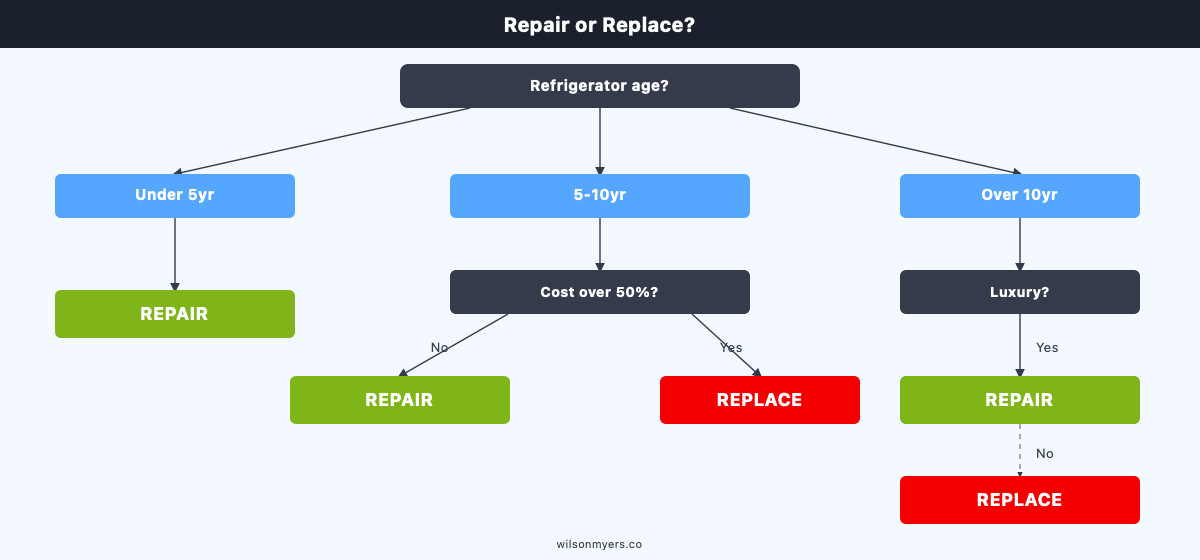
The decision to repair or replace refrigerator equipment is one of the most anxiety-producing moments in appliance ownership. Most homeowners face it with no clear framework. There is a better way. The 50 percent rule gives you a reliable starting point: if the repair cost exceeds 50 percent of the replacement cost of a comparable new unit, lean toward replacing. Apply that rule in combination with the age of the refrigerator and you have a decision most appliance technicians would stand behind.
Under five years old: repair almost always. The refrigerator has most of its useful life ahead, parts are available, and the repair cost rarely approaches the 50 percent repair cost threshold. Between five and ten years: apply the 50 percent rule. If a compressor replacement quote approaches or exceeds half of what a comparable new unit costs, the financial case for repair gets thin. Over ten years old: replace unless the repair is minor. A door seal, a water inlet valve, a thermostat, or a water filter are inexpensive fixes that make sense at any age. A compressor or sealed-system repair on a ten-plus-year refrigerator is rarely worth it, because you are investing heavily in a unit already past the midpoint of its expected life.
Homeowners asking “is it worth fixing a refrigerator” over ten years old should factor in energy costs too. Refrigerators made before 2010 consume 40 to 50 percent more electricity than current Energy Star models. Replacing a pre-2010 unit often pays back in reduced utility costs within three to five years, even if the appliance still runs adequately.
Sub-Zero built-in refrigerators, along with Thermador and Viking built-ins, carry expected lifespans of 20 to 25 years. The Sub-Zero 20 to 25 year lifespan changes the repair math significantly: a compressor repair at year ten or twelve is almost always the right call even at significant labor cost. For Sub-Zero owners in Denver, our dedicated guides cover the specific failure modes at each life stage: Sub-Zero refrigerator not cooling and Sub-Zero freezer not working. The decision framework is not the same for a luxury built-in as for a budget French door unit. Treating them identically when a refrigerator stops working is a common mistake that leads to expensive wrong choices.
For GE and other mid-range brands, the 50 percent rule applies cleanly. A GE French door refrigerator in the eight-to-twelve-year range where the compressor starts failing is typically a replace decision, not a repair. Not sure whether the repair estimate you received is reasonable? In my experience, a second opinion before committing to a major repair is always worth the cost of a diagnostic call. Our team at Wilson & Myers can give you an honest assessment of whether the repair makes financial sense for your specific unit and age. Use the Wilson & Myers fridge repair service page to learn what a diagnostic visit covers.
Not sure if your repair estimate is fair? Our technicians give honest repair-vs-replace recommendations with no pressure to book a major repair. Book a second-opinion diagnostic and know exactly where you stand before you commit.
Refrigerator lifespan varies significantly by configuration type. Know your range. Knowing the expected range helps you decide: when a refrigerator stops working at year seven, that is very different from year fourteen. A refrigerator that fails at year seven is not necessarily at end of life. One that fails at year fourteen may be.
Top-freezer models are the most durable configuration, typically lasting 15 to 20 years with standard maintenance. Bottom-freezer models follow at 13 to 17 years. Side-by-side refrigerators have more components and a shorter average lifespan of eight to 14 years. French door models, now the most popular configuration, typically run 10 to 15 years. Built-in refrigerators from Sub-Zero and comparable luxury brands are designed for 20 to 25 years or more, a lifespan that reflects both the build quality and the higher cost of replacement.
Maintenance makes a meaningful difference. This is true across all types. Refrigerators with clean condenser coils, functioning door seals, and regular filter changes consistently outlast identical models that are neglected. The same is true for garage fridges in Colorado winters. An ambient temperature below 40 degrees Fahrenheit causes the thermostat to stop calling for the compressor, because the unit “thinks” the surrounding air is cold enough. The freezer section warms up while the fridge compartment stays OK. This is a common Denver Metro homeowner complaint between October and March, and it shortens compressor life over time if the cycle is interrupted repeatedly. A garage-kit thermostat heater resolves this for units designed to operate in garage conditions.
Some refrigerator repairs belong to any handy homeowner: cleaning condenser coils, replacing a door seal, clearing a defrost drain, checking GFCI outlets. Knowing when to fix a refrigerator yourself and when to call a technician is the central question this guide answers. When those steps do not resolve a refrigerator not working, the problem is in territory that requires professional equipment. But several failure modes require a technician with proper equipment and training. Attempting them yourself saves nothing. It creates risk.
Call an insured technician when the compressor is clicking and failing to start, when the sealed refrigerant system is involved, or when the control board has failed. Also call if the unit will not run at all after you have confirmed the outlet is live and the breaker is on. Refrigerant handling is governed by EPA regulations that require licensed handling, not a homeowner repair. Compressor diagnosis requires equipment a homeowner does not carry.
Wilson & Myers serves Denver Metro Area homeowners across all major brands including Samsung, LG, Whirlpool, GE, Sub-Zero, and more. If your refrigerator is not working through a July heat wave, dirty condenser coils are the first thing to check before a compressor failure follows. In Denver, we see more refrigerator service calls in July than any other month, a direct result of summer heat pushing condenser coils past their threshold. We source replacement parts through national supplier networks and manufacturer contracts, and our technicians carry the diagnostic equipment to pinpoint the failure and give you a clear estimate on the same call. For LG owners, our LG fridge not cooling guide covers the common brand-specific failure patterns. Samsung owners should check our Samsung refrigerator not cooling guide. Frigidaire owners should check our Frigidaire refrigerator not cooling guide. GE owners should check our GE refrigerator not cooling guide.
Check the power first: confirm the outlet is live (test with a phone charger), look for a GFCI outlet nearby with a reset button that may have tripped, and check the breaker panel. If power is confirmed and the refrigerator is still not working or stops cooling, check that the thermostat dial has not been bumped to a warm setting. When a refrigerator is not working and these two checks clear, you are looking at a component issue that needs a diagnostic visit.
A refrigerator that runs but does not cool usually has dirty condenser coils, a failed condenser fan, a frost-clogged evaporator caused by a defrost system failure, or in serious cases, a compressor problem. Clean the condenser coils first. If the freezer is cold but the fridge section is warm, the evaporator fan or damper is the more likely cause. A compressor failure is typically indicated by a completely silent unit with no vibration from the back lower section.
Unplug the refrigerator, wait five full minutes, then plug it back in. This allows the compressor’s thermal protector to reset after a power surge or outage. The five-minute wait is important: plugging back in immediately after an outage can prevent the compressor from restarting. If the fridge has been through a power outage, this soft reset resolves the problem in many cases without any further steps needed.
Lifespan depends on the configuration type. Top-freezer models typically last 15 to 20 years. Bottom-freezer models average 13 to 17 years. Side-by-side refrigerators run eight to 14 years. French door models last 10 to 15 years. Built-in luxury refrigerators such as Sub-Zero are designed for 20 to 25 years or more. Regular condenser coil cleaning and door seal maintenance extend lifespan across all types.
Apply the 50 percent rule: if the repair cost exceeds 50 percent of what a comparable new refrigerator would cost, lean toward replacing. Age matters too: refrigerators under five years old are almost always worth repairing; those over ten years old are worth repairing only for minor fixes like door seals or filters. Sub-Zero and other luxury built-ins are an exception, with lifespans of 20 to 25 years making major repairs financially sound further into the unit’s life.
Most refrigerator problems fall into four categories. Not cooling (dirty condenser coils or defrost failure) is the most common. The freezer working while the fridge section is warm (evaporator fan or damper) is the second most common call. Unusual noises (start relay clicking or condenser fan failure) and water leaking under the unit (defrost drain clog or overflowing drain pan) round out the list. Ice maker failure also makes the top five, usually caused by the arm in the off position, a frozen fill tube, or a clogged water inlet valve. Power failures from tripped GFCI outlets or breakers are the most overlooked cause of a refrigerator not working.
Wilson & Myers provides refrigerator repair and appliance diagnostic services across Denver Metro Area, including Denver, Boulder, Lakewood, Aurora, Littleton, Englewood, Sheridan, Wheat Ridge, Edgewater, Golden, Arvada, Westminster, Thornton, Northglenn, Commerce City, Brighton, Broomfield, Superior, Louisville, Lafayette, Longmont, Erie, Centennial, Greenwood Village, Cherry Hills Village, Glendale, Parker, Castle Rock, Highlands Ranch, Lone Tree, and Morrison. Book online or contact us to confirm availability in your area.
Our insured technicians diagnose any refrigerator across Denver Metro Area and give you an honest repair-or-replace recommendation. We source parts through national supplier networks and manufacturer contracts.
Found This Helpful?
It is a week before Thanksgiving, and you set the oven to 350 degrees before starting the stuffing. Forty minutes later, the preheat signal fires. That is roug…
You opened the KitchenAid freezer this morning and the bin was empty. In my experience, the arm is the first thing worth checking: the fix costs nothing and ta…

Has your refrigerator water dispenser stopped delivering water? In my experience, a large share of these calls end before a technician arrives. A child lock ac…
You open the dishwasher after the cycle and the plates look exactly as you loaded them: dry, cold, with last night's dinner still caked on. Your dishwasher is…
A washer that shakes violently during spin traces to one of seven causes, from a bunched load to a failed drum bearing. Here is the order to check them, and th…
A gas smell during oven preheating is normal for about 90 seconds. Here is how Denver technicians tell routine startup odor from a real gas leak…
Welcome to the community.
You'll receive our next expert update soon.

Wilson & Myers is a verified member of the Denver Metro Chamber of Commerce.


