

Need a Professional Hand?
If a DIY fix isn't enough, our insured technicians are just a click away. We’ll diagnose the issue and get your home running right again.
BOOK NOWA gas stove clicking but not lighting follows one of three failure patterns. Each one has a different fix. Knowing which one applies tells you whether this is a ten-minute cleaning job, a breaker reset, or a service call. If you notice any gas smell at any point, the section directly below comes first. This guide covers surface burners on your gas cooktop and shows how to fix gas stove clicking but not lighting across all three patterns. If the oven cavity is the one that will not light, see our gas oven not lighting guide for that separate repair path. Most stoves not lighting but clicking need a port cleaning, a burner cap reset, or a breaker check. A gas stove clicking when stove is off almost always has moisture in the igniter switch and resolves in 24 hours. If you smell gas leave immediately and call the gas utility from outside before anything else.
A surface burner clicking while you smell gas has one correct response: get out. No diagnostic step belongs before that action.
If you notice the smell of gas while the stove is clicking, stop immediately. Do not turn any lights on or off, do not use your phone inside the house, and do not attempt any troubleshooting. Leave the house, leave the door open behind you, and call your gas utility provider from outside. Do not re-enter until the utility has cleared the home.
For most Denver Metro homeowners, the gas utility is Xcel Energy, available around the clock. Call them first. Stove diagnosis starts only after the utility declares the property safe.
Gas stove clicking but not lighting breaks into three patterns, each pointing to a different part of the ignition system.
| Pattern | What you hear and see | Most likely cause | What to try |
|---|---|---|---|
| Clicks but no flame | Clicking with knob on, stove making clicking noise, no flame appears | Clogged burner ports, wet electrode, misaligned cap | Cleaning and cap reset (Cluster 1 below). |
| No click at all | Silent when knob turns, no spark sound at all | Tripped breaker, failed spark module, faulty igniter switch | Check circuit breaker first (Cluster 2 below). |
| Clicks when off | Clicking continues after knob returns to off | Moisture in igniter switch, burner cap grounding electrode | Air-dry and cap check (Cluster 3 below). |
A stove clicking but not lighting usually has something blocking the path between the spark and the fuel-air mixture at the burner surface. Some GE and Whirlpool models need up to ten or twelve clicks before a burner catches. A few clicks alone is not a fault.
Run the utility lighter test first, and only if there is no smell of gas. If you notice any gas odour, stop and follow the section above. Hold a lighter near the burner ports while turning the knob.
A flame means gas is flowing. The lighter test for gas presence separates a supply fault from a spark fault. If no burner lights this way, gas may not be reaching the stove; check whether other gas appliances still work and call your utility if they do not.
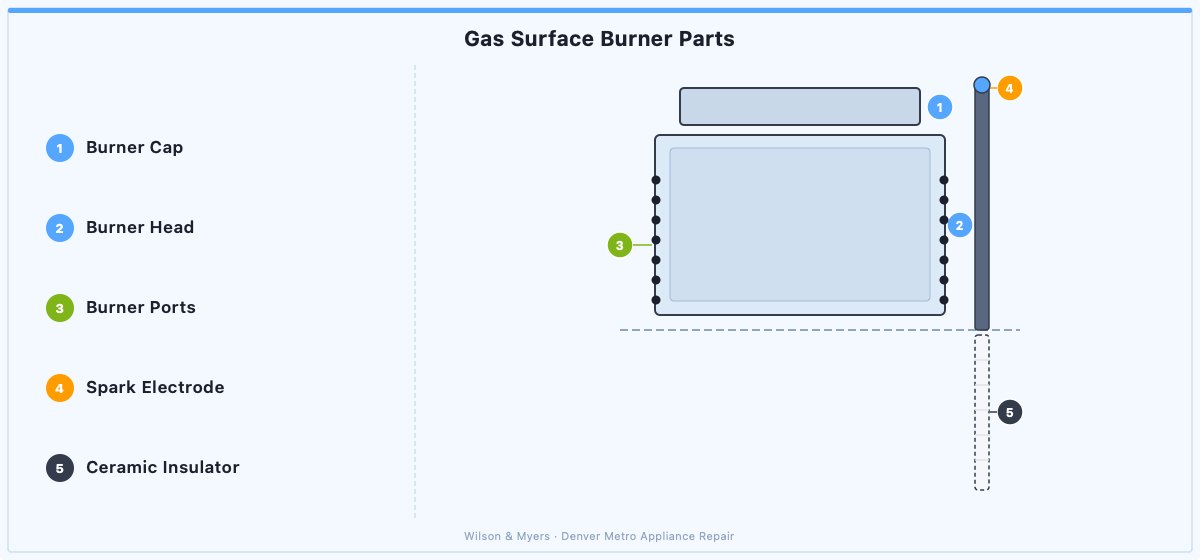
Gas exits through a ring of small holes in the burner head. Food debris and grease clog those burner ports after spills or heavy cooking. The fix is straightforward. Burner port cleaning with pin is the standard fix: work a straight pin around the ring, clearing one port at a time.
Our technicians see clogged ports on more than half of all Cluster 1 calls across Denver Metro homes.
Moisture on the ceramic insulator redirects the spark. It diverts before crossing the spark gap at burner cap level and reaching the gas. After a spill or cleaning, air-dry the electrode area completely; a cool hair dryer on low speeds it up. Unplug the range or cut the circuit breaker before touching any electrode wires.
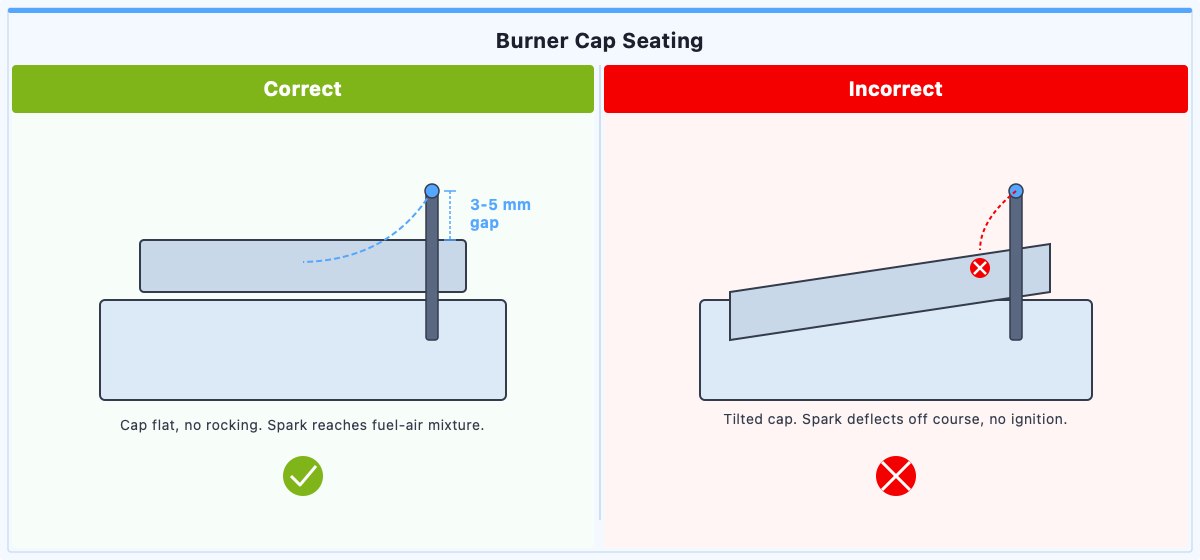
The spark gap sits three to five millimetres between the electrode tip and the underside of the burner cap. Even a slight tilt throws the spark off course. Misaligned burner cap after cleaning is the leading cause on calls where the homeowner says the stove worked fine before they cleaned it.
Samsung and LG sealed burner systems are especially sensitive to cap position. Viking and JennAir ranges are too. The fit matters.
This is the most common fix. Remove the cap, clear debris from the seating ring, and reset it flat with no rocking. Gas stove burner not lighting immediately after a cleaning resolves here most of the time.
In a dimmed room, press the knob to Lite and check the spark color. A blue-white spark healthy-looking and sharp confirms the electrode is working; a yellow-orange spark weak in output points to carbon tracking, a worn tip, or a visible crack. In my experience, a crack in the ceramic body means replacement is overdue.
Do not ignore it. Gas stove clicking but no spark from one specific burner is a sign of that failure.
Warning: Cut power at the circuit breaker before touching any electrode wires or the ceramic body.
Nine out of ten clicking stoves just need the burner cap cleaned and reset. When every burner goes silent at once, I go straight for the spark module: that is not a cleaning problem.
When a gas stove doesn’t ignite with no clicking sound at all, the ignition circuit is open. Gas stove clicking but no spark across every burner points to power or the central module. That is a different fault. One silent burner while others click points to that burner’s individual switch or wire.
Every gas range and gas cooktop runs electronic ignition on 120-volt household current. A tripped breaker cuts power to the spark module and silences all burners at once. Check the panel for any breaker in the middle or full-off position, reset it, and try the stove.
Circuit breaker check first is the fastest diagnostic step. It takes under a minute. No tools needed.
The spark module, also called the ignition control board, generates high-voltage pulses, typically 6,000 to 15,000 volts. These route through wires to the spark electrode at each burner. When the module fails, all burners go silent.
The gas valve may still open when you turn the knob, but no electrode fires. This pattern holds across GE, Whirlpool, Bosch, and Wolf gas ranges alike.
Spark module replacement is professional work. The component sits inside the range chassis with high-voltage wiring. An insured technician uses specific test equipment to confirm the module before ordering a part.
One burner silent while others click isolates the fault to that burner. The igniter switch behind the control knob closes the circuit at the Lite detent. A broken contact, corroded terminal, or severed wire breaks the loop for that one surface burner only.
One burner silent means switch is the shorthand our technicians use. Switch and wire repairs require the range panel open with power cut at the circuit breaker.
A gas stove clicking when stove is off most often has moisture in the igniter switch holding the contacts closed. Wet contacts complete the ignition circuit even with the knob returned to off. Moisture in igniter switch self-resolving as the surface dries is the most common outcome. Give it time.
After a spill or cleaning session, water enters the igniter switch body and holds the spring contacts closed. That is why the gas stove igniter keeps clicking even with the knob at off. Dry the stovetop and control-panel area with a fan, or use a cool hair dryer.
Leave it overnight. The answer to “why is my gas stove clicking when off” is moisture in the vast majority of cases across Denver Metro homes.
A burner cap sitting on or touching the electrode tip creates a grounded arc path and drives the spark module into a continuous cycle. Gas stove keeps clicking because the module senses an arc and fires again immediately. Listen for it. The tell is a steady click-click-click with every knob fully off, rather than the burst you hear during normal ignition.
Sealed burner models and the shallow caps on compact cooktops sit closest to the electrode, so they show this fault most often. The fix is the same. Remove the cap, clear debris from the seating area, and reset it level with no rocking. Check the seating ring for grit first: a single crumb under one edge will tilt the cap onto the electrode again.
If gas stove not lighting but clicking no gas smell persists more than 48 hours after a thorough air-dry with the cap correctly seated, the igniter switch contacts are likely stuck closed. A shorted switch will not self-resolve. It needs replacement. Switch replacement requires opening the range panel with power off at the breaker.
If the diagnosis points to a failed module, a shorted switch, or a cracked electrode, stop troubleshooting. Book online and a Wilson and Myers technician will identify the fault before any work begins.
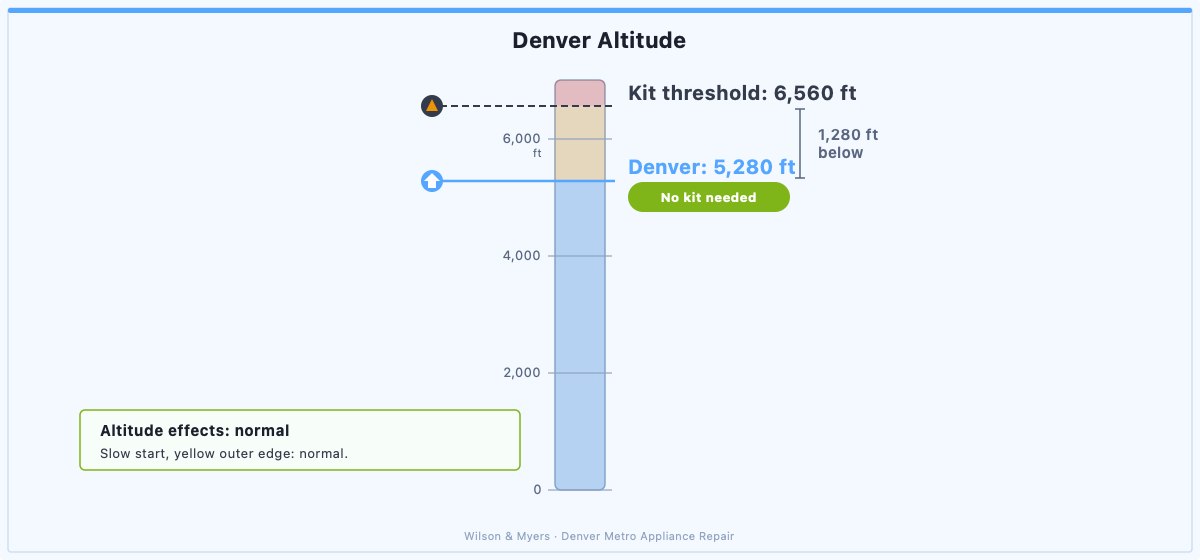
At 5,280 feet, Denver’s air carries about 17% less oxygen than at sea level. On a working burner, this affects combustion: Denver altitude ignition can take a fraction of a second longer, and the outer flame edge may run slightly yellow or orange. Neither is a fault on a healthy burner. Watch for it.
GE and Whirlpool each publish a high-altitude conversion kit for gas ranges. Both set the same threshold for the altitude orifice kit at 6,560 feet, per their published specifications. Denver at 5,280 feet sits below that line.
The average Denver home does not need a high-altitude conversion kit. Wolf also provides altitude conversion for pro-range models; an insured Wolf technician should assess those installs individually.
Altitude alone does not cause total ignition failure: a gas burner not lighting here has one of the three cluster causes above.
A gas stove clicking but not lighting sometimes has a clear DIY path: clean the ports, reset the cap, flip the breaker. Some problems need a pro. Those require professional tools and safe access to live circuits inside the range chassis. In my experience, a spark module rarely fails without a trigger, so when every burner goes quiet at the same moment I look first for a recent power event or a tripped breaker.
Call when the circuit breaker is fine and every burner is still silent: the spark module needs professional testing before ordering a replacement. If a shorted igniter switch keeps clicking beyond 48 hours of drying, switch replacement needs the range panel open with power cut. A visible crack in the ceramic insulator means the electrode needs replacing before the stove is used again.
Wilson and Myers handles stove cooktop repair and cooktop repair across all three failure clusters for every major brand. Homeowners in Denver, Golden, Arvada, Highlands Ranch, and Lakewood call us with this exact symptom. We do not work on gas lines, regulators, or shutoff valves.
A gas stove clicking but not lighting most often has a clogged or wet burner port, a misaligned burner cap, or a fouled spark electrode. Hold a lighter to the burner ports while turning the knob: if a flame appears, gas is flowing and the fault is ignition-side. Clean the ports and reseat the cap before assuming the electrode needs replacing.
When a gas stove keeps clicking after the knob is off, the igniter switch contacts are usually wet and staying closed. A recent spill or cleaning session is the typical trigger. Air-dry the stovetop and control-panel area for 24 hours. A burner cap resting on the electrode tip can produce the same symptom and is fixed by removing the cap, clearing debris, and reseating it level.
Dry the stovetop and the area around the control knobs with a cool hair dryer or a fan, then leave it overnight. If the clicking began after you moved the burner cap, remove it, check the seating ring for debris, and reset it flat. Clicking past 48 hours of drying points to a shorted igniter switch and needs professional replacement.
Yes: hold a utility lighter close to the burner ports and turn the knob to the Lite position to allow gas to flow. If gas is flowing, a flame appears and manual lighting works. If manual lighting works consistently but the igniter does not fire, the ignition system needs service. Do not use paper matches that require your hand too close to the burner.
Continuous clicking alone is not a fire hazard when no gas is flowing. A stove clicking when the knob is off is almost always moisture in the igniter switch, not a gas leak. The danger signal is a gas smell, not the clicking itself. If you smell gas while the stove is clicking, leave the house immediately and call the gas utility from outside.
Stop immediately and do not touch any light switches or use your phone inside the house. Leave the house with the door open behind you, call your gas utility from outside, and do not re-enter until a utility technician has inspected and cleared the property. This applies regardless of how faint the smell seems.
For ignition failures that do not resolve with a cleaning, a cap reset, or a breaker check, Wilson and Myers is ready to help. Book online and we will identify the fault before any repair work begins.
Our insured Denver Metro technicians test spark modules, igniter switches, and electrodes on every major gas range brand.
Found This Helpful?
It is a week before Thanksgiving, and you set the oven to 350 degrees before starting the stuffing. Forty minutes later, the preheat signal fires. That is roug…
A Frigidaire oven not heating can come down to a setting rather than a part. Before you book a repair, two checks cost nothing and take under a minute: the clo…
Has your refrigerator water dispenser stopped delivering water? In my experience, a large share of these calls end before a technician arrives. A child lock ac…
You open the dishwasher after the cycle and the plates look exactly as you loaded them: dry, cold, with last night's dinner still caked on. Your dishwasher is…
A washer that shakes violently during spin traces to one of seven causes, from a bunched load to a failed drum bearing. Here is the order to check them, and th…
A gas smell during oven preheating is normal for about 90 seconds. Here is how Denver technicians tell routine startup odor from a real gas leak…
Welcome to the community.
You'll receive our next expert update soon.

Wilson & Myers is a verified member of the Denver Metro Chamber of Commerce.


