
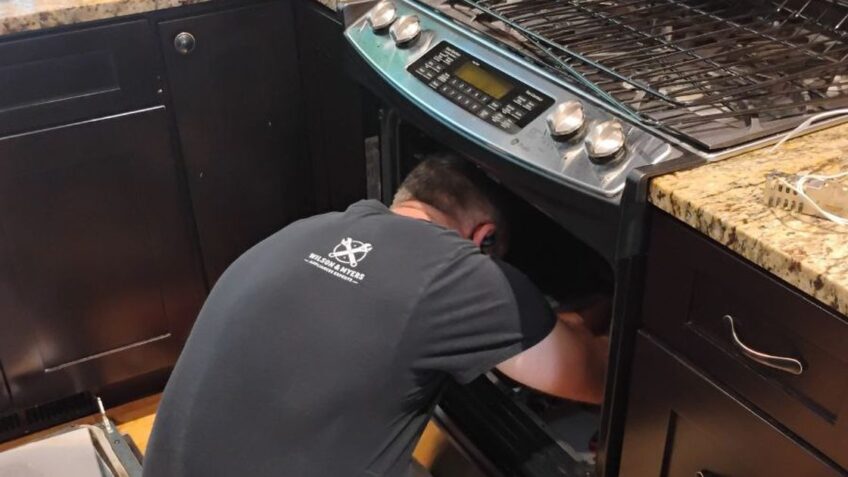


Need a Professional Hand?
If a DIY fix isn't enough, our insured technicians are just a click away. We’ll diagnose the issue and get your home running right again.
BOOK NOW| Symptom | What It Means | Safe to Diagnose? | Action |
|---|---|---|---|
| Brief gas smell, clears within 90 seconds of lighting | Normal pre-ignition window | Yes | Watch and wait |
| Smell persists more than 5 minutes after the oven lights | Possible delayed ignition | See causes below | Proceed to cause sections |
| Any gas smell with the oven completely off | Possible gas leak | No | Leave and call gas utility |
| Hissing sound plus any gas odor | Active gas leak | No | Leave immediately, call 911 |
| Whoomph sound when the oven lights | Delayed ignition confirmed | Yes | Check igniter and burner ports |
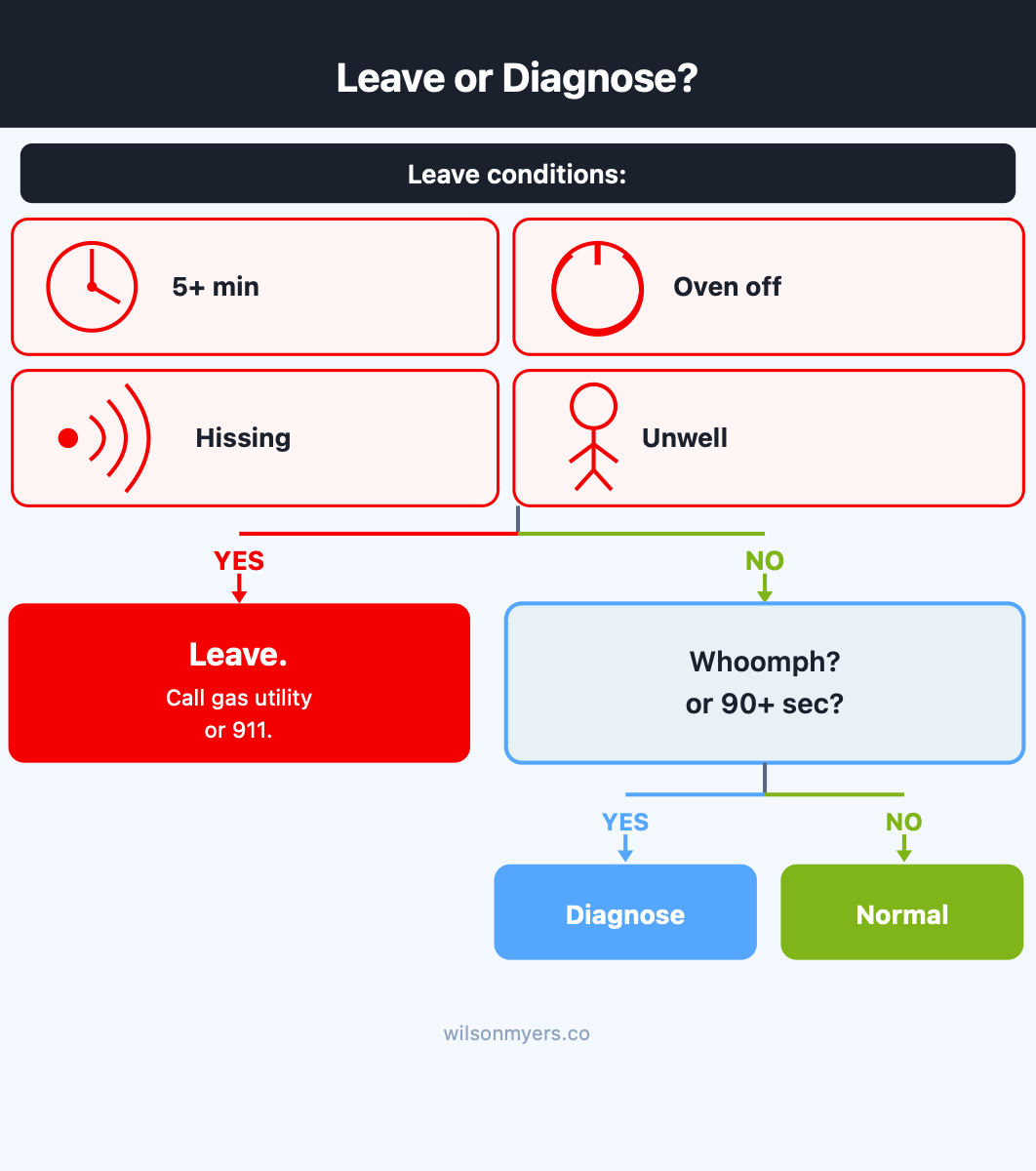
A gas smell when oven is on does not automatically signal an emergency. Four specific conditions do. The principle: leave before you diagnose when any of these four is present, and leave without stopping to turn anything off first.
The oven smells like gas when preheating and the smell is still there five or more minutes after the oven has lit. The smell is present with the oven completely off. A hissing sound is audible near the oven or the gas supply line at the rear of the range. Anyone in the home is feeling unwell, dizzy, or nauseated.
None of these tests ask you to judge whether the smell is strong. A frightened person cannot calibrate perception accurately, and someone with a slow leak often describes it as faint. If the oven is not lighting at all rather than lighting slowly with a smell, that diagnostic path is at if your oven isn’t lighting at all.
When in doubt, leave the home and call from outside.
Do not turn electrical switches on or off on your way out. Do not touch the gas supply valve at the rear of the range. Call your gas utility’s emergency line or 911 from outside and return only after the gas company clears the property.
The first call in a constant gas smell situation is to the utility, not to an appliance repair company. Our insured technicians inspect gas connections during every oven service call and refer line repairs to licensed gas fitters, but a persistent gas smell from oven with the appliance off is a utility emergency.
Many homeowners searching why does my gas oven smell like gas when preheating are experiencing a normal pre-ignition window, not a fault. A brief odor during the first 90 seconds of oven startup is expected in both hot surface igniter and spark ignition systems. Once the oven lights, the smell clears within one to two minutes.
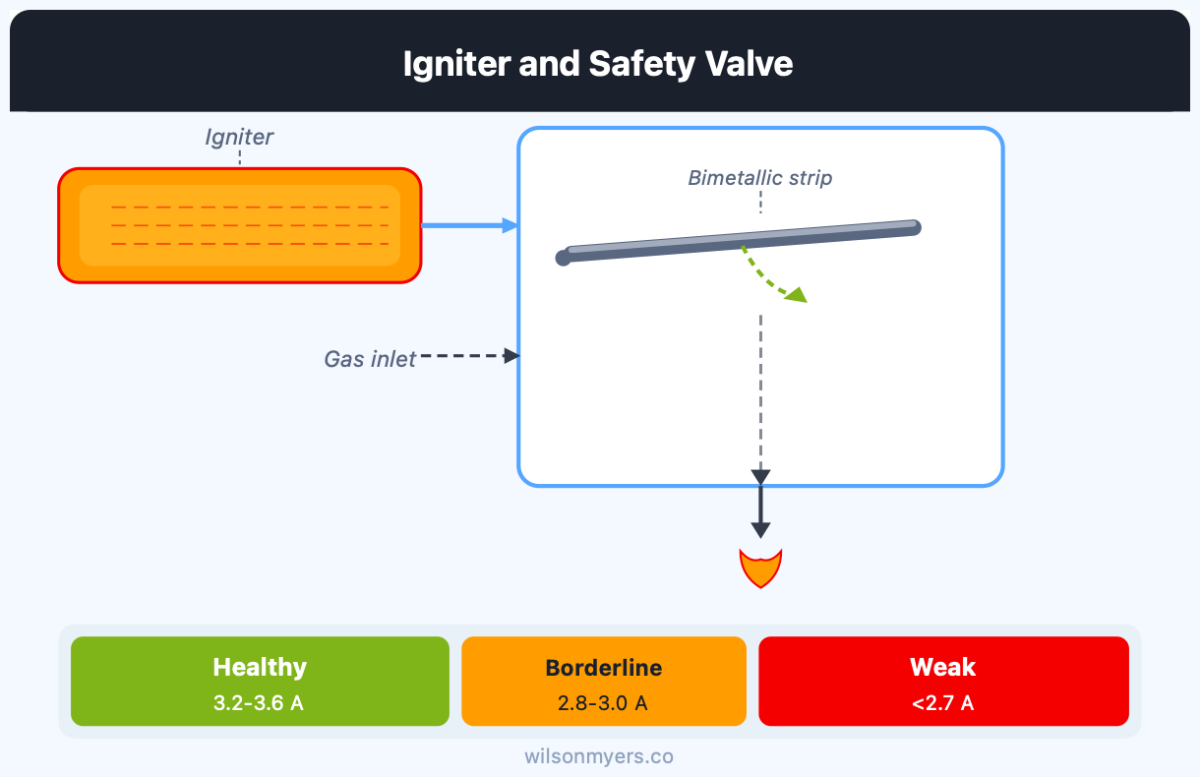
The control board sends 120 volts AC to a silicon carbide or silicon nitride element, which heats over 30 to 90 seconds. A healthy igniter draws 3.2 to 3.6 amps at full temperature. The gas safety valve contains a bimetallic strip wired in series with the igniter; when current reaches roughly 3.0 amps, the strip deflects and opens the valve mechanically.
Gas flows into the bake burner tube and the glowing element lights it. GE, Whirlpool, Maytag, and Wolf rely on this bimetallic mechanism in their oven bake circuits, and the oven thermostat manages temperature only after the bake burner has established a flame.
Natural gas is odorless. Utility companies add mercaptan odorant, the source of the rotten egg smell. That is why homeowners asking why does my oven smell like rotten eggs when preheating are detecting the same natural gas odorant as anyone who notices any gas oven smell before lighting.
A gas range smell during preheating normal in duration is under 90 seconds and clears after the flame establishes. If it does not clear, move to the cause sections below.
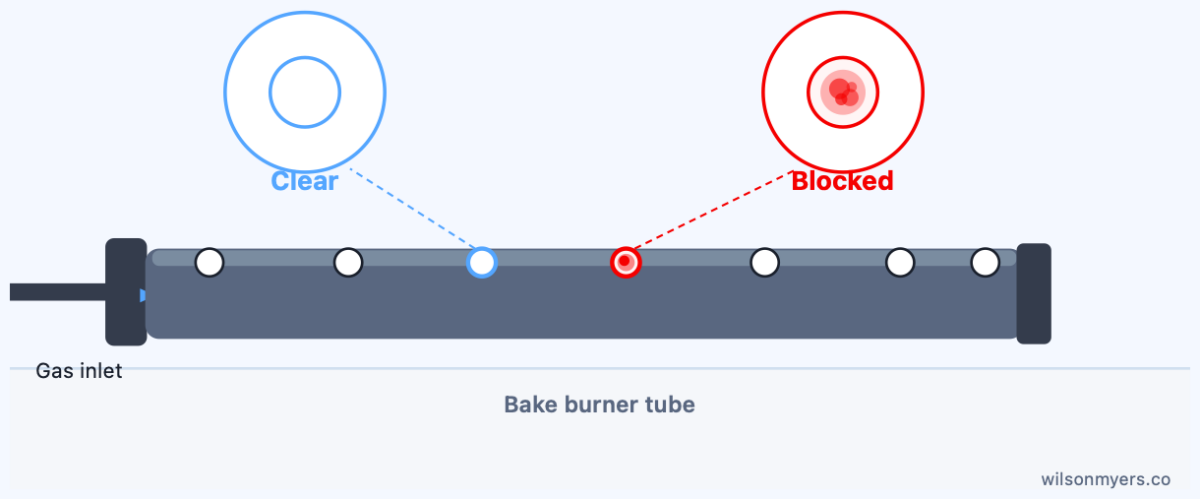
Burner port blockage is the most accessible cause of a gas smell during preheating. Partial blockages delay or unevenly distribute ignition, allowing unburned gas to accumulate at the sealed sections before the flame establishes.
The bake burner tube runs across the bottom of the oven cavity with a row of small orifice ports along its length. Spilled food, grease runoff from roasting, and cleaning chemical residue coat and partially seal these holes. Oven smells like gas but no leak is confirmed often traces to this cause, especially when the smell started after a spill or cleaning session. Gas oven smell before lighting that was not present six months ago points here first.
The oven must be fully cool before you start.
If the oven gas smell comes and goes after cleaning, the ports may have physical damage. We source replacement bake burner tubes through national supplier networks and manufacturer contracts.
A visibly glowing igniter is not the same as a healthy one. The gas supply valve opens based on current draw through the bimetallic strip, not on whether the element looks orange. An igniter below the threshold keeps the valve hesitating, and that hesitation is what produces a gas oven smells like gas when turned on complaint.
A working igniter draws 3.2 to 3.6 amps. As the element ages, its resistance increases and current draw drops. At 2.8 to 3.0 amps the igniter is in a borderline zone where the bimetallic arm in the safety valve heats slowly; gas oven delayed ignition is the direct result.
Below roughly 2.7 amps the gas safety valve does not open properly. A clamp-meter test measuring igniter current draw in-circuit is the diagnostic a technician runs, alongside an igniter resistance test, where 80 to 175 ohms is the healthy range.
At Denver’s 5,280 feet, air pressure runs about 12 percent below sea level. Thinner air changes combustion efficiency, so an igniter already drawing near the borderline range has less margin here than at sea level. It is also why a Denver altitude adjustment is a routine part of gas range setup here, with some manufacturers specifying one above 4,000 feet.
A gas oven takes long to light and smells during preheating in the textbook presentation of a fading igniter. The oven takes more than 90 seconds to reach flame. The igniter glows dull orange rather than bright orange-to-white.
The defining marker of delayed ignition is the whoomph ignition sound: a soft thud as accumulated gas lights at once. Homeowners describe it as a poof, pop, or thump.
Replacing the bake igniter requires disconnecting 120-volt power and working directly alongside the gas supply valve. Because the valve also degrades over time, replacing the igniter alone may not resolve the delay. A technician tests both components together so you are not replacing one and finding the other also needs attention.
In my experience, a glowing igniter is not always a healthy one. Once the current draw slips below about 3.0 amps, the gas valve starts to hesitate. That hesitation is what you smell.
Some oven bake circuits use spark ignition rather than a hot surface igniter.
A spark ignition system produces an audible click and a visible spark at a ceramic electrode near the burner when the oven starts. Samsung, LG, some older GE models, and some Bosch ranges use a spark igniter for the oven bake circuit. If your surface burners are clicking without lighting, that is a related but distinct symptom covered at if your surface burners are clicking.
Grease and food debris on the spark igniter electrode reduce spark intensity. Each failed spark attempt allows three to four seconds of gas accumulation before the system retries; some models wait 40 seconds between attempts, so the spark module delay adds up quickly.
Apply a spray degreaser to the electrode and scrub gently with a soft brush. Let it dry fully before testing. If the smell and delay persist after cleaning, the spark module itself may be failing, which is a pro repair.
A loose or damaged gas connection at the rear of the range is the one cause on this list where the answer is always a licensed professional.
An oven gas smell that comes and goes throughout the day with the oven completely off points to a gas supply line fault rather than an ignition problem. Oven smells like gas but no leak is apparent to the eye does not clear this cause. Brass compression fittings develop slow leaks after years of vibration or range movement; a flexible corrugated supply line can crack at a bend. Soap-bubble testing on the fittings is the field diagnostic, and that is a licensed gas fitter’s job.
Our insured technicians inspect gas connections on every oven service call and refer all gas supply line repair to a licensed contractor. The gas utility emergency line is the first call for any constant gas smell from oven. A licensed gas fitter handles the line repair after the utility confirms the property is safe.
An improperly torqued rear fitting is a common finding on range and cooktop installations that later develop a slow leak. If the oven isn’t reaching temperature at all, that is a different problem described at if the oven isn’t reaching temperature at all.
If the smell keeps returning after you have cleared the ports, the igniter is the next thing to test. Our insured technicians measure the current draw rather than judging the glow. Book a gas oven diagnostic.
On March 19, 2026, the CPSC announced a recall of about 174,800 Frigidaire gas ranges in the United States, with a further 5,300 sold in Canada. The hazard is delayed ignition of the oven’s bake burner. Electrolux Group and the CPSC recorded 62 reports of it, including 30 burn injuries. CPSC tells owners of a recalled range to stop using the oven immediately, though the cooktop burners remain usable.
The recall covers Frigidaire gas ranges sold between June 2025 and January 2026 at Lowe’s, Home Depot, and other major retailers. The recall covers specific model numbers within the serial range VF52200000 to VF54399999, printed on a nameplate in the drawer beneath the oven. Check yours at GasOvenBurnerRecall.com or on the CPSC page for recall 26-333. Some affected units present the same gas oven smells of gas pattern that igniter wear produces in any brand; the model number check is the only reliable confirmation.
Electrolux Group provides professional in-home installation of a new bake burner at no cost. Contact them through the recall page for scheduling. For Frigidaire ranges outside the affected production window, a standard igniter or burner port diagnosis applies.
Of the three reasons a gas oven smells like gas while it preheats, only the middle one brings us into the picture. Call us when the oven takes more than 90 seconds to light, when you hear the whoomph ignition sound at startup, or when cleaning the burner ports did not resolve the smell.
Our insured technicians serve Denver, Lakewood, Littleton, Aurora, and the broader Denver Metro Area. We test both the igniter and the safety valve together on every diagnostic visit. For oven repair and stove and cooktop repair, we schedule as soon as a slot opens.
Tell us the model number and what the oven does when you start it. That is usually enough for the technician to know which components to test first. Book a visit.
Answers to the questions Denver homeowners ask most about a gas smell during oven preheating.
Yes, briefly. During the first 60 to 90 seconds of startup, the hot surface igniter heats while the gas safety valve begins to open. A small amount of unburned gas enters the oven cavity before ignition, producing a detectable odor. If the smell clears within one to two minutes of the oven lighting, this is normal behavior.
If it persists beyond five minutes, something needs attention.
Leave the home without switching anything on or off if the smell is present with the oven off, persists more than five minutes after lighting, or accompanies a hissing sound or anyone feeling unwell. Call your gas utility’s emergency line from outside or call 911. Do not return until the gas company clears the property. A brief smell that clears after the oven lights requires no action.
Two symptoms point to a failing igniter: the oven takes more than 90 seconds to light, and a whoomph sound occurs when the flame finally establishes. A technician confirms this with a clamp-meter current draw test. A working igniter draws 3.2 to 3.6 amps. The borderline range is 2.8 to 3.0 amps; below roughly 2.7 amps the gas safety valve fails to open properly.
The oven lighting does not mean the ignition system is healthy. It means gas accumulated during an extended pre-ignition window and eventually lit. Blocked burner ports, a weak hot surface igniter, and spark ignition delay each produce this pattern. The gas oven smells like gas when turned on and then the flame establishes, but later than the system is designed to do it.
Yes, specifically when burner port blockage is the cause. Spilled food and grease residue partially seal the small orifice holes in the bake burner tube. Partial blockage creates uneven ignition, allowing gas to accumulate at the sealed ports before the flame can establish. A gas smell that started after a spill or cleaning session points to the burner ports as the first thing to inspect.
Whether oven smells like gas when preheating is it dangerous depends on duration and context. Under 90 seconds and clearing after the oven lights, this is normal pre-ignition odor. Still present five minutes after lighting, present with the oven off, accompanying a hissing sound, or alongside anyone feeling unwell: those are the conditions that require leaving the home. When in doubt, leave and call from outside.
Our insured technicians test the igniter current draw and the gas safety valve together, so you know which one is at fault before anything is replaced.
Found This Helpful?
A residential dishwasher leaking from bottom rarely fails where the dishwasher puddle on floor tiles appears. Pull the kick panel; the highest wet surface mark…
It is a week before Thanksgiving, and you set the oven to 350 degrees before starting the stuffing. Forty minutes later, the preheat signal fires. That is roug…
A Frigidaire oven not heating can come down to a setting rather than a part. Before you book a repair, two checks cost nothing and take under a minute: the clo…

Has your refrigerator water dispenser stopped delivering water? In my experience, a large share of these calls end before a technician arrives. A child lock ac…
You open the dishwasher after the cycle and the plates look exactly as you loaded them: dry, cold, with last night's dinner still caked on. Your dishwasher is…
A washer that shakes violently during spin traces to one of seven causes, from a bunched load to a failed drum bearing. Here is the order to check them, and th…
Welcome to the community.
You'll receive our next expert update soon.

Wilson & Myers is a verified member of the Denver Metro Chamber of Commerce.


