

Need a Professional Hand?
If a DIY fix isn't enough, our insured technicians are just a click away. We’ll diagnose the issue and get your home running right again.
BOOK NOWIt is a week before Thanksgiving, and you set the oven to 350 degrees before starting the stuffing. Forty minutes later, the preheat signal fires. That is roughly three times what it should take. When an oven reaches temperature slowly, one of three things has changed. The cause is either a door gasket bleeding heat, a bake element or gas igniter past its efficient operating life, or a temperature sensor reading lower than the actual cavity temperature. If your oven does not reach cooking temperature at all, see our oven not heating up guide. This article covers ovens that reach temperature but take longer than 12 to 15 minutes to reach 350 degrees F.
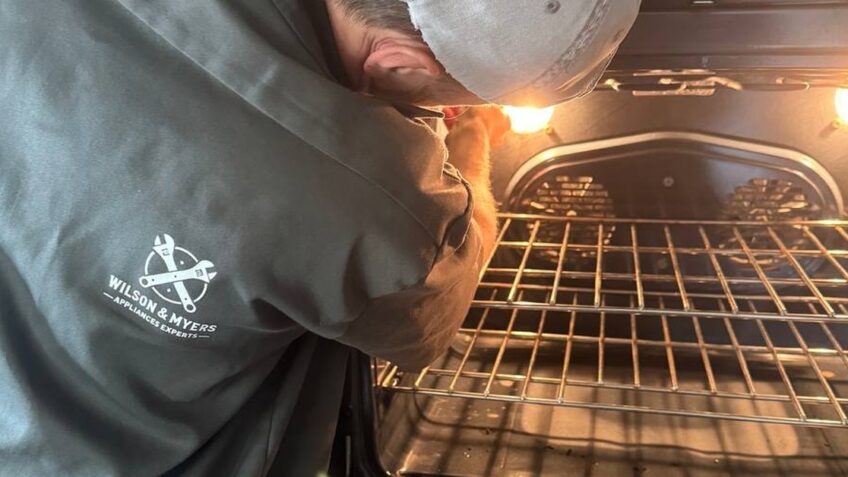
KitchenAid and Maytag both confirm 12 to 15 minutes as normal preheat time to 350 degrees F. That is the answer to how long should it take to preheat oven. If you have been asking why does my oven take so long to preheat, check the non-fault factors below first. The same applies if you are asking why is my oven slow to preheat, or why is my oven taking so long to heat up.
Extra racks slow preheat by absorbing radiant heat. Remove all but the rack you need to shave a few minutes. Cold room extends preheat: in a Denver kitchen in late autumn, the oven starts farther from its 350 degree target.
A 208-volt supply instead of 240 volts causes elements to run at lower wattage by design. A hidden bake element heats the oven floor rather than the air directly, which takes longer than an exposed element would; Whirlpool, Samsung, and LG use this design. A Rapid Pre-Heat mode engages the convection fan and shortens preheat on a healthy appliance.
When these factors have been ruled out and the oven takes too long to preheat, one of the three repair causes below applies. Anyone asking why does my oven take 30 minutes to preheat is usually looking at one of them.
| What You Notice | Likely Cause | Gas or Electric |
|---|---|---|
| Preheat takes 25 to 40 minutes but oven reaches temperature | Door gasket, bake element, igniter, or sensor | Both |
| Preheat signal fires but oven cavity is cold | Temperature sensor reading high | Both |
| Oven never reaches cooking temperature | Component failure: see the oven not heating up guide | Both |
| Gas oven igniter glows but burner lights after 90 seconds or more | Weakening igniter | Gas |
| Oven door exterior feels unusually warm during a cycle | Heat loss through door gasket | Both |
Oven never reaching temperature at all? See our oven not heating up guide.
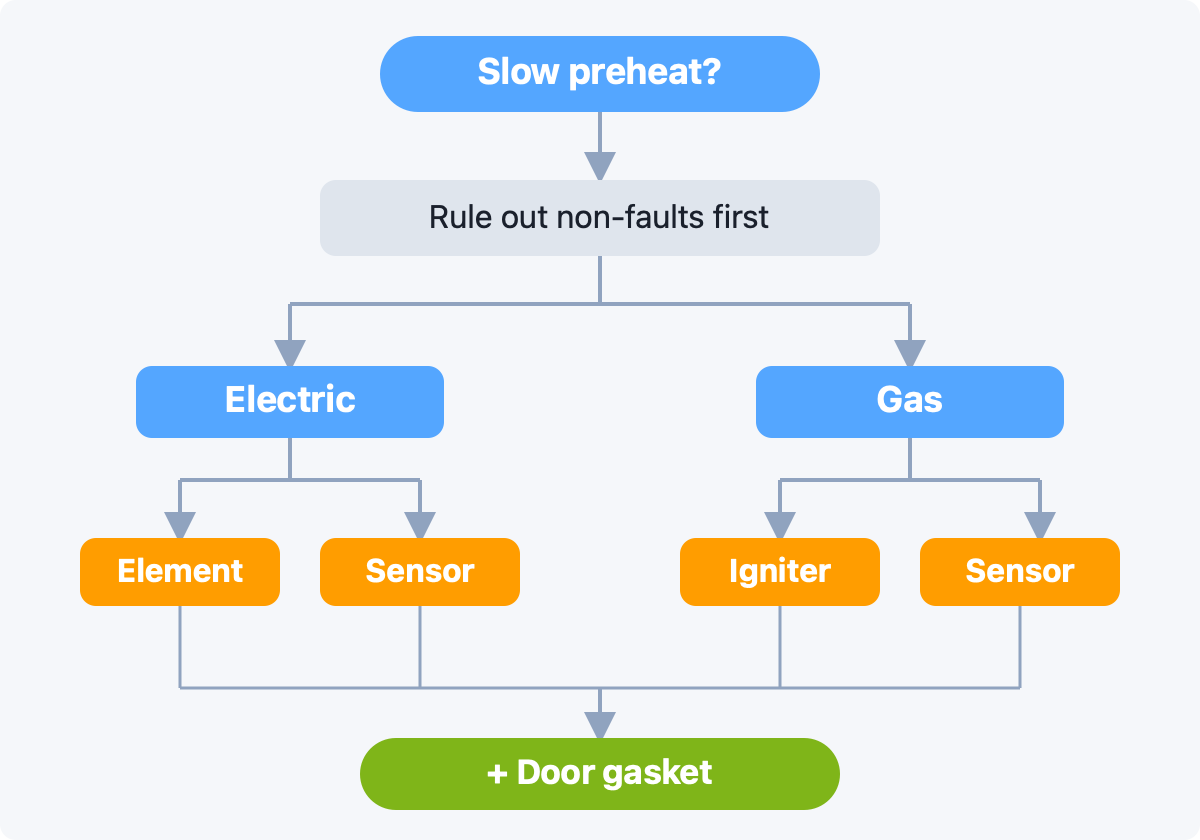
If you are asking why does my electric oven take so long to preheat, the cause is one of two components: the bake element or the temperature sensor. Both produce the oven slow to heat up electric pattern. Gas oven? Skip to the next section.
A healthy bake element glows uniform red-orange when the oven cycles on. Look for dark sections that do not glow, physical cracks, or uneven color. A partially failed element still heats at reduced wattage; the oven preheats to temperature but takes long.
Unplug the range, disconnect the element from its terminal block, and measure resistance across both terminals with a multimeter. Appliance parts specialist guidance puts a healthy bake element at approximately 20 to 25 ohms. An open reading, or one well outside that range, confirms the element. This test works on GE, KitchenAid, Maytag, and Frigidaire models.

The temperature sensor is an RTD probe at the back of the cavity. When it drifts low, it reports the cavity as colder than actual, so the control board runs the element longer. The result looks like oven not reaching temperature fast enough, but the sensor is the cause. In my experience, sensor drift gets confused with a calibration issue; oven calibration adjusts the setpoint and cannot fix a faulty reading.
With the range unplugged, measure resistance across the sensor probe terminals. Appliance parts specialist guidance places a healthy sensor at approximately 1,080 ohms at room temperature. A reading significantly outside that range points to sensor drift. When the sensor reads high, the oven preheat signal goes off but oven not hot.
If you are asking why does my gas oven take so long to preheat, start with the silicon carbide igniter. The gas safety valve only opens when the igniter draws sufficient current through their shared circuit.
A weakening igniter still draws enough current eventually, but progressively later in each cycle. The burner lights, the oven slow to heat up gas pattern sets in, and 12 minutes becomes 30 or more.
Silicon carbide igniters degrade with each heating cycle as micro-cracks form, increasing resistance and reducing the current drawn. The gas safety valve requires a minimum current to open fully; a weakening igniter reaches that threshold later and later.
Watch the igniter glow during a preheat. A healthy igniter reaches bright orange and the burner lights within 30 to 60 seconds. Field observations from appliance repair technicians put a weakening igniter at 90 seconds or more, sometimes two or three minutes. The igniter glow time test confirms the fault without any tools.
A gas oven igniter that glows for two or three minutes before the burner lights has cracking silicon carbide and falling current draw. Replace it before the burner stops lighting entirely.
If the igniter glows but the burner never lights, the gas safety valve is not opening. That fault is covered in our gas oven not lighting guide.
If the igniter lights within 30 to 60 seconds but the gas oven still takes forever to preheat, check the temperature sensor. Gas and electric ovens use the same RTD sensor design and the same approximately 1,080 ohm baseline. On a Thermador or Wolf range, sensor drift toward the high side means the preheat signal fires early, before the cavity reaches temperature. Sensor replacement resolves it; oven calibration will not.
A door gasket that no longer seals bleeds heat from the cavity on gas and electric ovens alike. Heat loss through the door extends preheat. The dollar-bill gasket test is free and takes 30 seconds.
Close the oven door on a dollar bill. Pull the bill firmly. A properly sealing gasket grips it and resists the pull.
If the bill slides out without resistance, the gasket is not sealing at that point. Check all four edges: top, bottom, and both sides. Gaskets often seal well on one edge and fail on another.

Physical signs include cracks in the silicone or fiberglass braid and sections that no longer contact the oven frame. An oven door exterior that feels unusually warm during a cycle is another indicator. Gasket replacement is DIY-accessible on most Samsung, LG, and Frigidaire ranges. On a Frigidaire oven not heating fully, the gasket test is the same first step.
The dollar-bill test and bake element visual inspection are homeowner-friendly. Multimeter work on the sensor requires only basic familiarity with the tool and an unplugged appliance. Gas igniter replacement involves working near gas components; any homeowner not comfortable around gas lines is better served by an insured technician. Wall oven sensor access often requires partial unit removal.
Wilson and Myers technicians serving Denver, Lakewood, Littleton, Aurora, and Highlands Ranch diagnose oven preheating problems. We source parts through national supplier networks and manufacturer contracts. Book an oven repair appointment online.
How long should it take for an oven to preheat?
KitchenAid and Maytag both document 12 to 15 minutes as normal preheat time to 350 degrees F with racks in place. Cold kitchens and extra racks each add a few minutes. If your oven consistently takes 25 minutes or more to reach 350 degrees F, one of the three repair causes in this guide is likely responsible.
Is it normal for an oven to take 30 minutes to preheat?
Thirty minutes is longer than the 12 to 15 minute benchmark to 350 degrees F. Rule out the non-faults: remove extra racks and confirm supply voltage. If the oven still takes 30 minutes to preheat, or the oven takes forever to preheat, a weakening bake element, failing igniter, door gasket heat loss, or drifting sensor is likely the cause.
How do I know if my oven temperature sensor is bad?
Unplug the range and measure resistance across the sensor probe terminals with a multimeter. Appliance parts specialist guidance places a healthy sensor at approximately 1,080 ohms at room temperature. A reading significantly outside that range points to sensor drift. A sensor reading high fires the preheat signal before the cavity reaches temperature; a sensor reading low extends the heating cycle.
Why does my oven preheat signal go off but the oven is not hot?
The preheat signal fires when the sensor reports the set temperature to the control board. If the sensor reads higher than actual, the signal fires early while the cavity is still below set point. A separate oven thermometer confirms the gap. This is a sensor reading high fault; sensor replacement resolves it.
Can I still use my oven if it takes too long to preheat?
Yes, a slow preheat is an inconvenience rather than a safety issue. Account for longer preheat times and avoid placing food in too early. Slow preheat often progresses: a weakening igniter eventually fails to light the burner, and a partial bake element failure can become complete. Address it early to avoid a critical loss of oven access.
Why does my new oven take longer to preheat than my old one?
Newer ovens with a hidden bake element under the oven floor take longer by design than older exposed-element models. The element heats the floor, not the air directly. The Rapid Pre-Heat feature, if available, typically brings preheat back to 12 to 15 minutes to 350 degrees F.
Our insured Denver Metro technicians diagnose oven preheating problems and service all major brands, gas and electric.
Found This Helpful?
A Frigidaire oven not heating can come down to a setting rather than a part. Before you book a repair, two checks cost nothing and take under a minute: the clo…

Has your refrigerator water dispenser stopped delivering water? In my experience, a large share of these calls end before a technician arrives. A child lock ac…
You open the dishwasher after the cycle and the plates look exactly as you loaded them: dry, cold, with last night's dinner still caked on. Your dishwasher is…
A washer that shakes violently during spin traces to one of seven causes, from a bunched load to a failed drum bearing. Here is the order to check them, and th…
A gas smell during oven preheating is normal for about 90 seconds. Here is how Denver technicians tell routine startup odor from a real gas leak…

A gas stove clicking but not lighting follows one of three failure patterns. Each one has a different fix. Knowing which one applies tells you whether this is…
Welcome to the community.
You'll receive our next expert update soon.

Wilson & Myers is a verified member of the Denver Metro Chamber of Commerce.


