

Need a Professional Hand?
If a DIY fix isn't enough, our insured technicians are just a click away. We’ll diagnose the issue and get your home running right again.
BOOK NOWYou opened the dishwasher expecting dry dishes and found dripping plastic, beaded glasses, and pooled water in the bottom of every cup. A dishwasher not drying properly hits Bosch, LG, Samsung, KitchenAid, and Whirlpool models alike, and the cause is almost always one of six things. Most homeowners can identify the culprit in five minutes.
Dishes still wet after a full cycle? The fault is almost always one of six things: empty rinse aid, a wrong cycle setting, a failed heating element, a tripped high-limit thermostat, a seized vent fan assembly, or plastic physics. Start with the 30-second checks. If those pass, the component tests below will point you to the exact fault.
| Cause | Key sign | DIY or Pro | Urgency |
|---|---|---|---|
| Rinse aid empty or dispenser broken | Dishes wet but warm; plastic worst | DIY first (refill + inspect cap) | Low |
| Heated dry setting off | Dishes cold and wet every cycle | DIY (30-second check) | Low |
| Heating element failure | Room-temp dishes; Sanitize LED blinks | Pro (continuity test + swap) | High |
| High-limit thermostat trip | Heats sometimes, cold other times | Pro (multimeter at room temp) | High |
| Vent fan assembly failure | Heavy condensation on door interior; top rack stays wet | Pro | Medium |
| Plastic items (physics) | Only plastic stays wet; glass dries fine | DIY (loading technique + rinse aid) | Low |
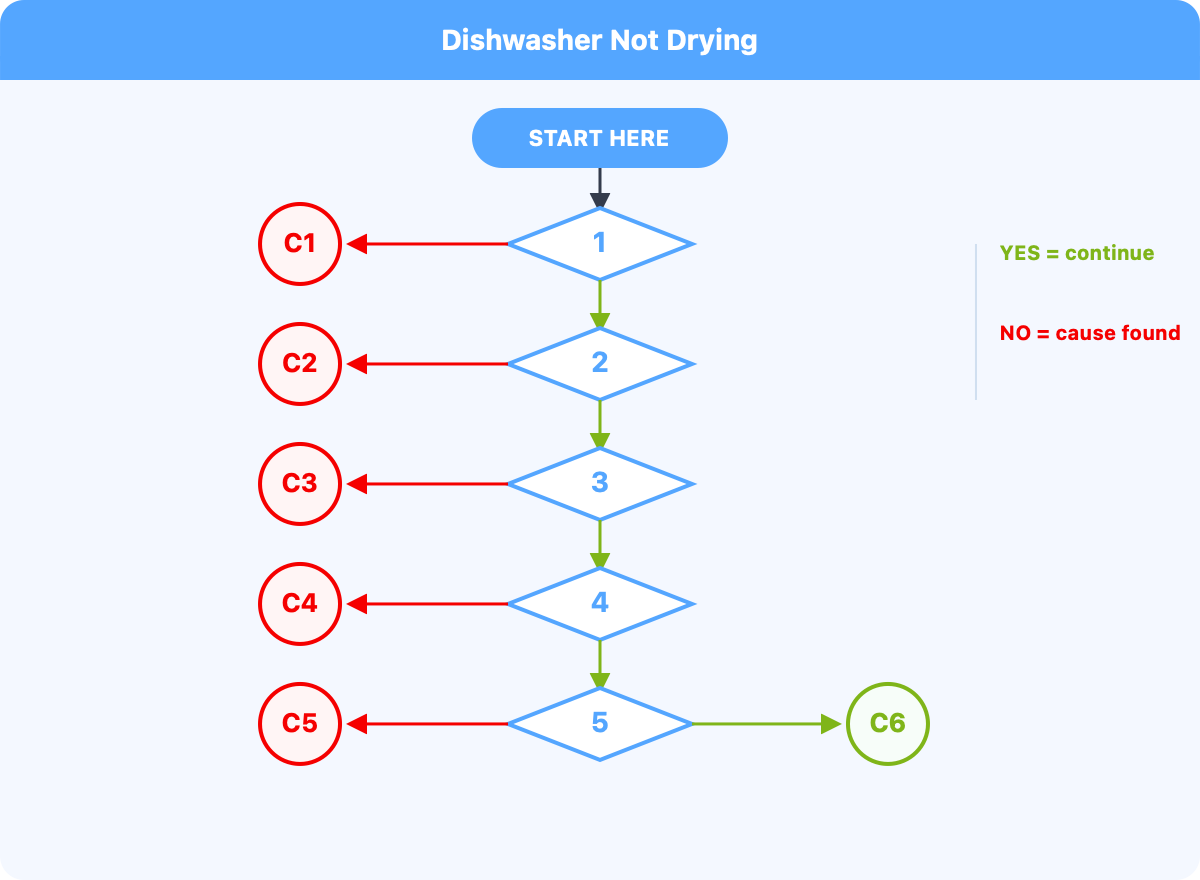
C1 = rinse aid empty, C2 = heated dry off, C3 = heating element failure, C4 = high-limit thermostat, C5 = vent fan assembly, C6 = plastic thermal mass (by design)
Knowing how to fix a dishwasher that is not drying starts with a rule: check the free fixes before pulling any panels. Diagnostic triage ordering saves time and money. Running a cycle without heated dry active means the drying phase uses no element heat at all. On Whirlpool, KitchenAid, GE, and Samsung standard models, it is a separate button press, not a default. Eco and Quick Wash cycles disable it automatically.
Pull the door open right at cycle end and touch a ceramic mug. Warm dishes mean the element ran and you have a rinse aid issue. Room-temperature dishes mean the heat was never on. Enable heated dry and run a Normal wash. That 30-second check resolves the dishwasher not drying on heated dry setting complaint faster than any other step.
When rinse aid runs out, water clings in beads across every surface. Dishes still wet after dishwasher completes the full cycle is the classic sign. Open the dispenser cap on the door interior; if it reads empty, refill and run a full Normal cycle with heated dry. A dishwasher leaving dishes wet after that fix means a component needs attention.
Rinse aid drops surface tension in the final rinse so water films off instead of beading. On glass the effect is immediate. On plastic, where surface tension is higher, it is the only chemical lever that helps. A Whirlpool dishwasher not drying but running warm usually traces to the dispenser, not the element.
The wax motor opens rinse aid dispenser door at the correct point in the cycle. Rinse aid dispenser failure sits between a simple refill and a component repair. When the motor fails, you have a dishwasher not drying with rinse aid full in the reservoir, leaving dishwasher dishes wet after cycle. A multimeter on Rx1 at the motor terminals returns OL on a dead unit; a cracked cap shows as hairline fractures on the sealing surface. Both require door panel access to replace.
Open the door right at cycle end and touch a ceramic mug. Room temperature means the element did not heat. A second confirmation: Sanitize LED blinks when element fails cycle temperature rather than showing a steady light. Both tests take under two minutes without tools.
Our techs see element failure more often than any other single component. On Frigidaire and GE models, the coil shows visible burn marks at the break point.
The heating element draws 1100 watts at 120 volts and sits at the bottom of the tub interior as a coiled ring. When it burns out, the internal wire breaks and current cannot pass. The drying cycle runs its full timer while delivering zero heat.
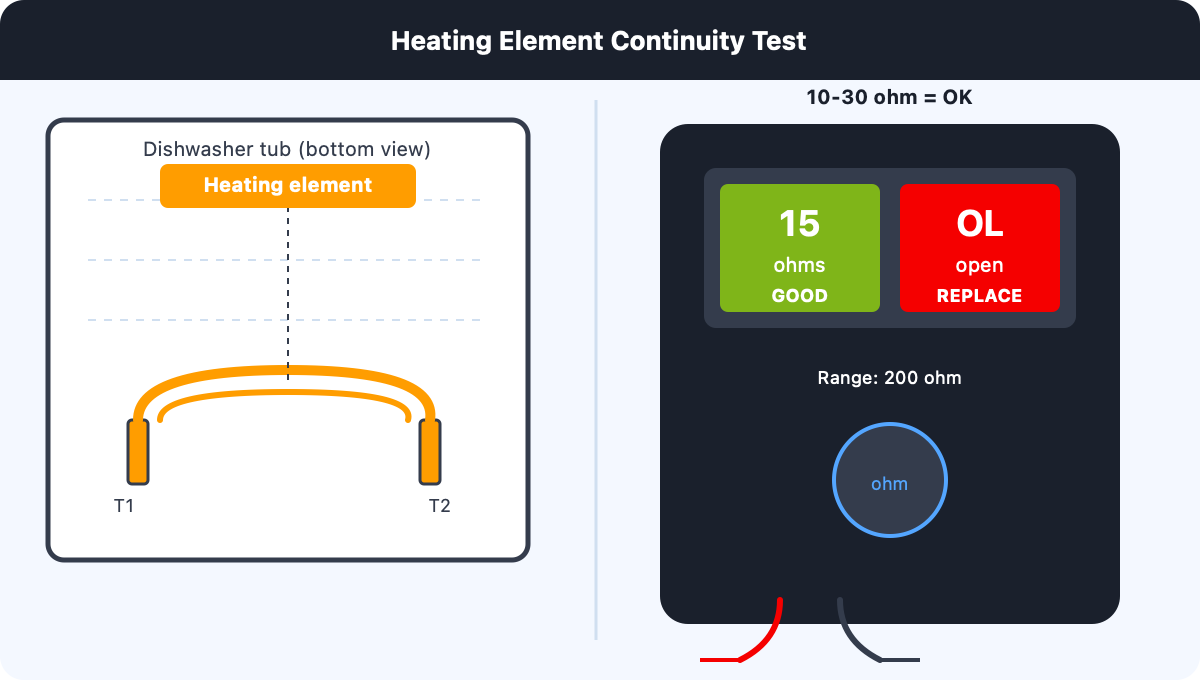
Disconnect the dishwasher from power before touching any terminals. Set the multimeter to resistance mode (Rx1) and place probes on both element terminals. Element resistance 10 to 30 ohms is the normal range. An OL reading means open circuit replace element immediately. Zero ohms indicates a short. Either fault requires replacement.
On a Samsung dishwasher not drying, element access is a professional job on most models. Swap the element and still wet? Read the thermostat section before assuming the replacement part is defective.
High-limit thermostat coverage is the gap most repair guides skip entirely. A fatigued bimetal strip begins tripping at temperatures well below the 207 F cutoff point. The element tries to heat; the thermostat cuts it off prematurely. The drying cycle runs its full timer delivering almost no heat, and the symptom looks identical to element failure.
The high-limit thermostat trips at 207 F to protect the element from overheating. Disconnect power, locate the thermostat on the outer tub wall, and set the multimeter to Rx1. A healthy thermostat reads near-zero ohms at room temperature. An OL confirms defective contacts: replace it when the element tests clean but drying still fails.
Frigidaire units older than five years see more thermostat failures than most brands in Denver Metro. This is the cause behind most dishwasher not drying after replacing heating element complaints: the old thermostat trips the new element off at low temperatures.
On an LG dishwasher not drying, a seized vent fan motor is one of the most frequent component repairs our techs document. The symptom is recognizable: heavy condensation on the inside of the door at cycle end, top rack worst. Confirm the motor with a multimeter continuity test; OL means the winding is open.
The vent flap can also warp or get blocked by a loose utensil. A stuck flap traps humidity even when the fan runs. Replacement requires door panel disassembly, typically a professional job on Samsung and LG models.
Bosch 300 series use condensation drying, relying on stainless tub walls and residual rinse heat with no heating element in the drying phase. The 800 series is common in Denver Metro homes with premium appliances. As a Denver hi-end appliance authority for Bosch service, we see condensation-drying questions more often than any other brand question. Glass dries on condensation models. Plastic stays wet by design.
A Bosch dishwasher not drying dishes on the 300 series is often an expectation gap, not a fault. Open the door two to three inches at cycle end to let steam escape. The heated dry vs condensation distinction clarifies the diagnosis before any service call is needed.
Bosch 500 series uses AutoAir: the door opens two inches at cycle end. AutoAir opens door 40 percent better drying than sealed models per manufacturer data. See our Bosch dishwasher E15 error guide for other Bosch fault codes.
Dishwasher not drying plastic items is the single most common complaint we hear from Bosch 300 series owners. Low thermal mass explains the pattern: containers lose heat three times faster than ceramic once the wash cycle ends. Plastic thermal mass physics accounts for the rest: low specific heat capacity, little absorbed energy, and rapid cooling. That is why plastic cools faster than ceramic glass: by the time drying begins, a container is near room temperature while ceramic still holds evaporating heat.
In a condensation drying machine, plastic containers are as cool as the tub wall and attract condensation from warmer ceramics. Rinse aid lowers surface tension enough to partially offset this, but some residual moisture on deep concave plastics is physics, not a fault.
Angle plastic containers at 45 degrees so pooled water drains before drying begins. Load lids face-down. For a KitchenAid dishwasher not drying plastic reliably, enabling ProDry adds heat time that reduces residual moisture. The sanitize cycle runs a higher final rinse temperature, improving plastic drying on any heated-dry machine.
If wet plastic is the only complaint and glass dries fine, no component is failing. See our Frigidaire dishwasher not starting guide for related issues, or our dishwasher installation page for cycle-setup tips.
A dishwasher stops drying dishes when one of six things fails. The six causes: empty rinse aid, heated dry not enabled, burned-out heating element, high-limit thermostat tripping early, seized vent fan assembly, or the thermal mass gap between plastic and glass. Start with the settings check and rinse aid before testing any component.
Plastic has low thermal mass: it cools to room temperature before the drying cycle begins while glass and ceramic still hold enough heat to evaporate surface water. In condensation drying machines, plastic attracts condensation from warmer neighbors. Rinse aid lowers surface tension so water sheets off rather than beads. Angle containers downward to drain pooled water.
Rinse aid lowers water surface tension in the final rinse so water sheets off rather than beads. On glass the effect is immediate. On plastic, where surface tension is higher, it is one of the few interventions that makes a real difference. An empty or clogged dispenser leaves dishes wet even when the element runs perfectly.
Disconnect power first. Access the element terminals beneath the tub interior. Set a multimeter to Rx1. Element resistance of 10 to 30 ohms is healthy. An OL reading means open circuit; replace the element immediately. Zero ohms indicates a short. Never test with power connected.
If your dishwasher not drying anymore began overnight after years of reliable service, that points to component failure, not a setting change. The heating element burns out between four and eight years in. The high-limit thermostat fails abruptly at low temperatures. If your dishwasher won’t dry and nothing changed, run a continuity test on both components.
The 300 series uses condensation drying with no heating element in the drying phase; condensation drying relies on stainless tub walls and residual heat from the final rinse. Glass dries well; plastic stays wet by design. Step up to the 500 series for AutoAir, which opens the door at cycle end for 40 percent better results. Bosch 800 series adds CrystalDry zeolite at 176 F, claiming 60 percent better drying than standard condensation models.
Open the door right after a cycle. Heavy condensation on the inside of the door panel with the top rack worst is the clearest sign the vent fan assembly is not moving humid air. A multimeter continuity test on the motor terminals confirms; OL means the winding is open and the assembly needs replacement.
Try the rinse aid refill and the heated dry setting first. If dishes are still room temperature at cycle end, the fault is almost certainly a component. Wilson & Myers provides dishwasher repair service across the Denver Metro Area. We serve Denver, Aurora, Lakewood, Littleton, Englewood, Sheridan, Wheat Ridge, Edgewater, Golden, Arvada, Westminster, Thornton, Northglenn, Commerce City, Brighton, Castle Pines, Castle Rock, Broomfield, Superior, Louisville, Lafayette, Longmont, Erie, Centennial, Greenwood Village, Cherry Hills Village, Glendale, Parker, Highlands Ranch, Lone Tree, Boulder, and Morrison. Book online to confirm availability.
Wet dishes after every cycle point to a part that needs replacement or recalibration. Wilson & Myers sends an insured technician to your Denver home, diagnoses the root cause, and sources the correct part through national supplier networks and manufacturer contracts.
Found This Helpful?
A residential dishwasher leaking from bottom rarely fails where the dishwasher puddle on floor tiles appears. Pull the kick panel; the highest wet surface mark…
It is a week before Thanksgiving, and you set the oven to 350 degrees before starting the stuffing. Forty minutes later, the preheat signal fires. That is roug…
Has your refrigerator water dispenser stopped delivering water? In my experience, a large share of these calls end before a technician arrives. A child lock ac…
You open the dishwasher after the cycle and the plates look exactly as you loaded them: dry, cold, with last night's dinner still caked on. Your dishwasher is…
A washer that shakes violently during spin traces to one of seven causes, from a bunched load to a failed drum bearing. Here is the order to check them, and th…
F8 E4 means water reached the drip tray, not a fill fault. Here is the two-step reset and why it can fire on a brand-new install with a dry tray…
Welcome to the community.
You'll receive our next expert update soon.

Wilson & Myers is a verified member of the Denver Metro Chamber of Commerce.


