

Need a Professional Hand?
If a DIY fix isn't enough, our insured technicians are just a click away. We’ll diagnose the issue and get your home running right again.
BOOK NOWA residential dishwasher leaking from bottom rarely fails where the dishwasher puddle on floor tiles appears. Pull the kick panel; the highest wet surface marks the breach. A dishwasher leaking water onto the floor is always downstream, and this guide maps five zones to the parts behind them.
What causes a dishwasher to leak from the bottom depends on where the water first appears: door means gasket or spray arm; under the machine center means pump seal; fill phase means inlet valve. A dishwasher leaking at the bottom during cycle falls into one of these five zones, and the table below maps each one.
| Where Water Appears | When It Appears | Likely Cause | First Check |
|---|---|---|---|
| At door or door bottom | During wash cycle | Door gasket, alignment, cracked spray arm | Check gasket corners; check machine level |
| Under machine center | Any phase | Pump seal or sump seal | Pull kick panel; trace to highest wet point |
| At door, first 90-120 seconds | Fill phase | Inlet valve stuck open, float debris | Lift float; check free movement |
| Suds or soapy water at door front | Wash phase | Wrong detergent oversudsing | Look for foam; switch to dishwasher detergent |
| Machine off, water on floor | Between cycles | Inlet valve seep, supply line fitting | Check whether wet area is at machine or wall |
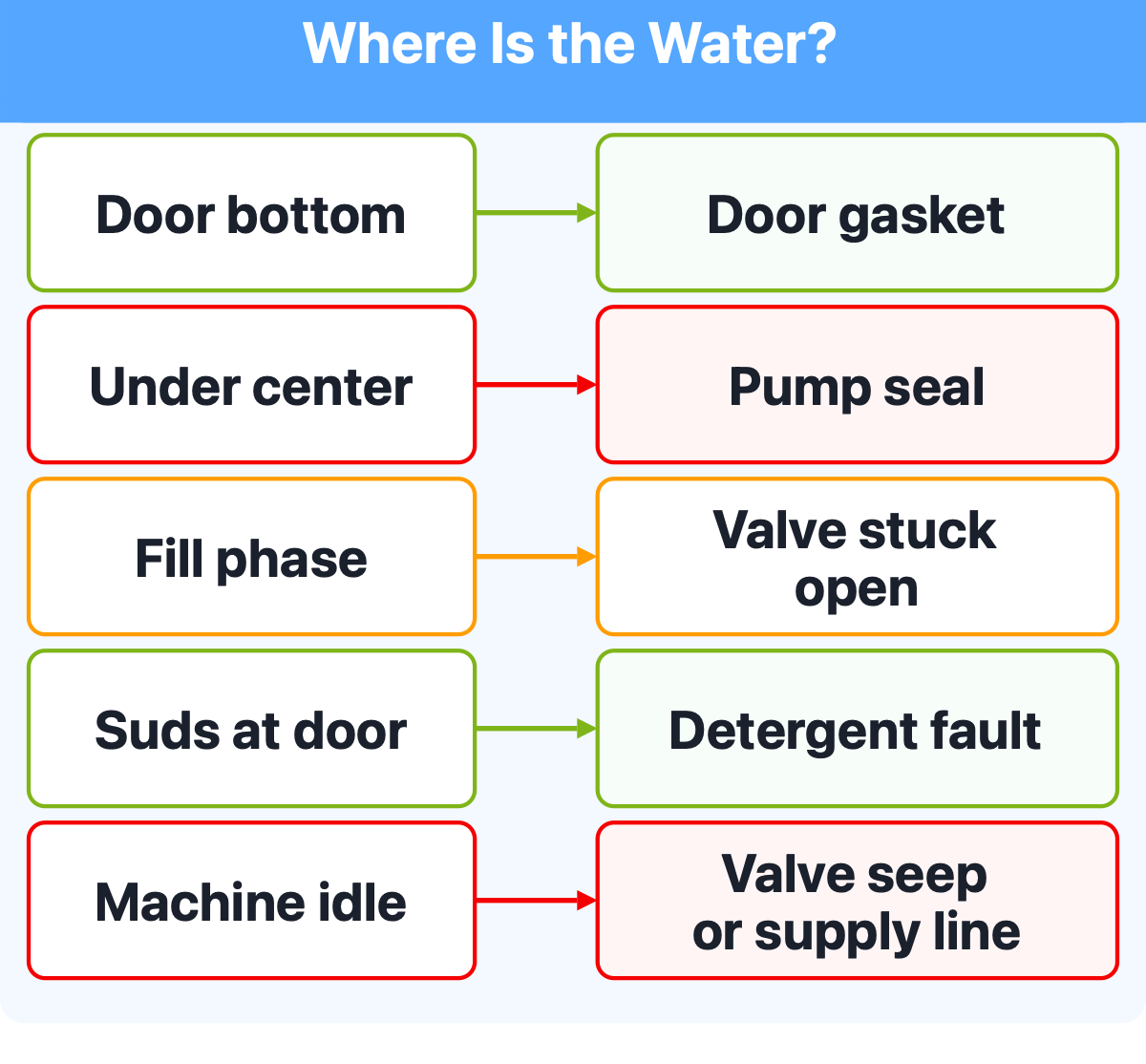
The diagram maps the same five zones to the part behind each one.
Water runs down before it pools, so the floor puddle is almost never the source. Pull the kick panel and find the highest wet point. That is where the leak starts.
A dishwasher leaking from door corners or diffusely along the bottom seal starts with the door gasket. Before ordering a replacement, check whether the machine is level; an unlevel frame presses the door seal unevenly and causes the same symptom with a good gasket in place.
Door gasket corner failure is the top culprit; run your finger along the channel at the lower corners where rubber takes the most compression. A dishwasher leaking water under the door from a failed corner feels rigid or cracked at that spot. Replacement is moderate DIY: remove the old gasket, clean the channel, and press-fit the new one from the top.
An unlevel dishwasher loads one corner of the door gasket with all the sealing pressure while the opposite corner barely contacts the tub. Use a level front to back and side to side, then adjust the leveling feet. In my experience, this correction resolves the leak on Whirlpool and KitchenAid models without any part replacement.
A fracture in the spray arm redirects a jet toward the door seal at an angle the gasket cannot block. Inspect the arms for visible cracks; this leak appears only in the wash phase.
One more door-bottom cause: a drain hose without the required high-loop siphons water back through the tub and out the door at the end of the drain phase. If your dishwasher leaks at the door only as the drain runs, see our guide on Bosch dishwasher not draining. It also covers the Bosch E15 error code that fires when water reaches the base tray.
Disconnect power at the circuit breaker and shut off the water supply valve under the sink before any check that puts your hands under the dishwasher. Standing water sits beside live electrical connections down there.
When the dishwasher leaks water and the door stays dry, the source is almost always the pump or sump area. A dishwasher leaking from base with no cycle-phase correlation points to the motor shaft seal or sump seal. The motor shaft seal wraps the impeller shaft; when the rubber dries out and cracks, water leaks past it and runs to the base cavity. The sump housing retains moisture after every cycle, and long periods of non-use let that moisture evaporate, which accelerates seal cracking.
Remove the kick panel and shine a flashlight into the cavity. Follow the drip upward to its highest wet point. I’ve traced this pattern on GE, Whirlpool, and Samsung machines: dry door, central floor puddle, no cycle-phase connection. It was the pump seal every time, or the adjacent sump seal, sometimes called the tub seal, which sits between the pump housing and the tub bottom.
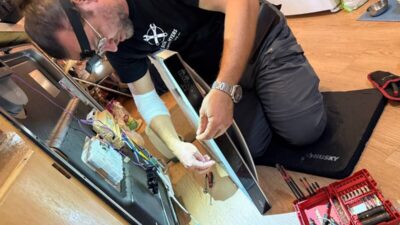
Access requires pulling the appliance and reaching the sump from below. If your dishwasher leaks from the base, schedule a dishwasher repair in Denver Metro and our insured technicians will diagnose the source.
Water at the door during the first 90 to 120 seconds of a cycle, before the wash phase starts, points to an overfill fault. Most residential dishwashers fill to roughly two gallons in that window; when the float assembly fails to signal the stop, the tub keeps filling past that level until water overflows at the door.
Lift the float manually in the lower front of the tub. Whirlpool’s product help page lists float switch movement as a core troubleshooting step; if it does not move freely, clean the debris from the chamber. A Whirlpool, Maytag, or KitchenAid machine showing F8 E4 is likely overfilling from this fault. If the float moves freely and the tub still overfills, the inlet valve seat has corroded and the valve needs replacement.
For the fill-circuit detail, see our guides on dishwasher not getting water and Frigidaire dishwasher starting issues.
Foaming water at the door front during the wash phase is the one dishwasher leak with a free fix: wrong detergent. Regular dish soap or an oversized pod dose produces suds the circulation pump cannot contain. A dishwasher leaking only during wash cycle with visible foam at the door front is oversudsing, not a seal failure.
Run a short cycle and watch the door. Foam escaping confirms the cause. Drain the tub, run a rinse cycle with no detergent, then restart with dishwasher-specific detergent.
Bosch machines with a built-in water softener are especially susceptible; a full-dose pod creates excess suds on every wash. We see this pattern several times a month in Denver Metro kitchens when a homeowner switches pod brands. Samsung and LG models sometimes pause the cycle on excess suds.
Water on the floor with the machine off and the tub dry narrows to two sources: a weeping water inlet valve or a supply line fitting at the wall. The inlet valve carries line pressure between cycles; when the seat corrodes, a slow drip accumulates.
If the wet area is at the wall fitting behind the machine, the supply line connection has loosened; that is a plumbing repair and a plumber is the right call. If the wetness is at the machine’s rear inlet, the inlet valve is failing.
The valve cannot be repaired; replacement is the fix.
Only use dishwasher detergent, not dish soap or any product that foams; this is the one free fix in the list. Wipe the door gasket at the lower corners monthly: food residue holds the rubber away from the tub just enough for water to escape at the seam. Check that the machine is level once a year; a half-inch tilt loads one corner of the seal on every cycle.
Most checks above you can run without tools. Fixing what you find is a different question. Pump seal replacement, sump seal work, inlet valve replacement, and a cracked tub assessment all require pulling the appliance, disconnecting the supply and drain lines, and working at the base. Do not run the dishwasher if the leak source is unidentified; standing water near the electrical connection creates an electrocution risk.
Wilson and Myers handles dishwasher repair across Denver Metro, including Lakewood, Aurora, and Centennial. A puddle under the center matching the pump-seal pattern, a door still dripping after leveling and a new gasket, or water appearing with the machine off: all three warrant a professional diagnosis. Do not let the leak run until water reaches the subfloor.
If the machine is also leaving dishes wet after the cycle, see our guide on dishwasher not drying; for dishes coming out with residue, see dishwasher not cleaning dishes. The same highest-wet-point triage applies to a washing machine leaking from the bottom and a refrigerator leaking water. Still leaking after the door check and detergent test? Book online and an insured Wilson and Myers technician will find the source.
Why is my dishwasher leaking from the bottom?
The cause depends on where water first appears. Door means the door gasket, alignment, or a cracked spray arm. Under the center means pump seal; the first 90 to 120 seconds mean inlet valve or float assembly. Find the highest wet point under the kick panel before diagnosing.
Is it safe to use a dishwasher that is leaking?
Do not run a leaking dishwasher until you identify the source. Water pooling near the electrical connections under the machine creates an electrocution risk. Shut the machine off at the circuit breaker and close the water supply valve under the sink. Leave it off until a technician has confirmed it is safe to operate.
How do I fix a dishwasher leaking from the bottom?
Knowing how to fix a dishwasher leaking from the bottom starts at the kick panel. Pull it, find the highest wet surface, and that point names the cause. Water at the door means gasket or leveling; suds at the front means detergent. Water under the center is a pump seal repair, a technician job.
What causes a dishwasher to leak at the door?
A worn door gasket is the most common cause of a dishwasher leaking from the door bottom. An unlevel machine causes the same symptom without any part failure; uneven compression lets water find the gap. A cracked spray arm directing flow toward the door is less common. Check the gasket first, then level the machine.
Can too much detergent cause a dishwasher to leak?
Yes. Regular dish soap or an oversized pod dose produces high suds the pump cannot contain. The foam escapes through the door gap and pools at the base. Drain the tub, run a cycle with no detergent to flush the suds, then switch to dishwasher-specific detergent in the correct dose.
When should I call a professional for a leaking dishwasher?
Call a technician when the leak comes from under the center of the machine, when the tub overfills despite cleaning the float, or when water appears with the machine off. If gasket and detergent checks have not stopped the leak, that is also a pro call. An unidentified leak near electrical connections is a safety risk.
Our insured technicians diagnose dishwasher leaks across Denver Metro. We source parts through national supplier networks and manufacturer contracts.
Found This Helpful?
A Samsung washer not spinning leaves clothes wet in the drum and the dryer waiting. Samsung's four platforms handle this differently: WF front-load, WA top-loa…
It is a week before Thanksgiving, and you set the oven to 350 degrees before starting the stuffing. Forty minutes later, the preheat signal fires. That is roug…
Has your refrigerator water dispenser stopped delivering water? In my experience, a large share of these calls end before a technician arrives. A child lock ac…
You open the dishwasher after the cycle and the plates look exactly as you loaded them: dry, cold, with last night's dinner still caked on. Your dishwasher is…
A washer that shakes violently during spin traces to one of seven causes, from a bunched load to a failed drum bearing. Here is the order to check them, and th…
F8 E4 means water reached the drip tray, not a fill fault. Here is the two-step reset and why it can fire on a brand-new install with a dry tray…
Welcome to the community.
You'll receive our next expert update soon.

Wilson & Myers is a verified member of the Denver Metro Chamber of Commerce.


