



Need a Professional Hand?
If a DIY fix isn't enough, our insured technicians are just a click away. We’ll diagnose the issue and get your home running right again.
BOOK NOWThe panel is the fastest diagnostic in the kitchen, and it answers what no cause list can: whether anything has failed at all. Frigidaire’s own alarm guide documents six things a display can show, and two of them are modes rather than faults. The other four are a genuine over-temperature warning, two events, and one alarm that has nothing to do with cooling at all.
| Display | What Frigidaire says it means | Fault or state |
|---|---|---|
| H or HI | Too warm in the refrigerator or freezer for over an hour | Fault signal |
| PF | Power outage or surge, which can leave a high temperature alarm | Event |
| 77 77 | Demo mode, the store setting that runs without the functional components | State, nothing broken |
| SB SB | Sabbath mode, minimum power for religious observance | State, nothing broken |
| Door ajar | A door left open for more than five minutes | Event |
| DI SP | Ice stuck in the dispenser chute, unrelated to cooling | Unrelated |
HI blinking means the box has been warm for over an hour. Frigidaire pairs it with an alarm every 60 seconds and a light beside the CLEAR ALERTS button. Pressing that button stops the alert. Nothing else changes.
PF is the power failure indicator. The Frigidaire refrigerator not cooling after power outage case is the simplest one here: power was lost, the box warmed, and it needs hours to pull back down. Owners then ask how to reset a Frigidaire refrigerator that is not cooling. A reset clears a mode or a stale alert, never a failed part.
Demo mode is the one that catches people out. Frigidaire built it for showroom floors and describes it as running without using the functional components. The cooling in demo mode is off on purpose.
Lights and panel carry on as normal. Unplugging for five minutes and restoring power is the exit Frigidaire’s guidance supports. Some panels show a different two-character code for the same mode.
Sabbath mode is the other state on that list, a minimum-power setting for religious observance. It dims the panel and locks the buttons. It does not switch the cooling off.
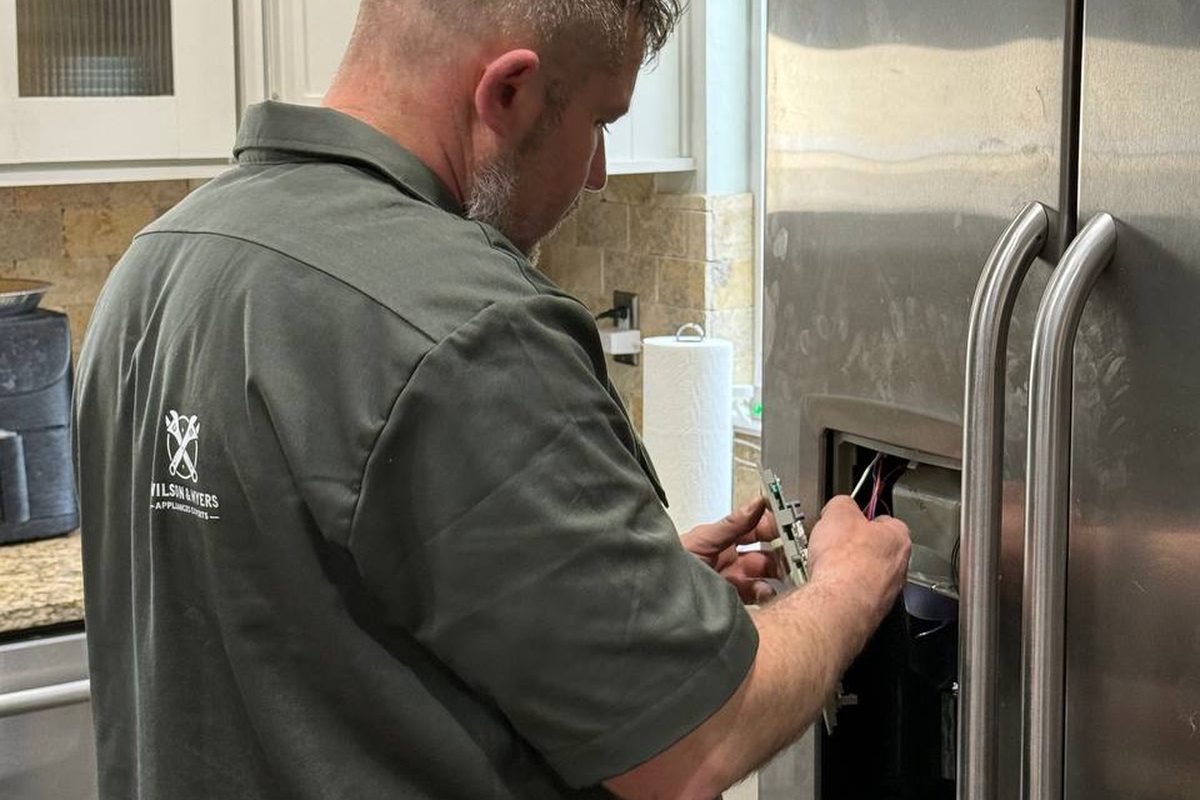
In my experience the panel is the one people skip. It looks like a thermostat, not a diagnostic.
Some refrigerators that read as broken are doing what they were built to do. Frigidaire asks for 24 hours after an installation, a move or a power restore before judging the temperature. A defrost cycle pauses cooling on its own schedule. Warm rooms, packed shelves and a door left ajar all move the numbers.
A Frigidaire refrigerator stopped cooling right after a delivery is almost always still inside that 24-hour stabilization window. Frigidaire recommends 37°F for the fresh food side and 0°F for the freezer. The acceptable ranges are 33°F to 47°F and -6°F to 6°F. A control nudged warm reads as a failure and is not one.
Frigidaire’s own first checks are boring, and usually right. Clear whatever is stacked against the interior vents.
Check the door gasket with the dollar-bill gasket test. Close a bill in the door and pull. If it slides out, the gasket is pulling warm room air in all day.
A unit that cannot hold temperature stops making ice. If the ice maker quit at the same time, treat it as one problem.
Frigidaire states that the installation location should not drop below 55°F, and that one number rules out a lot of Denver garages from October onward. Below that floor Frigidaire does not warrant the unit to hold temperature, and in an unheated garage the freezer is usually the side that softens first. The fresh food side looks fine. Nothing has failed.
In the Denver homes I service, the refrigerator that fails first is almost always the second one, standing in an unheated garage. A Frigidaire fridge not cooling out there in February is a design envelope problem rather than a repair. The same garage refrigerator in August sits far above what a standard unit was built for.
Frigidaire does sell for that spot. Its garage-ready top freezer model FFTR1835VS is rated from 45°F to 110°F, a rating that belongs to that model rather than the line. Every other unit is judged against the 55°F floor.
The pattern turns up in Arvada detached garages and in older Denver basements. Lakewood utility rooms that never see a heat register do the same thing.
We have seen the summer version in Aurora. The garage hits 100°F, the door stays shut, and the condenser has to shed its heat into air that is barely cooler than the refrigerant it carries.
Ask why is my Frigidaire refrigerator not cooling and nearly every answer opens with the condenser coils. Frigidaire’s own not-cooling article never mentions them. It checks the outlet, the 24-hour window, the temperature settings, the blocked vents and the door seal, a fair map of where the manufacturer expects failures to be.
Dirty condenser coils are real. Denver’s dry dusty air loads them faster than a humid climate would. What they produce is a slow drift: longer run times each month, a degree of warming.
They rarely produce a refrigerator that was cold on Tuesday and warm on Wednesday. Read the display first, then the room, then the vents.
Coil-first advice runs on every brand. That is why our cross-brand guide to a refrigerator that is not cooling sits separately.
Everything to this point costs you nothing but a minute. Once the panel is clear and the vents are open, what is left is a failed component. A refrigerator repair visit starts with the same panel read, moves to the airflow path and the sealed system, and ends with you being told which one it is.
A Frigidaire refrigerator not cooling but freezer is cold has two different answers, because Frigidaire ships two cooling layouts. On the conventional one, all the cold is made in the freezer and metered across, so the fault sits in the air path. On a dual evaporator model the fresh food section has its own coil. The same symptom means something else.
Which cooling layout you own is printed somewhere, not guessed. Read the model number off the plate. On a top freezer it sits along the upper left wall of the fresh food compartment; on a French door or side-by-side, along the upper right.
Then look that model up on Frigidaire’s product page or its specification sheet. Find the line labelled Cooling System. It reads Single Evaporator or Dual Evaporator. If your model’s page carries no Cooling System line, treat the unit as the conventional single evaporator layout.
Most Frigidaire refrigerators use that layout. The second coil turns up on part of the French door line and not on all of it, so a top freezer or side-by-side owner can stop here. Frigidaire publishes no evaporator count for top freezer and side-by-side models.
French door does not mean dual. A Frigidaire Professional French door model lists Single Evaporator on its own spec sheet. The layout has to be read, not inferred from the doors.
The name Frigidaire gives this airflow path is a marketing one: EvenTemp Cooling System appears on product pages, not on the specification sheet where the layout is printed. Frigidaire describes the EvenTemp system as optimizing airflow to prevent warm spots and unwanted freezing.
Airflow is what fails here. A Frigidaire refrigerator not cooling but freezer works normally is not a compressor problem.
Freezer cold, fresh food side warm: the compressor is almost never the problem. On a Frigidaire the first question is which cooling layout you have, because that decides what we go looking for.
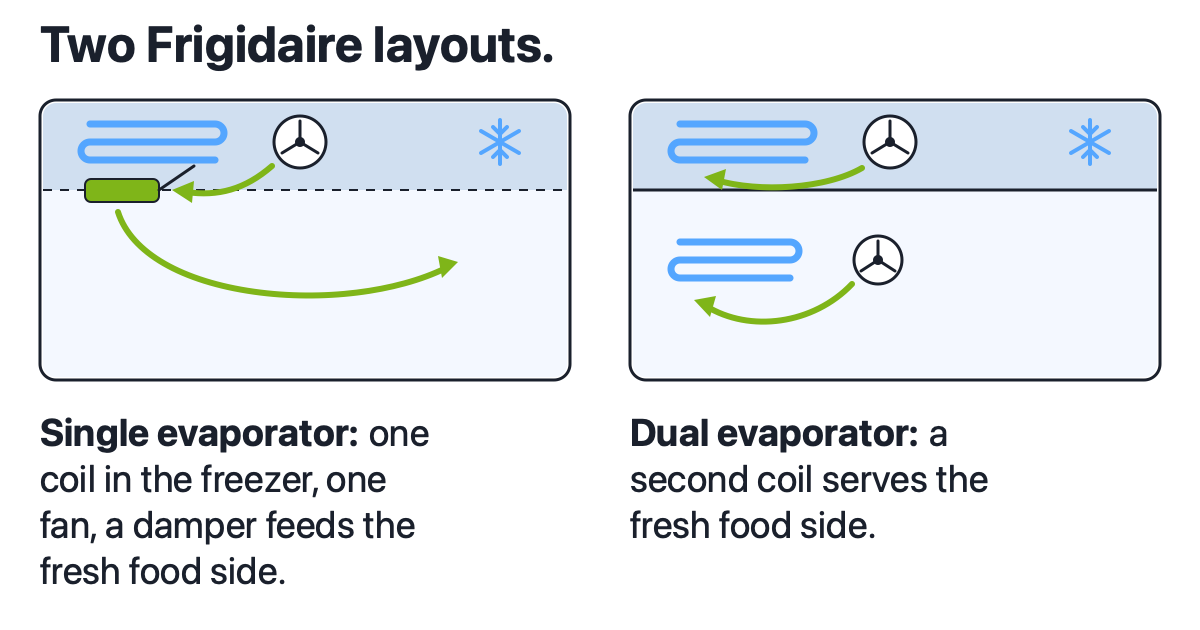
What follows describes the conventional single evaporator air path. Does your Cooling System line read Dual Evaporator? Then stop here. That second coil has its own circuit and its own defrost.
Sorting out which failed is a technician’s measurement, not a look and listen check. Skip ahead to When to Call Wilson and Myers.
A motorized air damper in the upper left corner of the fresh food compartment meters cold air across from the freezer. When it stops opening, the fresh food side starves while the freezer stays exactly as cold as it should be.
Hold a hand at that vent with the freezer fan running: no air means the damper, not the fan. The part is the air damper control. The thermostat and the defrost control drive it, not anything you set. Stuck open, the opposite complaint: food freezing on the top shelf.
One fan moves cold air out of the freezer on this layout, and nothing else pushes air into the fresh food side. Open the freezer door and hold the door switch in. A working evaporator fan spins up within seconds and you can hear it. Silence, or a fan that starts and stalls, explains a warm fresh food section.
The coil behind the freezer’s back panel frosts every cycle, and a defrost heater melts it off on a schedule. When that stops happening, frost over the evaporator thickens until air cannot pass through.
The freezer holds longest. It sits against the coil, so the fresh food side goes first. Onset over days rather than minutes tells this apart from a dead fan.
Frigidaire runs defrost timing through an adaptive defrost control board that watches evaporator temperature rise and fall. On many side-by-side units it is a separate board in the control housing, not a function buried in the main control. That matters for a Frigidaire side-by-side refrigerator not cooling in the fresh food compartment. The board can decline to run a defrost while the heater and the coil are both healthy.
When a Frigidaire refrigerator is not getting cold in either compartment, the useful information is audible. A unit that runs without stopping is a different fault from one that tries to start and gives up, and you can separate them from across the kitchen. Continuous running points at heat that cannot leave. A click every few minutes points somewhere else.
The compressor hums, an overload protector clicks it offline, and the attempt repeats every two to five minutes. That is how any single-phase compressor behaves when it cannot start, on any brand: the start relay has failed open, or the overload beside it has.
Both sit behind live terminals and a capacitor that holds charge after the plug is out. Other refrigerator noises take practice to tell apart. This cadence does not.
Frost that has buried the evaporator does it. So does a stopped condenser fan. A Frigidaire refrigerator running but not cooling is either losing the cold it makes or not making any.
Frigidaire’s spec sheets list the condenser type as dynamic, meaning fan-cooled, so a dead condenser fan is a documented path on these units rather than a guess. The same sheets list the refrigerant as R-600A, one more reason a sealed system is not a driveway repair.
Did the freezer give up first? The freezer not freezing path fits better, and our freezer repair page covers that side. The cross-appliance version sits in our guide to fixing a refrigerator.
A thermistor is a sensor whose resistance changes with the cold around it, and the temperature control board reads it and decides what to power. A technician diagnoses both by measurement, which is why the board is the most misdiagnosed part in the machine. One narrowing step needs no tools: a panel showing HI and still sounding its alarm is powered and reading its sensors. A dark panel on a line that has a display is a different problem.
Everything in the first section needs a display. A Frigidaire Gallery refrigerator not cooling gives its owner a code to read. A plain dial or slider control cannot show HI, PF or a mode code at all. That owner diagnoses by hand: which compartment is cold, what it sounds like, where it stands.
Across Frigidaire, Frigidaire Gallery and Frigidaire Professional, one difference changes your diagnosis. That difference is the display.
A Frigidaire top freezer refrigerator not cooling on a basic panel gets diagnosed by compartment and by sound. Layout changes the odds. On a bottom freezer the fresh food vents sit at eye level, easy to bury under a party platter. On a side-by-side the column is tall and narrow, so a frosted coil starves the fresh food side sooner.
Three of the faults above are not homeowner work, for specific reasons. Sealed system repair needs recovery equipment and an EPA-608 certified technician. Compressor start components sit behind live terminals beside a capacitor that holds charge with the plug out. A temperature control board is the part guessed at most often, and swapping one on a hunch teaches you nothing.
A visit starts the way this article does. We read the panel and confirm which cooling layout the model uses. Then it is measurement: air at the damper, the evaporator fan under power, the defrost circuit, and the sealed system last. Parts come through national supplier networks and manufacturer contracts, and we order OEM where the model calls for it.
Food safety is the one clock running while you decide. A refrigerator sitting above its range for hours puts what is inside it at risk, and that call belongs to you rather than to a repair schedule. Our refrigerator repair service page describes what a Denver Metro Area visit covers.
The panel you read in the first ten seconds is where we start too. It stays the cheapest diagnostic in the house. Nobody checks it before pulling the unit out to reach the coils.
On the conventional layout, cold air is made in the freezer and metered across through a motorized damper. So this is an airflow failure: the damper, the evaporator fan, or frost over the evaporator. On a dual evaporator model that side has its own coil instead.
77 77 is Frigidaire’s demo mode, built for store display units. Frigidaire describes it as running without using the functional components, so the panel works while nothing gets cold. Nothing is broken. Unplugging for five minutes and restoring power is the exit Frigidaire’s guidance supports.
Unplug for five minutes, then restore power. On models with a CLEAR ALERTS button, press it to clear a high temperature alarm. A reset clears a mode or a stale alert, not a failed damper, fan, defrost circuit or sealed system.
Constant running with no cold means the machine is working and the heat is not leaving. Frost over the evaporator, a stopped condenser fan or a sealed system loss all produce it. Frigidaire spec sheets list a dynamic, fan-cooled condenser, so a dead fan is a real path.
Frigidaire recommends 37°F for the refrigerator and 0°F for the freezer, with 33°F to 47°F and -6°F to 6°F given as acceptable ranges. A control at the warm end of those ranges is a common reason a Frigidaire fridge is not cold while nothing has failed.
Frigidaire asks for 24 hours after an installation, a move or a power restore before the temperature is judged. A unit inside that window can look like a failure and be normal. After 24 hours with the doors shut, a warm box is a real fault.
If the panel is clear and the vents are open, the next step is a measurement. Our insured technicians diagnose the airflow path, the defrost circuit and the sealed system.
Found This Helpful?
You opened the KitchenAid freezer this morning and the bin was empty. In my experience, the arm is the first thing worth checking: the fix costs nothing and ta…

A Frigidaire oven not heating can come down to a setting rather than a part. Before you book a repair, two checks cost nothing and take under a minute: the clo…

Has your refrigerator water dispenser stopped delivering water? In my experience, a large share of these calls end before a technician arrives. A child lock ac…

A Whirlpool dryer that tumbles but never heats traces to one of five faults, and three of them cost nothing to check. Here is the order to work through them, p…

F8 E4 means water reached the drip tray, not a fill fault. Here is the two-step reset and why it can fire on a brand-new install with a dry tray…

A Bosch dishwasher E22 error means one thing: the filter is blocked, and there is probably water sitting in the bottom of the tub…
Welcome to the community.
You'll receive our next expert update soon.

Wilson & Myers is a verified member of the Denver Metro Chamber of Commerce.


