Your KitchenAid Ice Maker Stopped Making Ice. Start Here.
You opened the KitchenAid freezer this morning and the bin was empty. In my experience, the arm is the first thing worth checking: the fix costs nothing and ta…

We repair KitchenAid ranges and stoves in gas, electric and dual-fuel, from 30-inch freestanding units to 48-inch Commercial-Style models. Our technicians are insured, and every repair carries a 100-day labor warranty. We diagnose first and quote second, and you decide before any part is ordered.
KitchenAid’s See All ranges page showed twenty current models in August 2026. Eight are gas, five electric, five dual-fuel and two induction. Treat that as a floor, because the listing filters down to what the brand sells today.
A range bought ten years ago still cooks dinner in Denver Metro kitchens, and we still work on it.
The brand’s own fuel pages under-report. Gas listed seven models, Electric six and Dual Fuel three, sixteen against the twenty on See All. The four missing from a fuel page are all Commercial-Style, so filtering by fuel hides them.
Two of the twenty are induction, and induction cooking surfaces sit outside what we service on any brand.
Your model number will often differ from anything we list by the last two characters. Read us the whole code.
A dead oven above live burners is frequently not a dead oven. A gas range carries a second shut-off valve on the pressure regulator, separate from the house supply. With that valve closed, gas reaches the cooktop burners and never reaches the oven.
The lever sits where objects can move it. We have seen one knocked across by a baking sheet in the drawer underneath, and it also moves during delivery.
Two more causes are published for the same symptom. Foil or a liner on the oven bottom can block gas flow to the burner. An overloaded storage drawer is the third, where pans press on the igniter.
Knocked closed, so the burners light and the oven never does
Foil or a liner blocking air or gas flow to the burner
Pans and spare racks pressing on the igniter below the floor
If the oven still will not light with that valve open and the floor clear, the fault is ours to find.
The display writes a fault in two parts, a family and a sub-code. F2 on its own and F2 E0 are not the same fault. The published text names a group of suspects, not a single part.
| Code | What the published text names |
|---|---|
| F2 | The oven temperature sensor, the control, or the wiring |
| F2 E0 to F2 E6 | The user interface or keypad, the control, or the wiring |
| F3 E0 and F3 E1 | The oven temperature sensor, the control, or the wiring |
| F5 E0 to F5 E3 | The oven door latch assembly, the door switch, or the wiring |
| F5 E5 | The oven did not reach self-clean temperature within thirty minutes |
| F8 E0 and F8 E2 | Cooling fan too slow or too fast, airflow named on the slow one |
| FC E4 and FC E5 | The Wi-Fi antenna or its wiring, with cooking unaffected |
Seven sub-codes in the F2 family carry one identical sentence, so F2 E4 is not a different repair from F2 E1. The published first step on all of them is a breaker reset: off one minute, on, then watch the oven.
Write the code down before you clear it. A range that clears cleanly may never show it again, and the visit loses its best evidence.
A self-clean cycle latches the door and holds it. The cavity has to fall to roughly 200F before the latch releases, and that takes longer than most people wait.
A latch arm that will not move on a cold oven, or that sits between full right and full left, is a service call.
F5 E5 is the odd code in that family. It reports that the oven never reached self-clean temperature within thirty minutes, a heating fault rather than a stuck door.
The published warning is that self-cleaning fumes are dangerous to some birds, so ventilate and move the cage.
Start by knowing what normal sounds like. Every burner clicks while one is set to LITE, so clicking across the cooktop is not a fault. A damp burner after cleaning, or one that took a spillover, clicks too.
On models with reignition the system re-sparks whenever a draft blows a flame out.
Two fixes are published for a single dead burner. Clogged ports open with a straight pin, a needle or small gauge wire. The cap and base carry matching marks, and the cap should sit flush with minimal movement.
The centre rear position is the exception. On some gas slide-in and freestanding ranges it is an oval burner. The KFGS330TPS spec block lists that position as Oval Burner at 12,000 BTU. Its cap is a Spreader, attached to the base rather than sitting loose, so lift and reseat does not transfer.
Burner work on a separate drop-in surface belongs on cooktop repair, or KitchenAid cooktop repair.
A new range that bakes differently from the old one is usually accurate and unfamiliar. The published wording is blunt: the oven provides accurate temperatures, but it may cook faster or slower than your previous oven.
Three separate ways into calibration exist, and the documentation says each is specific to your range. One holds the Temp or Time down arrow five seconds until 0F CAL appears, then adjusts in 5F steps. Another holds BAKE five seconds and adjusts in 10F steps. The adjustment runs about thirty degrees either way.
Calibration is not a failed sensor. F3 E0, F3 E1 and the 1d and 3d families all point at the oven temperature sensor, the control, or the wiring. An oven twenty-five degrees out is usually a setting. An oven that will not hold heat is usually a part.
Nine of the twenty current ranges wear the Commercial-Style name. It describes heavy knobs and a flat stainless front. It does not describe a machine rated for a restaurant line.
The brand’s own Gas Range Limited Warranty, document W10863343A, makes the point for us. Its first exclusion covers commercial, non-residential or multiple-family use. That document is the gas warranty and governs three of the nine Commercial-Style models. Read it as the manufacturer’s position rather than the whole story.
These ranges carry no numeric display, which changes how a fault reaches you. Blinking amber lights and a tone mean an error is stored. The published clear is to move the Temp knob to any position and back to Off, then cut power for one minute.
Reading the code itself needs the range on your Wi-Fi and registered in the KitchenAid app, under Settings, Service and Support, Appliance Error.
One limit is worth stating plainly. For the Commercial-Style codes the published pages give a clearing procedure and name no component. We will not borrow meanings from the display-range list.
On a Commercial-Style range the probe is not a standalone gadget. The range has to be on your Wi-Fi and registered in the app before it reports anything. The cycle also has to be started from the app.
Start the oven at the oven and you get no reading and no notifications, with nothing broken. A seated probe makes the range sound a tone, and no tone means it is not fully in the jack.
On display ranges, F3 E4 and plain F8 publish nothing beyond that seating instruction. A fair share of probe calls end without a repair, and we say so.
The plate is inside the oven door. KitchenAid describes it as an adhesive label carrying the serial and model numbers, silver on major appliances. It publishes no second location for ranges.
A wall oven label is also inside the door. A cooktop label sits on the liner beneath the burners, a different appliance on a different page.
Those route to wall oven repair and KitchenAid oven repair.
Exclusion 15 of that gas warranty removes service and parts where model or serial numbers are removed, altered or not easily determined. The plate lives on the surface people scrub hardest.
Sometimes the answer is a new range, and then three numbers decide it: cutout width, height and depth. A 30-inch opening will not take a 36 or 48-inch Commercial-Style range without cabinet work.
Exclusion 6 of the same warranty removes conversion from natural gas or L.P. gas from coverage. A range sold as LP convertible can still be converted, but the conversion sits outside that warranty.
We handle fitting too, on range and cooktop installation.
Four checks need no tools and take five minutes. Confirm the regulator shut-off lever is open before you decide the oven is dead. Clear foil off the oven floor and empty the storage drawer. Write down any code, then cut the breaker for a minute and watch what comes back.
Call us when the code returns, or when the latch arm will not move on a cold oven. Call us when a burner still will not light with clean ports and a seated cap. Gas connections are not a place to experiment.
We cover KitchenAid ranges and stoves across Denver Metro, gas, electric and dual-fuel alike. Book a range visit and give us the model number from inside the oven door. Add the code from the display if the range shows one.
These come up on the phone most weeks.
A gas range has a second shut-off valve on the pressure regulator. Closed, it feeds the cooktop and starves the oven.
The published text names the user interface or keypad, the control, or the wiring. That is three suspects rather than a diagnosis.
Cool the cavity to about 200F, then press Cancel or Off to start a latch reset and wait twenty seconds. A latch arm that will not move on a cold oven needs a visit.
Inside the oven door, on a silver adhesive label carrying the model and serial numbers. No second location is published for ranges.
No. The gas range warranty excludes commercial, non-residential and multiple-family use in its first exclusion. The name describes the styling of a residential appliance.
Yes. Stove and range are the same appliance in everyday speech, and this page covers both formats: freestanding, slide-in, double oven and Commercial-Style.
These general pages cover every brand we service: range and stove repair, oven repair and cooktop repair.
KitchenAid cooking appliances is the category above this page, and the KitchenAid brand page covers the kitchen side. Other cooking brands sit on residential cooking.
Every repair carries a 100-day labor warranty, and we source KitchenAid parts through national supplier networks and manufacturer contracts.
Gas connections have their own conditions when a unit comes out. Send us the model and we will book an insured technician.
Repair guides, maintenance tips and troubleshooting walkthroughs written by our insured technicians.
You opened the KitchenAid freezer this morning and the bin was empty. In my experience, the arm is the first thing worth checking: the fix costs nothing and ta…
A Frigidaire oven not heating can come down to a setting rather than a part. Before you book a repair, two checks cost nothing and take under a minute: the clo…
A Whirlpool dryer that tumbles but never heats traces to one of five faults, and three of them cost nothing to check. Here is the order to work through them, p…
F8 E4 means water reached the drip tray, not a fill fault. Here is the two-step reset and why it can fire on a brand-new install with a dry tray…
A Bosch dishwasher E22 error means one thing: the filter is blocked, and there is probably water sitting in the bottom of the tub…
A Frigidaire refrigerator not cooling is not always a broken refrigerator. The display on the door settles that question in about ten seconds…
You walked into the laundry room and the display is flashing D80. The drum is still turning. You do not know whether to stop the cycle or let it finish. D80 is…
A GE refrigerator not cooling usually falls into one of two failure paths. The question is simple: is the freezer still cold? If yes, the sealed system is inta…
You pull open the freezer on a July evening and find an empty bin. A Frigidaire ice maker not working in peak summer is one of the most frequent calls our Denv…
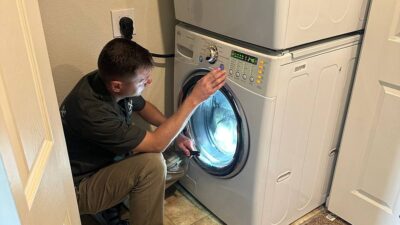
The LG washer UE code means the machine detected an unbalanced load during the spin cycle and stopped to protect the drum and bearings. UE is protection not br…
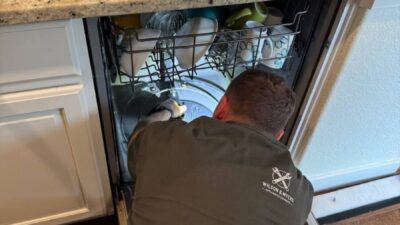
E24 on a Bosch dishwasher means the drain cycle did not complete. A clogged filter basket is the cause in most cases. If the filter is clear, the drain pump or…
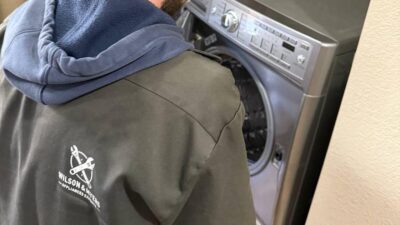
When the LG washer LE code flashes mid-cycle, the drum stops, and your laundry sits locked inside. Most people's first thought is a broken motor. It usually is…
Wilson & Myers dispatches insured technicians to homes running KitchenAid appliances throughout the Denver Metro Area.
A burner that will not light and an oven cavity that will not reach temperature are different faults. We diagnose which.

Wilson & Myers is a verified member of the Denver Metro Chamber of Commerce.