Your KitchenAid Ice Maker Stopped Making Ice. Start Here.
You opened the KitchenAid freezer this morning and the bin was empty. In my experience, the arm is the first thing worth checking: the fix costs nothing and ta…

An ice maker that has stopped is nearly always a water fault, a drain fault or a harvest fault. We repair KitchenAid undercounter machines and the ice maker built into a KitchenAid refrigerator. Our technicians are EPA-608 certified, which is the credential refrigerant work actually requires.
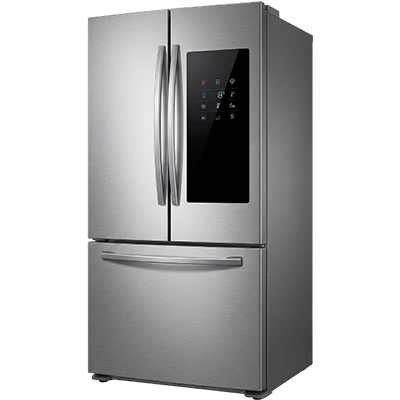
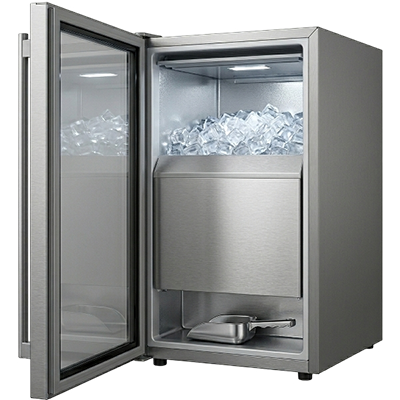
KitchenAid ice making happens in two places, and the two machines share little beyond the name. One is an undercounter unit in a wet bar, an island or an outdoor kitchen. The other sits inside a French-door refrigerator and feeds the door dispenser.
| What differs | Undercounter machine | Inside a refrigerator |
|---|---|---|
| How ice forms | water recirculates over an evaporator plate and builds one slab | water fills a mould in the freezer compartment |
| How ice releases | hot gas warms the plate and the slab slides onto a cutter grid | a mould heater and ejector push it into the bin |
| Storage bin | not refrigerated, so some melting is normal | inside the freezer |
| Drain | present, either gravity or pump | none |
| Water filter interval | nine months or 2000 gallons | six months |
| What governs it | room temperature | freezer temperature |
Own both machines and two KitchenAid documents will hand you two different filter intervals. That is not a contradiction. The ice maker filter is a nine month part and the refrigerator filter is a six month part.
If yours is the in-refrigerator ice maker, our guide to a KitchenAid ice maker not working walks that fault tree from the shutoff arm to the module.
Three faults cover most of the undercounter calls we take across Denver Metro. All three are set up by routine maintenance rather than wear, which is why they arrive right after a cleaning.
it closes the bottom of the water pan, and a loose cap empties the pan, so you get thin ice or none
the manual is blunt, and a filter not correctly locked into the housing means the ice maker will not produce ice
it watches the ice pile from the right side wall of the bin, and mineral film alone stops production
The current Owner’s Manual warns about that drain cap four separate times, in both of its cleaning procedures. The filter sits on the right-hand side of the controls and may hide behind a small push-latch door, depending on the model.
Nothing else belongs in the ice bin. Store only the ice and the supplied scoop, and keep the scoop in its holder. A scoop leaning on the sensor reads as a full bin.
A machine that looks dead is often a machine that cannot drain. A kinked hose, an over-long drain run, or a disposer knockout plug still in place will all present as no power. That sends plenty of owners to the breaker instead.
KitchenAid prints the one minute test in the Owner’s Manual. Pour one gallon of water into the ice storage bin. It should drain out. If it does not, suspect a kinked drain tube.
If the drain ties into a garbage disposer, that knockout plug has to be out. We meet the same plug from the other side on garbage disposal repair calls.
Drain runs are limited in both rise and length. Two documents covering this machine print different figures. We work to the limit on the plate for your model.
Minerals rejected during freezing wash back into the reservoir and eventually plate out on the evaporator. Scale holds the slab when hot gas tries to release it, and the sheet jams against the cutter grid. The Clean indicator is a schedule prompt, not a fault.
The cleaning cycle runs itself for roughly seventy minutes, cleaning and rinsing. How often it is needed depends on water hardness, and Denver Metro is served by many utilities, with some homes on wells. That is a starting assumption, never a finding about your address.
The Owner’s Manual asks for an installation above 55 F and below 110 F, and puts best results between 70 F and 90 F. Basement wet bars, garages and outdoor kitchens are where these machines go in Denver homes. An unheated garage sits under that floor for months.
The ice bin on an undercounter machine is not refrigerated, and KitchenAid states that some melting is normal.
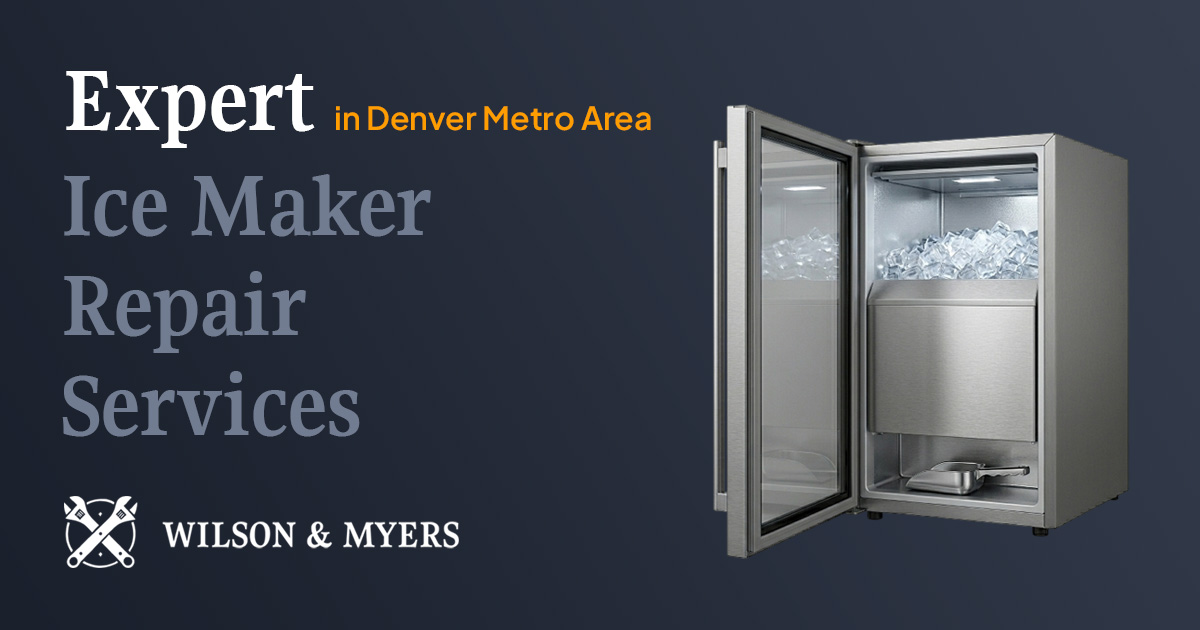
The water side of this machine is published in hard numbers, and those numbers explain most noise complaints. The machine wants a cold supply between 30 and 120 psi. Fifty psi is the figure KitchenAid recommends.
Above 60 psi you may hear a loud sound as water crosses the inlet valve during fill. Above 80 psi the Performance Data Sheet calls for a pressure reducing valve. Both belong to a licensed plumber rather than to us, and we will say so.
Not every noise is a fault. KitchenAid publishes the sounds this machine is supposed to make.
the water valve opening at the start of each cycle
water running over the evaporator plate and back into the pan
refrigerant moving as a cycle ends
the ice sheet sliding from the evaporator onto the cutter grid
Reverse osmosis is its own fault class on this machine. KitchenAid does not recommend an RO system where a drain pump is fitted, and specifies gravity drain only. Where RO is used it has to be whole-house capacity. A faucet-capacity system cannot hold the supply steady through a freeze cycle.
A machine that has never made ice is often a supply question, not a repair. Our refrigerator water line installation page covers that side of it.
On a KitchenAid refrigerator the ice can be made and still never arrive at the glass. Two software states sit ahead of any failed part. Check the Control Lock or Dispenser Lock first.
Sabbath Mode is the second. In it, ice and water will not dispense and no alarm sounds. The interior lights stay off and only the Sabbath button is lit. Leaving the mode usually means holding that button for three seconds.
After those, clumped ice in the delivery chute and a bin not snapped fully into place are the usual causes. Do not break bin ice apart with anything sharp, because that damages the bin and the dispenser mechanism.
For ice production the freezer wants 0 to 5 degrees F, which is colder than many owners set it. If the refrigerator itself is not holding temperature, that is a different visit. Our KitchenAid refrigerator repair page owns cooling, defrost and the sealed system.
One fault presents as a refrigerator problem and is not. An ice maker left switched on with no water line connected can buzz, over-cool the freezer and freeze food in the crisper drawers.
No document published for this machine carries an alphanumeric fault code. There is no F code and no E code here, whatever a listicle tells you. What the machine has instead is a short set of indicator states.
Machines from the 2007 KitchenAid service platform report differently again. Faults arrive as blink counts on the indicator, two for the bin thermistor and three for a harvest failure. Those counts belong to that generation only.
None of these machines is connected. The specification sheets read Connectivity: No, so there is no app to open and no remote diagnostic to pull.
The most useful thing you can have ready is the model number. It decides which manual applies, whether the machine drains by gravity or by pump, and which parts we order.
On a current undercounter unit KitchenAid points inside the machine, beneath the lid. On an older one the silver label sits inside the lower machine compartment, visible from the front with the toe grille off. On a refrigerator it is inside, on the left wall.
Look inside the door first, and tell us if it is not there. Older KitchenAid model numbers also carry a legacy key worth knowing. Two characters in the middle say whether the machine has a drain pump and which way the door swings.
Not every KitchenAid undercounter ice maker has a drain pump. Some fifteen inch machines ship as gravity drain, with the pump sold separately. On those, a pump fault is not possible.
Four checks are worth doing before you book, and none of them needs a tool. They take a few minutes and settle a real share of our calls.
Call us when the fault returns after those four checks. Call us when the Service light comes back after a power cycle, or when ice will not release from the plate. Call us too when the machine is built into cabinetry, because pulling an undercounter unit out is where an inexperienced hand does the damage.
Anything that touches refrigerant is regulated work, and that is the point where the machine stops being a homeowner job.
Questions Denver Metro owners ask before a KitchenAid ice maker visit.
Yes. We cover the fifteen and eighteen inch undercounter machines, panel-ready units included.
Yes. We handle the fill valve, the harvest cycle, the bin and the dispenser. If the refrigerator itself is not cooling, that work sits on our KitchenAid refrigerator repair page.
On a current undercounter unit, inside the machine beneath the lid. On an older one, inside the lower machine compartment behind the toe grille. On a refrigerator, inside on the left wall.
Because the bin on an undercounter machine is not refrigerated. KitchenAid states that some melting is normal, so this on its own is not a reason to book a visit.
Yes. The serviceable set is far wider than what the brand currently sells. On an older unit the legacy model key tells us most of what we need before the visit.
The model number, what the machine is doing, and whether it drains by gravity or by pump. A photo of the indicator lights helps.
Tell us the model number and what the ice looks like, whether thin, cloudy, jammed or absent. That tells us which fault tree to open. Book online and we will confirm a time.
Not sure the machine is a KitchenAid? Our ice maker repair and refrigerator repair pages cover every brand.
The KitchenAid brand page and the KitchenAid kitchen appliances page carry the rest of this line. We also service Whirlpool, Maytag and JennAir machines, and you can browse all brands or the refrigeration brands we service.
Every repair carries a 100-day labor warranty, and we source KitchenAid parts through national supplier networks and manufacturer contracts.
The auger motor, the inlet valve and the harvest cycle fail differently. We diagnose which before quoting.
Repair guides, maintenance tips and troubleshooting walkthroughs written by our insured technicians.
You opened the KitchenAid freezer this morning and the bin was empty. In my experience, the arm is the first thing worth checking: the fix costs nothing and ta…
A Frigidaire oven not heating can come down to a setting rather than a part. Before you book a repair, two checks cost nothing and take under a minute: the clo…
A Whirlpool dryer that tumbles but never heats traces to one of five faults, and three of them cost nothing to check. Here is the order to work through them, p…
F8 E4 means water reached the drip tray, not a fill fault. Here is the two-step reset and why it can fire on a brand-new install with a dry tray…
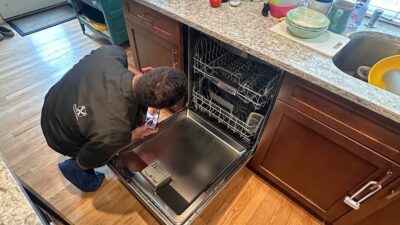
A Bosch dishwasher E22 error means one thing: the filter is blocked, and there is probably water sitting in the bottom of the tub…

A Frigidaire refrigerator not cooling is not always a broken refrigerator. The display on the door settles that question in about ten seconds…
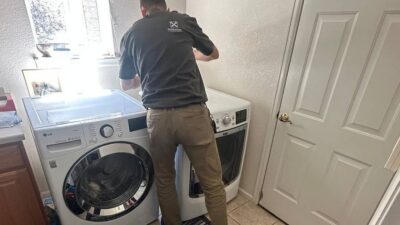
You walked into the laundry room and the display is flashing D80. The drum is still turning. You do not know whether to stop the cycle or let it finish. D80 is…

A GE refrigerator not cooling usually falls into one of two failure paths. The question is simple: is the freezer still cold? If yes, the sealed system is inta…
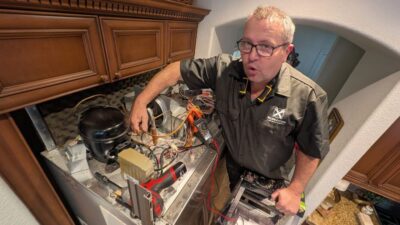
You pull open the freezer on a July evening and find an empty bin. A Frigidaire ice maker not working in peak summer is one of the most frequent calls our Denv…
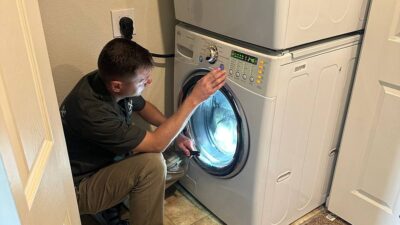
The LG washer UE code means the machine detected an unbalanced load during the spin cycle and stopped to protect the drum and bearings. UE is protection not br…
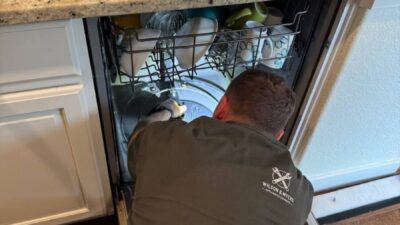
E24 on a Bosch dishwasher means the drain cycle did not complete. A clogged filter basket is the cause in most cases. If the filter is clear, the drain pump or…

When the LG washer LE code flashes mid-cycle, the drum stops, and your laundry sits locked inside. Most people's first thought is a broken motor. It usually is…
Wilson & Myers dispatches insured technicians to homes running KitchenAid appliances throughout the Denver Metro Area.
Undercounter machines and in-refrigerator units fail differently. Tell us which you have and what it is doing.

Wilson & Myers is a verified member of the Denver Metro Chamber of Commerce.