Your KitchenAid Ice Maker Stopped Making Ice. Start Here.
You opened the KitchenAid freezer this morning and the bin was empty. In my experience, the arm is the first thing worth checking: the fix costs nothing and ta…

Wilson & Myers repairs Henny Penny pressure fryers, rotisseries, and holding cabinets for restaurant kitchens across the Denver Metro Area. Our insured technicians handle ignition, heating, and control faults.

Henny Penny builds the broadest commercial cooking ecosystem in the fryer category. Categories include pressure fryers, open fryers, rotisserie ovens, heated holding cabinets, breading stations, and the Velocity oil-management platform. We service every active product family below.
The Henny Penny PFE-500 electric pressure fryer and PFG-600 gas pressure fryer are the flagship models in Denver QSR kitchens. The PFE-500, PFE-561, and PFE-590 cover the electric series. The PFG-600, PFG-690, and PFG-691 cover gas-series volume operations. The Velocity Evolution Elite and 8-head premium Velocity platform sit above the standard line. All PFE and PFG models run the Computron 8000 controller. The Henny Penny electric pressure fryer line is high-volume. The Henny Penny pressure fryer 500 and Henny Penny pressure fryer 600 variants drive most service calls we handle on this brand. For Henny Penny fryer repair across Denver Metro, book a repair online or call our commercial team.
The LVE-103 electric and LVG-103 gas open fryers cover standard volume. The Henny Penny OFG-322 is the most-searched open-fryer model. The Evolution Elite EEE-141 and EEE-154 use a reduced 30-lb oil capacity; the F5 (OFE-51X, 2023) adds a 3-minute filtration cycle. For dedicated open-fryer service depth, our Frymaster and Pitco pages cover those specialist lanes. Henny Penny LVE, LVG, and OFG calls route through our commercial fryer repair team.
The Henny Penny SCR-6 and Henny Penny SCR-8 commercial rotisserie ovens also serve as industrial rotisserie units. They offer 6-spit and 8-spit capacity for high-volume chicken programs. No other fryer-adjacent brand in the W&M commercial portfolio covers rotisserie. Motor failures on the spit drive, heating element burnout, glass door gasket wear, and control board faults are the primary SCR service events. Commercial rotisserie oven service routes through our commercial appliance services team.
The Henny Penny HC900, HSF-100, HMR, and HMC families hold finished product at safe temperature between the fryer and the service window. The Henny Penny holding cabinet, Henny Penny warmer, and insulated heated holding cabinet categories carry the highest CPC values in the Henny Penny dataset. Henny penny food warmer units are used across QSR programs where finished product must hold before service. HACCP compliance under Colorado 6 CCR 1010-2 requires hot-hold at or above 135 degrees Fahrenheit. Door gasket compression set, heater band failure, humidity-pan sensor issues, and controller drift are the standard service calls on HC900 and HSF units.
Henny Penny breading systems include dump stations, breading tables, and sifters for QSR breading lines. The Velocity Series (PXE, OXE, PXG, OXG) extends the Henny Penny velocity fryer platform with an 8-head oil-management system. The system uses 25% less oil than comparable models. Oil Guardian automatic top-off sensors are standard. Filter pan O-rings and filter valves are the primary Velocity wear items. The Henny Penny combi oven line adds steam-combination cooking to the ecosystem and shares Computron-family controller diagnostics.
Lid gasket failure is the most critical pressure-containment event on a Henny Penny pressure fryer. The reversible gasket (part PN 16120) can be flipped once before full replacement. A failed gasket prevents pressure from building, stopping the cook cycle entirely. Denver’s dry climate at roughly 30% average humidity accelerates rubber seal compression set faster than in humid coastal markets. Deadweight clogs are the second pressure-regulation call: cool the unit, remove and clean the deadweight, and clear the exhaust line. Lid spring fatigue from oil contamination is a third failure mode. Cracked lid liners let oil into the spring assembly and add mechanical load over time.
The Computron 8000 is Henny Penny’s proprietary controller across pressure fryers, open fryers, Evolution Elite units, and rotisserie ovens. When multiple errors are active, only the highest-priority code displays. Computron 1000 controllers appear on older units still in Denver Metro kitchens. Our Computron diagnostic competency adds a fourth controller platform to W&M’s commercial capability set. We service Computron alongside ArcticFox on Kolpak walk-ins, Master Controller on Master-Bilt units, and Dixell on Nor-Lake and Atosa equipment. See the error code table in the next section for E-4 through E-18-A specifics.
LVE and EEE-series electric open fryers fail primarily at the heating element; a continuity test identifies the problem on the first visit. LVG and OFG gas units see gas valve faults, thermopile degradation, and basket lift mechanism wear. Oil filtration system clogs are a safety-critical mode. Accumulated crumb in the fry vat creates oil spray-out risk when Express Filter or Daily Filter procedures are skipped. The Evolution Elite’s 30-lb oil capacity makes filtration discipline more consequential per cycle.
SCR-6 and SCR-8 spit-drive motor failure usually manifests as intermittent rotation before full stop. Top and bottom heating elements burn out independently. Glass door gaskets on display-cook rotisserie units wear from repeated thermal cycling and warrant semi-annual inspection. Controller faults on SCR units follow Computron-family error patterns. For holding cabinets, door gasket compression set and heater band failure are the two primary temperature-loss causes. Humidity-pan sensor faults affect models with moisture injection. Controller drift in a HACCP-critical holding function must be corrected and documented before the next health inspection.
Filter pan O-rings are the primary Velocity wear item. Worn O-rings create slow oil fills, bubbles in the pump line, and eventually no-fill events. Filter valve replacement is the secondary call. Oil Guardian automatic top-off sensor faults produce irregular oil levels; sensor replacement or recalibration restores normal operation. Return-line clogs from accumulated crumbs respond to standard cleaning procedures. Velocity system service protects the primary oil-cost advantage these units provide to high-volume QSR operations.
The Henny Penny computron 8000 is the proprietary controller platform across pressure fryers, open fryers, and Evolution Elite units. It also extends to the broader Henny Penny commercial cooking ecosystem. Verified error codes for E-4 through E-18-A are documented below. Legacy Computron 1000 controllers on older Henny Penny equipment display a parallel code set; our technicians carry references for both platforms.
E-4 — Control board overheating
Cause: Blocked side louvers or inadequate clearance.
First step: Verify fryer clearance; clear louver obstructions; inspect board ventilation.
E-5 — Oil overheating
Cause: Temperature probe drift or contactor/burner locked on.
First step: Verify temperature probe; check contactor and burner for lock-on condition.
E-6 — Temperature probe fault
Cause: Probe open or shorted; wiring break.
First step: Inspect probe wiring; replace probe if open or shorted circuit confirmed.
E-10 — High-limit thermostat trip
Cause: Oil too hot; contactor or burner locked on; dry-fire event.
First step: Cool unit to ambient; reset thermostat; diagnose contactor and oil level.
E-15 — Drain switch fault
Cause: Drain switch contact failure or wiring break.
First step: Inspect drain switch contacts and wiring; repair or replace switch assembly.
E-18-A — Left level sensor fault
Cause: Oil-level sensor open or wiring failure.
First step: Inspect sensor wiring; replace oil-level sensor if open circuit confirmed.
Henny Penny pressure fryers operate differently at Denver’s 5,280-foot altitude. Water boils at approximately 202 degrees Fahrenheit in Denver versus 212 degrees at sea level. Sea-level cycle-time settings will undercook product in a Denver Metro commercial kitchen because the pressure differential math changes at altitude. Our technicians adjust cook-cycle calibration for local altitude as part of standard Henny Penny pressure fryer service. No Denver-area competitor currently publishes altitude-specific pressure-fryer calibration guidance.
Gas-series PFG-600 and PFG-691 units require burner and gas valve calibration for Denver’s thinner air. Deadweight pressure settings on the PFG line warrant verification whenever a unit arrives from a lower-altitude location. Denver’s dry climate also accelerates lid gasket compression set on pressure fryers. The reversible gasket (PN 16120) and lid liner should be inspected more frequently in Denver than in coastal markets. A compromised gasket is a pressure-containment safety issue. HACCP compliance under Colorado 6 CCR 1010-2 applies to holding cabinet operations co-located with fryer programs; we document holding-cabinet temperature verification alongside fryer calls.
Chester Wagner patented the commercial pressure fryer in 1954 in Eaton, Ohio, and founded Henny Penny Corporation in 1957. Current CEO Kevin Buchler leads a company that became 100% employee-owned via ESOP on December 30, 2014. The Cobb family transferred ownership to the employee trust on that date. Henny Penny is independent of Middleby, Welbilt, and Ali Group. The company owns Wood Stone Corporation (stone-hearth oven specialist, Bellingham, Washington) as a subsidiary, acquired January 2014. QSR partnerships with KFC, Chick-fil-A, Wendy’s, and McDonald’s make Henny Penny the benchmark commercial pressure fryer manufacturer.
Wilson & Myers brings Computron 8000 and Computron 1000 diagnostics, altitude-aware pressure-fryer cycle calibration, and Velocity oil-management system expertise to Denver Metro. We source Henny Penny parts through national supplier networks and manufacturer contracts. The 7-year manufacturer vat warranty and 15-to-20-year real-world lifespan on well-maintained Henny Penny pressure fryers make qualified service the right commercial decision over early replacement. Our insured technicians service the full ecosystem: pressure fryers, open fryers, rotisserie ovens, heated holding cabinets, breading systems, and Velocity platform.
Henny Penny. Chester Wagner invented the commercial pressure fryer in 1954 and founded Henny Penny in 1957 to bring that technology to commercial kitchens. KFC has been a Henny Penny customer for approximately 40 years, receiving multiple Supplier of the Year awards including one in 2010. The PFE-590 electric pressure fryer is the KFC-spec unit in wide deployment. Henny Penny’s kfc pressure fryer relationship defines the category.
On pressure fryers, lid gasket failure (PN 16120) is the most critical call because a failed gasket prevents pressure from building. Deadweight clogs and pressure regulation drift follow. Computron 8000 error codes E-10 (high-limit trip) and E-6 (temperature probe fault) account for most controller service visits. On open fryers, heating element burnout (electric) and gas valve or thermopile failure (gas) are primary calls. Velocity units add filter pan O-ring wear and filter valve replacement to the service profile.
Henny Penny is 100% employee-owned through an Employee Stock Ownership Plan (ESOP). The Cobb family, which owned the company since 1975, sold all shares to the ESOP trust on December 30, 2014. Henny Penny is independent of Middleby, Welbilt, Ali Group, and private equity. Headquartered in Eaton, Ohio, the Henny Penny corporation owns one subsidiary: Wood Stone Corporation (stone-hearth oven specialist, Bellingham, Washington), acquired January 2014.
Water boils at approximately 202 degrees Fahrenheit at Denver’s 5,280-foot elevation versus 212 degrees at sea level. Pressure fryers compensate by sealing a pressurized cooking environment. Sea-level cycle-time settings will undercook product in a Denver kitchen. The pressure differential math changes at altitude. Gas valve calibration on PFG-series units and deadweight pressure settings also require altitude-specific setup. Wilson & Myers adjusts Henny Penny pressure fryer cycle calibration for Denver Metro conditions as part of standard service.
The Computron 8000 displays only the highest-priority fault when multiple errors are active. E-4 is control board overheating. E-5 is oil overheating from a faulty probe or locked-on contactor. E-6 is a temperature probe open or short requiring probe replacement. E-10 is a high-limit thermostat trip from oil overtemperature. E-15 is a drain switch fault. E-18-A is a left oil-level sensor open circuit. See the full table above for first-step service actions. The legacy Computron 1000 (Henny Penny computron 1000) on older units follows a parallel code structure.
A deep fryer submerges food in open hot oil at atmospheric pressure. A pressure fryer seals the chamber and builds internal pressure, elevating effective cooking temperature and retaining moisture inside the product. The result is crispier exterior texture with juicier interior in a shorter cycle. Henny Penny invented commercial pressure frying in 1954. Pressure fryers require more complex service than open fryers: lid gaskets, deadweight assemblies, and pressure relief components are safety-critical maintenance items that require trained technicians.
Henny Penny offers a 7-year manufacturer warranty on the stainless-steel fry vat, the longest vat warranty in the commercial fryer category. In Denver commercial kitchens with proper preventative maintenance, Henny Penny pressure fryers routinely reach 15 to 20 or more years of service. Lid gasket replacement, Velocity filter system service, and Computron controller maintenance are the recurring service items that protect that lifespan. For context, the value-tier CookRite ATFS line typically sees a 6-to-8-year lifespan under similar conditions.
Yes. Wilson & Myers services the full Henny Penny commercial cooking ecosystem. That includes SCR-6 and SCR-8 rotisserie ovens, plus HC900 and HSF and HMR and HMC heated holding cabinets. We also cover breading systems, Velocity oil-management units, pressure fryers, and open fryers. Operators running a combined Henny Penny Henny Penny equipment program benefit from one service provider covering all categories. Book a repair to schedule service on any Henny Penny line.
Related Commercial Brands We Service
Commercial fryer specialists: Frymaster · Pitco
Commercial cooking: Bakers Pride · Blodgett · Middleby Marshall
Multi-category commercial: Atosa
All commercial services: Commercial Appliance Services
Give us the unit model, the code on the controller, and whether the fryer holds temperature at all. We send an insured commercial cooking technician and order parts once the fault is confirmed.
Repair guides, maintenance tips and troubleshooting walkthroughs written by our insured technicians.
You opened the KitchenAid freezer this morning and the bin was empty. In my experience, the arm is the first thing worth checking: the fix costs nothing and ta…
A Frigidaire oven not heating can come down to a setting rather than a part. Before you book a repair, two checks cost nothing and take under a minute: the clo…
A Whirlpool dryer that tumbles but never heats traces to one of five faults, and three of them cost nothing to check. Here is the order to work through them, p…
F8 E4 means water reached the drip tray, not a fill fault. Here is the two-step reset and why it can fire on a brand-new install with a dry tray…
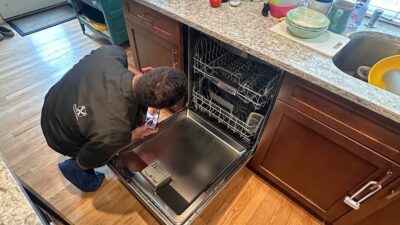
A Bosch dishwasher E22 error means one thing: the filter is blocked, and there is probably water sitting in the bottom of the tub…
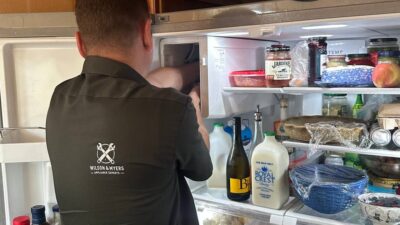
A Frigidaire refrigerator not cooling is not always a broken refrigerator. The display on the door settles that question in about ten seconds…
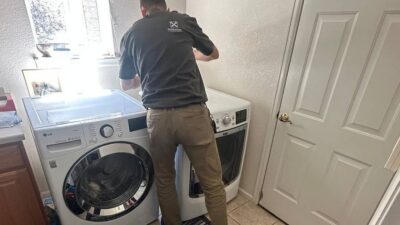
You walked into the laundry room and the display is flashing D80. The drum is still turning. You do not know whether to stop the cycle or let it finish. D80 is…
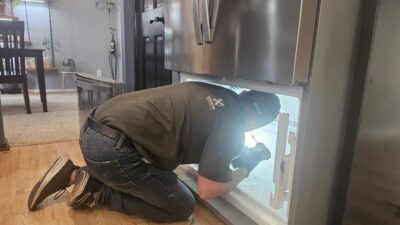
A GE refrigerator not cooling usually falls into one of two failure paths. The question is simple: is the freezer still cold? If yes, the sealed system is inta…
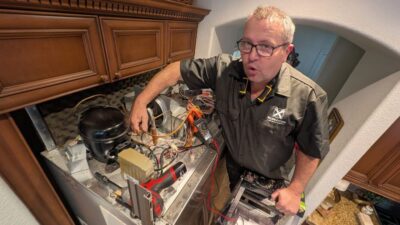
You pull open the freezer on a July evening and find an empty bin. A Frigidaire ice maker not working in peak summer is one of the most frequent calls our Denv…
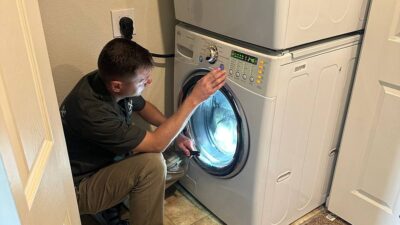
The LG washer UE code means the machine detected an unbalanced load during the spin cycle and stopped to protect the drum and bearings. UE is protection not br…
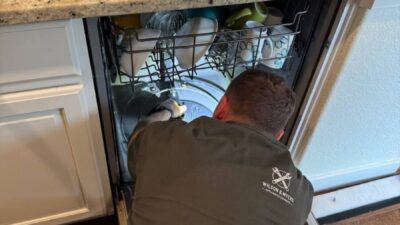
E24 on a Bosch dishwasher means the drain cycle did not complete. A clogged filter basket is the cause in most cases. If the filter is clear, the drain pump or…
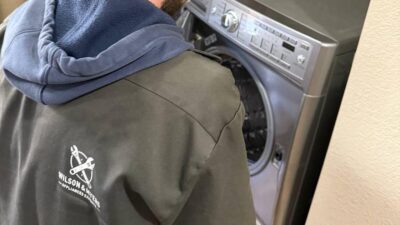
When the LG washer LE code flashes mid-cycle, the drum stops, and your laundry sits locked inside. Most people's first thought is a broken motor. It usually is…
Wilson & Myers dispatches insured technicians to restaurants and kitchens running Henny Penny equipment throughout the Denver Metro Area.
From pressure-fryer and rotisserie faults to holding-cabinet and control repair, Wilson & Myers services the full Henny Penny line across the Denver Metro Area.

Downtime in business? Get fast commercial appliance repair with authentic parts & advanced methods. Perfect for restaurants & offices!

Professional appliance installation by insured technicians following industry standards. Safe setup for ovens, dishwashers and more, so you avoid DIY errors!

Wilson & Myers is a verified member of the Denver Metro Chamber of Commerce.


