
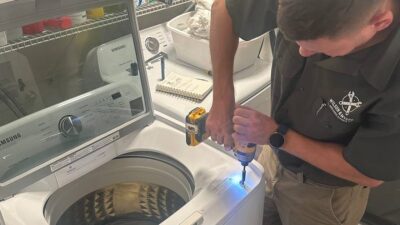
Samsung Washer Won’t Spin: Front-Load and Top-Load Fixes
A Samsung washer not spinning leaves clothes wet in the drum and the dryer waiting. Samsung's four platforms handle this differently: WF front-load, WA top-loa…

A Samsung wall oven that will not heat, locks its own door, or prints a C code is a hire decision. We diagnose first and quote second, and you decide before any part is ordered. This page covers the built-in oven only, in single, double and combination form.
Samsung’s current US wall oven line runs to at least nine model families and 21 SKUs. Every one of them is electric and 30 inches wide. What separates them is the cavity count, and that decides the visit.
An NV51 model number is oven only. An NQ70 is the combination unit, with a microwave cavity above a conventional oven below. It is the one built-in microwave Samsung sells in this country, and it reaches us as a wall oven job.
Samsung also splits the line into a 6 Series and a 7 Series in its own product titles. The 7 Series adds an in-cavity camera, the Flex Duo divider and Steam Cook. Those three additions carry most of what changes on a service call.
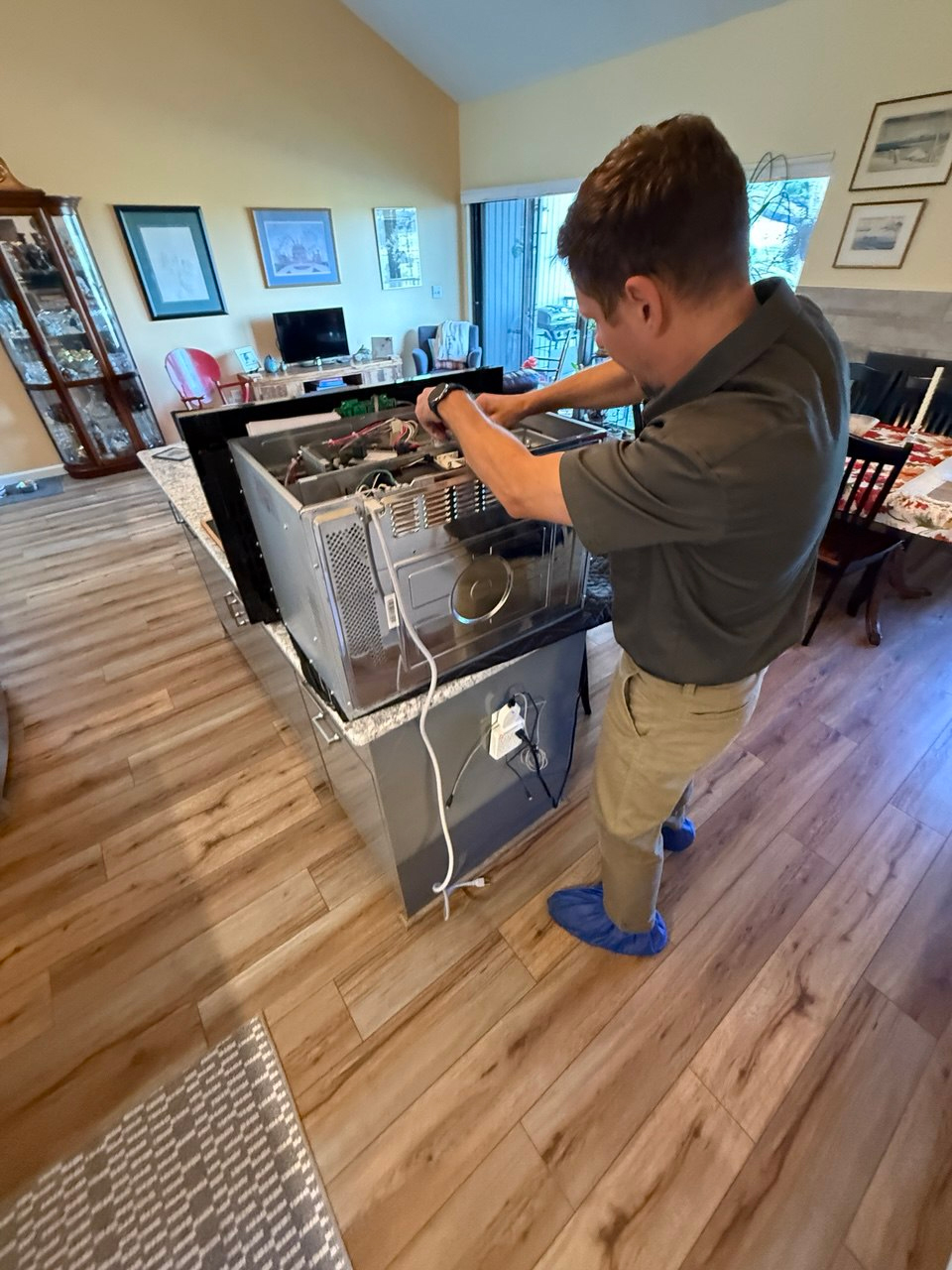
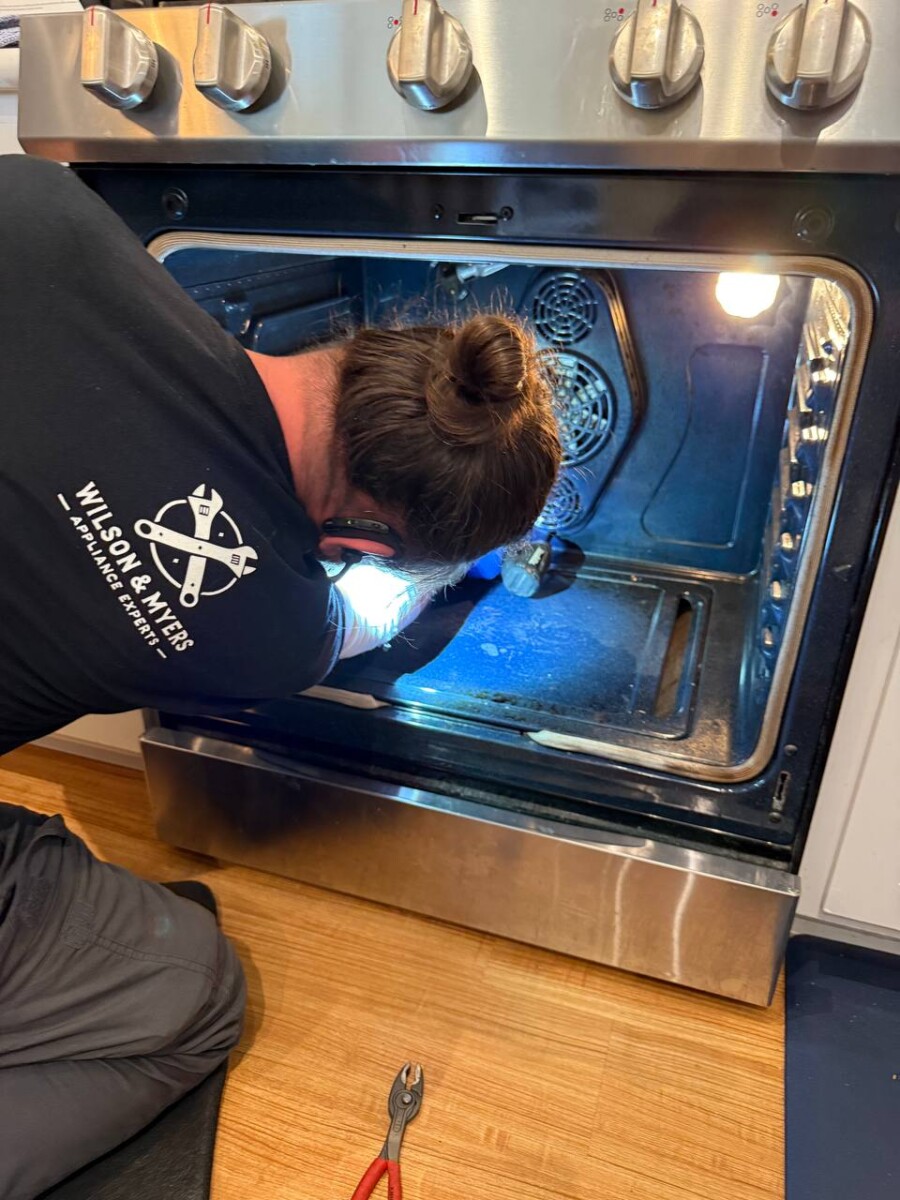
Samsung prints a door lock fault as C-d1 on every 6 Series machine and as C-d5 on every 7 Series machine. The cause text under both is word for word identical. Almost everything written online names only the first one.
We measured that split across nine Samsung documents, and it holds on the combination ovens too. It is the reason we ask for the model number before quoting a door lock. Neither the part nor the access route is the same on both bodies.
| Code | Samsung's own cause text | What it points at |
|---|---|---|
| C-d1 or C-d5 | The door lock is mispositioned | Lock motor, door switch, or the harness between them |
| C-20 | The oven sensor is open or short | Cavity temperature sensor, then the main board |
| C-21 | The internal temperature rises abnormally high | Sensor first, then the bake, broil and convection heaters |
| C-23 | The temp probe sensor is short | The meat probe circuit at the main board |
| C-30 or C-31 | The PCB sensor is open, short, or overheating | The main board, with no intermediate test published |
| C-70 | The steam sensor is open or short | The steam generator sensor circuit |
| C-72 | There are drain system-related problems | Water left in the steam system after the drain time |
| C-A2 | The cooling motor is operating abnormally | The cooling fan motor or its connector |
| C-F0 or C-F2 | Communication between boards is interrupted | Main board, sub board, or the touch film |
| C-10 | The cooking sensor is open or short | Combination ovens only, on the microwave side |
| -dC- | The divider moved while the oven was operating | The Flex Duo divider position switch |
Not every fault on this platform speaks in code. A display reading Wire Installation Fail means the power connection went in improperly, and Samsung’s support site calls the same fault bAd LinE. An oven showing Hot or door has refused a self test because the cavity is hot or the door is open.
Samsung’s service manuals document a stored fault history that no owner-facing page mentions. A hidden key combination opens a service screen, and one key on it returns the last five check codes. The combination differs by family, which is another reason the model number comes first.
That single feature changes how we work an intermittent oven. A fault that cleared itself overnight is still on the display. A first visit on this brand starts at the panel, not the back panel. The same screen reports live cavity temperature, fan speed and preheat state.
Demo mode is the cheapest no-fault call on this appliance. An oven that lights, beeps and counts down without ever getting warm is often a floor model nobody took out of display mode. Samsung publishes two of these modes, one for retail display and one for inspection, and the 7 Series carries both.
A built-in self test that ends in PASS found nothing wrong. On a double oven the same test can return Upper Bake Fail or Lower Broil Fail, which names the failed element before anything is opened.
Three designed behaviors account for a real share of the Samsung oven calls we take. We have seen all three of them reported to us as breakdowns. Each one is worth two minutes before it is worth a booking.
The descale lockout is the one that looks most like a failure. The water reservoir behind it is real hardware. A 22-ounce tank sits on the right side above the oven opening and is ejected by its own motor. It feeds a pump, a steam generator and a heater, each with its own failure mode.
The locked door has a published order of operations as well. Let the oven cool, power it back on, clear the control lockout, then cut the breaker for a full minute. Forcing the door while the motorised lock is engaged damages the locking system, which is a larger repair than the one you started with.
On this appliance the access route decides the length of the visit more than the part does. Counting the disassembly sections in Samsung’s own service manual, 7 of the 12 non-door repairs begin by pulling the unit out of the cabinet. That is a bare majority, and Samsung’s own warning calls it a two-person move.
One installation detail decides whether any of that runs smoothly. Samsung ships a long conduit and prints a plain instruction: do not cut it, because the length provided is there for serviceability. An installer who trimmed it has turned every rear-access repair into an electrical disconnect as well.
Doors on the 7 Series carry an LED harness under a rubber cap at the bottom right. It has to be unplugged before the door comes off. On a double oven the lower door must be open to reach the upper door’s connector, and pulling that door blind tears the wiring.
Samsung’s parts catalog shapes the quote as well. For the current generation it publishes assemblies rather than components: control box, control panel, door module, door sub, handle, latch sub and rear bracket. No discrete bake element, broil element or lock motor is published against a current model, though the service manual removes each one.
Four checks cost you nothing but a few minutes, and each one clears a fault we are regularly booked for.
Past that point the line is clean. Four situations belong to us rather than to you.
The symptom itself is worth reading first. Our guides on an oven not heating up and an oven that will not turn on cover the owner-side checks in full. When those run out, you can book a Samsung wall oven visit with the model number and the code beside you.
We ask for the full model number before we quote. The same fault carries a different code, a different part and a different access route across the two tiers. On an intermittent complaint we read the stored codes off the panel before anything is dismantled.
We read the display, confirm which body and tier you own, then quote the repair.
Nothing is ordered until you have the quote and say yes to it.
Every visit is made by an insured Wilson and Myers technician.
The repair is covered for 100 days after we leave.
Denver Metro adds one wrinkle worth naming. Samsung rates these ovens on two supply voltages, and a large share of local multifamily wiring runs at 208 volts rather than 240. The same machine sits one breaker band lower on that supply. A breaker sized off the wrong column reads as a fault the oven does not have.
If your fault belongs to a different machine, we cover those too. Our wall oven repair service and the wider oven repair service run across every brand. Samsung range and stove work sits on its own page.
We work the same way on the brands Denver homeowners cross-shop with Samsung, including LG and the step up to Bosch. The Samsung cooking appliance pages route the rest of the range, and the Samsung brand hub lists every appliance we take on.
Technicians reach Denver, Aurora, Lakewood and Centennial, along with the rest of Denver Metro.
It is Samsung’s door lock code, and it says the lock is mispositioned. On a 7 Series machine the identical fault prints as C-d5 instead. The check runs from the lock motor to the door switch and the harness between them, so the model number decides the part.
Not always. Check for demo mode first, because a display unit nobody reset behaves in exactly that way. If demo mode is not the answer, a bake element, a sensor or the main board is next, and that is our visit.
After 12 hours of steam cooking Samsung disables them until a descaling cycle has run. The oven flags it two hours before the lockout takes effect. If a full descale does not bring them back, the steam sensor or the drain path is the likely fault.
Yes. The NQ70 is the one built-in microwave Samsung sells here, and it lives in a wall oven cabinet. That cavity carries a magnetron and high voltage components, so it is not owner-serviceable in any form.
Samsung publishes assemblies for these machines rather than single components, and its catalog does not surface them by category. We order the correct assembly once the fault is confirmed, and timing depends on whether the supplier has it.
Every repair carries a 100-day labor warranty, and we source Samsung parts through national supplier networks and manufacturer contracts.
Read us the full model number and whatever the display is showing, C-d1, C-d5, C-21 or a plain English string. We diagnose first and quote second, and nothing is ordered until you say yes.
Repair guides, maintenance tips and troubleshooting walkthroughs written by our insured technicians.
A Samsung washer not spinning leaves clothes wet in the drum and the dryer waiting. Samsung's four platforms handle this differently: WF front-load, WA top-loa…
You opened the KitchenAid freezer this morning and the bin was empty. In my experience, the arm is the first thing worth checking: the fix costs nothing and ta…
A Frigidaire oven not heating can come down to a setting rather than a part. Before you book a repair, two checks cost nothing and take under a minute: the clo…
A Whirlpool dryer that tumbles but never heats traces to one of five faults, and three of them cost nothing to check. Here is the order to work through them, p…
F8 E4 means water reached the drip tray, not a fill fault. Here is the two-step reset and why it can fire on a brand-new install with a dry tray…
A Bosch dishwasher E22 error means one thing: the filter is blocked, and there is probably water sitting in the bottom of the tub…

A Frigidaire refrigerator not cooling is not always a broken refrigerator. The display on the door settles that question in about ten seconds…
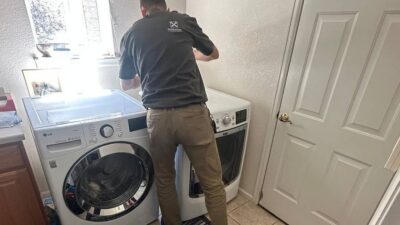
You walked into the laundry room and the display is flashing D80. The drum is still turning. You do not know whether to stop the cycle or let it finish. D80 is…
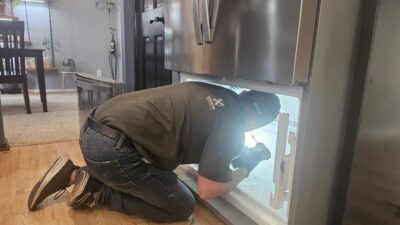
A GE refrigerator not cooling usually falls into one of two failure paths. The question is simple: is the freezer still cold? If yes, the sealed system is inta…
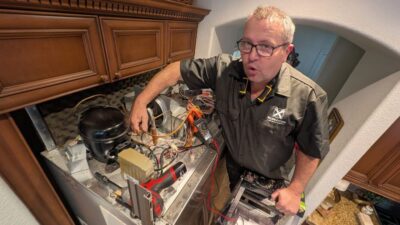
You pull open the freezer on a July evening and find an empty bin. A Frigidaire ice maker not working in peak summer is one of the most frequent calls our Denv…
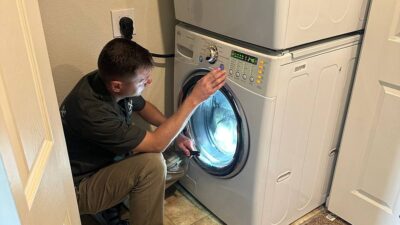
The LG washer UE code means the machine detected an unbalanced load during the spin cycle and stopped to protect the drum and bearings. UE is protection not br…
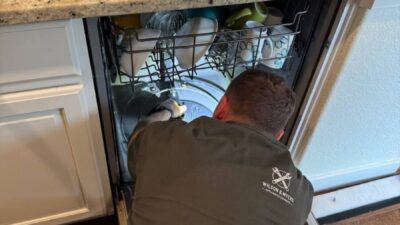
E24 on a Bosch dishwasher means the drain cycle did not complete. A clogged filter basket is the cause in most cases. If the filter is clear, the drain pump or…
Wilson & Myers dispatches insured technicians to homes running Samsung appliances throughout the Denver Metro Area.

Wilson & Myers is a verified member of the Denver Metro Chamber of Commerce.


